By Staff Reporter
ISLAMABAD: With barely a week to go before legislative elections in Gilgit-Baltistan, Pakistan’s mountainous northern territory is rapidly becoming the focus of a deepening political crisis — one involving airport blockades, expelled lawmakers, disputed detentions, and now a formal appeal to the judiciary.
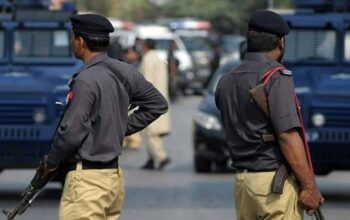
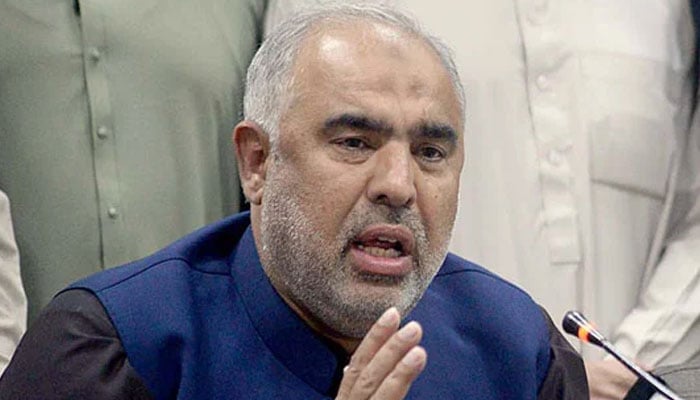
The sequence of events on Saturday unfolded with striking speed. Asad Qaiser, one of Pakistan Tehreek-e-Insaf’s most senior figures and a former speaker of the National Assembly, claimed he was physically prevented from entering Islamabad’s international airport by Punjab police officers, causing him to miss his flight to Skardu where he had been due to conduct campaign activity ahead of the June 7 polls. Videos shared by Qaiser on X showed long convoys of vehicles backed up at the airport’s entrance gates, and separate footage in which he appeared to be pleading with olive-uniformed officers to at least allow ordinary passengers to pass through.
“Punjab police did not allow entry into Islamabad airport, blocked the airport’s access routes, and we, along with the general public, had to face severe difficulties,” Qaiser wrote. “The Punjab police kept me under detention until the flight departed.” He framed the episode not as an isolated inconvenience but as evidence of a systematic effort to suppress PTI’s participation in the Gilgit-Baltistan campaign. “The GB election is being manipulated at all costs,” he said, “and the people are being deprived of their right to vote.”
Islamabad police, however, were swift to distance themselves. An official, speaking anonymously, told reporters the airport fell outside their jurisdiction and that the force had no involvement in whatever transpired.
The incident arrived barely twenty-four hours after PTI lawmaker Junaid Akbar and a group of colleagues — including several members of the national and provincial assemblies — were removed from Ghizer district by GB authorities while in the midst of canvassing. PTI described their treatment as an arrest and expulsion. The GB government offered a more circumscribed account, insisting no one was formally detained and that the group had been asked to leave solely on the grounds of violating the election code of conduct. Whether detention or ejection, the effect was the same: PTI campaigners were removed from a constituency they had travelled to contest.
Adding a further layer of complication, Khyber Pakhtunkhwa Chief Minister Mohammad Sohail Afridi — whose province borders GB — wrote on Saturday to the Chief Justice of the Supreme Appellate Court of Gilgit-Baltistan, Justice Sardar Muhammad Shamim Khan, calling for immediate judicial intervention. A copy of the letter was simultaneously forwarded to Chief Justice of Pakistan Yahya Afridi. The language Afridi employed was pointed. Reports from the region, he said, were “extremely alarming”, describing a situation in which one political party was encountering “unnecessary obstacles” at every turn: in its ability to hold public gatherings, move its leadership around the territory, and conduct ordinary campaign activity. “There are reports of political workers being harassed, unlawfully arrested and prevented from carrying out political activities,” he wrote, warning that if the judiciary did not act, the credibility of the entire electoral exercise would be “seriously undermined”. He urged the court to compel relevant institutions to guarantee a level playing field, and to halt what he characterised as the unlawful targeting of opposition workers.
Afridi had earlier sought to raise the matter directly with GB’s caretaker chief minister, Yar Muhammad. His office suggested Muhammad had been unresponsive to his calls. The GB government offered a rather more prosaic explanation: the caretaker CM had been at a medical appointment, had subsequently returned the call, and found that it was Afridi who was, by that point, unavailable.
The political reaction from the opposition was uniformly fierce. Senate Opposition Leader Allama Raja Nasir Abbas called Qaiser’s treatment “a blatant violation of democratic values and political freedoms”, noting the conspicuous asymmetry between the latitude afforded to ruling coalition figures — including sitting federal ministers actively campaigning in GB — and the restrictions being placed on PTI and its allied grouping, the Tehreek-i-Tahafuz-i-Ayin-i-Pakistan. “If leaders of a specific party are deprived of their fundamental democratic right to run election campaigns,” Abbas wrote, “then claims of transparent elections and political equality lose their credibility.” Such actions, he added, did not resolve political differences but deepened social division.
PTI’s information secretary, Sheikh Waqas Akram, sharpened the party’s central grievance: that the Election Commission of Pakistan, the body tasked with ensuring electoral fairness, had maintained conspicuous silence while federal ministers freely stumped across GB on behalf of the government. “Running an election campaign by sitting ministers is a clear violation of the ECP’s code of conduct,” he said.
That the crisis is not, strictly speaking, confined to PTI’s camp was underscored by a separate complaint from Khawaja Saad Rafique, a senior figure in the ruling Pakistan Muslim League-Nawaz. In a Facebook post, the former federal minister said he too had missed his Skardu flight on Saturday — a consequence, he alleged, of Rawalpindi police having blocked all traffic routes leading to the airport. Twelve other travellers had been caught in the same blockage, he said. No explanation had been offered for the disruption, and AirBlue, he claimed, had closed its boarding gates before the scheduled departure time even as the police-enforced gridlock kept passengers stranded in the heat. “Numerous women, children and elderly passengers around us were languishing in the hot weather,” Rafique wrote, attributing the chaos to “indifference and incompetence”.
The June 7 elections for the Gilgit-Baltistan Assembly are being held after a four-month delay — the original election programme, issued in connection with general assembly elections, was formally withdrawn in December. Local government elections in the territory are scheduled to follow on 14 June.
Copyright © 2021 Independent Pakistan | All rights reserved