By Staff Reporter
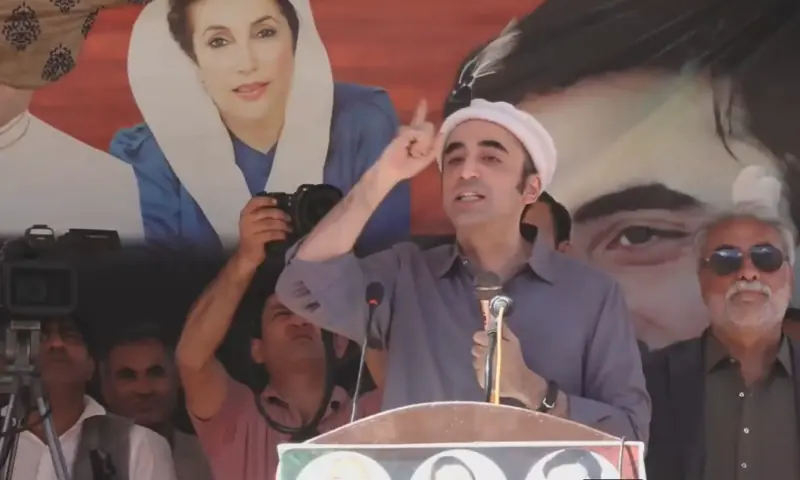
SHIGAR: In a pointed pre-election address that blended constitutional grievance with campaign theater, Pakistan Peoples Party chairman Bilawal Bhutto-Zardari called on Monday for Gilgit-Baltistan to be granted enforceable rights under any future constitutional amendment, and demanded the abolition of the federal ministry that oversees the territory.
Speaking at a rally in Shigar, a mountainous constituency in the run-up to the region’s June 7 elections, Bhutto-Zardari sketched a vision of GB freed from the long arm of Islamabad — its resources under local stewardship, its elections aligned with the national calendar, its people no longer spectators to decisions made far from their valleys.
“You have been facing it,” he told the crowd. “You have faced the consequences of your fate being decided in Islamabad.”
The remarks amounted to one of the more direct challenges to the status quo that the PPP leader has issued on the eve of a GB vote. While the region occupies a strategically vital position — bordering China, Afghanistan, and the contested territory of Kashmir — it remains constitutionally ambiguous, neither a full province nor a fully enfranchised entity, its residents denied representation in Pakistan’s parliament.
Bhutto-Zardari framed what he called the ‘haq-i-hakimiyat’ — the right of self-rule — as the animating cause of his party’s campaign. The first practical step, he argued, would be to synchronise GB elections with Pakistan’s general elections, a reform he said would lend the region’s political aspirations genuine institutional weight.
“When elections are held in Gilgit-Baltistan and the rest of Pakistan at the same time, progress in GB’s struggle for the right of rule will be made in the true sense,” he said.
On the question of resources — a perennial flash point in GB politics — Bhutto-Zardari drew a sharp contrast between the PPP and its rivals, whom he accused of treating the region’s mineral wealth, marble quarries, and mountain terrain as assets to be exploited from the capital.
“They want to run everything from Islamabad,” he said. “They want to run Gwadar from Islamabad, they want to run Karachi from Islamabad.” GB’s mountains and subsurface resources, he insisted, belong to GB’s people, not to federal ministries.
His sharpest institutional target was the Ministry of Kashmir Affairs and Gilgit-Baltistan, which he called an expendable relic. “What is the benefit of having a minister for Kashmir affairs and Gilgit-Baltistan?” he asked. “End this ministry.” If the federal government genuinely lacked resources, he argued, disbanding the ministry should be the first order of business — followed by transferring all political, financial, and administrative authority to the elected assemblies in Gilgit and Muzaffarabad.
The PPP, he added, would push to extend the protections of the 18th Amendment — Pakistan’s landmark 2010 devolution legislation — to GB, securing for the region the same rights and revenue-sharing arrangements that Pakistan’s four provinces enjoy.
The rally also served as a vehicle for Bhutto-Zardari to address economic anxieties rippling through GB and Pakistan more broadly. He cited the ongoing US-Israeli military campaign against Iran as a source of financial disruption, and urged voters to elect representatives oriented toward ordinary citizens rather than elites. He invoked the Benazir Income Support Programme — the cash-transfer scheme named for his mother, former Prime Minister Benazir Bhutto — as a pillar of PPP governance that rival parties were scheming to dismantle through provincial devolution.
“If it is devolved to provinces, what will Gilgit-Baltistan do?” he said. “Does GB have the budget to run this programme? Devolving it to provinces means ending this programme.”
Near the close of his remarks, Bhutto-Zardari deployed a line that drew an appreciative response from the crowd and doubled as a not-so-subtle commentary on Pakistan’s troubled electoral history. He asked supporters to secure Form-45 — the polling-station-level result sheet signed by the presiding officer — and promised to take care of Form-47, the constituency-level consolidated tally issued by the returning officer.
“You make arrangements for Form-45,” he said. “I will make arrangements for Form-47.”
He then appeared to walk the applause line back toward a more straightforward message. “We are confident that the PPP would not face any injustice in these elections and none of our seats will be stolen,” he said. “Your only responsibility is to come out on election day, cast votes at the polling stations, and return after taking Form-45.”
The allusion to election manipulation — however lightly coded — carried weight in a country where allegations of result-tampering and behind-the-scenes interference have shadowed nearly every recent election cycle. Bhutto-Zardari was careful to couch the PPP’s position in the language of procedural rectitude. “We never requested anyone to select us,” he said. “Our only demand is for free and fair elections and neutrality.”
The June 7 vote will determine the composition of the Gilgit-Baltistan Assembly, with the PPP, the Pakistan Muslim League-Nawaz, and Pakistan Tehreek-e-Insaf among the parties competing for seats.
Copyright © 2021 Independent Pakistan | All rights reserved