By Staff Reporter
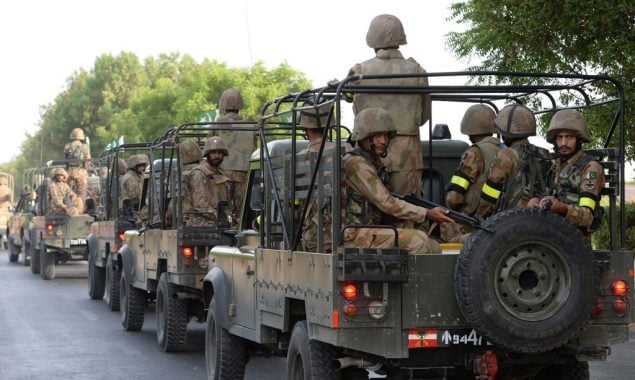
ISLAMABAD: The military said on Tuesday it has killed 17 militants in a series of intelligence-based operations sweeping across Balochistan, the country’s restive southwestern province, in retaliation for a suicide bombing last month that struck a passenger train near Quetta and left at least 14 people dead.
The Inter-Services Public Relations, the military’s media wing, said troops conducted raids across five districts — Mastung, Nushki, Zehri, Khuzdar and Kech — targeting networks linked to the Baloch Liberation Army, the separatist group that claimed responsibility for the May 24 attack.
The military said the militants were operatives of “Fitna-al-Hindustan” — a designation adopted by the state to cast the insurgency as a proxy enterprise backed by India.
“Following intense and fierce exchanges of fire, seventeen terrorists belonging to Indian-sponsored Fitna-al-Hindustan have been sent to hell, giving a significant blow to the terrorist networks operating in these areas,” the ISPR statement read.
Security forces also recovered weapons, ammunition, a large cache of explosives and prepared improvised explosive devices from the slain militants, according to the military, which said the men had been actively involved in attacks throughout the region.
The May 24 bombing struck near a railway crossing known as Chaman Phatak on the outskirts of Quetta, killing at least 14 people — among them three Frontier Corps personnel — and wounding 20 others, including women and children, according to the Balochistan provincial government. The BLA said the attack was carried out by a suicide bomber who drove an explosive-laden vehicle into the train, which was carrying security personnel and their families.
Balochistan, which borders both Iran and Afghanistan and holds some of Pakistan’s most significant mineral deposits, has endured a grinding low-level insurgency for decades. In recent years, the violence has grown more brazen, with attacks targeting not only security forces but also civilians and Chinese engineers working on projects tied to the multibillion-dollar China-Pakistan Economic Corridor — an infrastructure and investment initiative that runs through the heart of the province.
The ISPR said the operations were being carried out under the banner of “Azm-e-Istehkam,” or “Resolve for Stability,” a nationwide counter-terrorism campaign formally approved by Pakistan’s Federal Apex Committee on the National Action Plan. The military pledged that operations would “continue at full pace to wipe out the menace of foreign-sponsored and supported terrorism from the country.”
The latest sweep comes amid a broader and deepening security crisis that officials trace to August 2021, when the Afghan Taliban returned to power in Kabul. Since then, militant violence has surged across both Balochistan and the neighboring Khyber Pakhtunkhwa province, where the Pakistani Taliban — known as the TTP — has intensified attacks on security forces and civilians alike. Islamabad has repeatedly pressed the Taliban government to dismantle militant sanctuaries on Afghan soil; those appeals, Pakistani officials say, have gone largely unheeded.
The strains along the Afghan border came to a head last October, when armed clashes erupted after Taliban-affiliated militants launched a series of attacks on Pakistani border posts. Pakistani officials said more than 200 Taliban fighters and allied militants were killed in the fighting, while 23 Pakistani soldiers died defending those positions.
In the months that followed, Pakistan launched “Operation Ghazab lil-Haq” — a major military offensive in which Pakistani forces killed roughly 684 Afghan Taliban operatives and allied militants, wounded more than 900 others and destroyed 252 militant checkpoints, according to Information Minister Attaullah Tarar. Despite several rounds of talks, the two governments have failed to reach any lasting accommodation.
Earlier this year, five Pakistani soldiers, including a major, were killed during a separate sanitisation operation in Barkhan district in Balochistan; the military said seven militants also died in that engagement.
The drumbeat of operations reflects the Pakistani military’s stated determination to hold ground against a coordinated, foreign-backed effort to destabilize the state.
Copyright © 2021 Independent Pakistan | All rights reserved