By Staff Reporter
ISLAMABAD: Pakistan’s national anti-corruption agency has returned more than six billion rupees — roughly $21.5 million — to the government of Khyber Pakhtunkhwa province, authorities said on Tuesday, marking the first concrete recovery in a fraud case that investigators say drained more than 37 billion rupees, or approximately $133 million, from public coffers over nearly a decade.
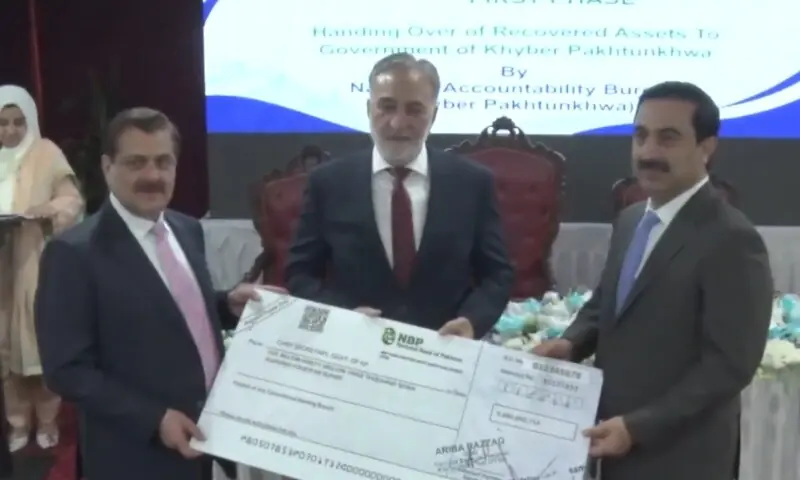
The transfer, formalized at a ceremony in Peshawar, where National Accountability Bureau chairman Lt. Gen. (retired) Nazir Ahmad handed the recovered assets to the province’s chief secretary, represents only a fraction of what investigators believe was stolen. Billions more in frozen assets remain entangled in legal proceedings, and the bureau says additional recoveries are expected as those cases move through the courts.
The investigation centers on Upper Kohistan, a remote and rugged district in the country’s northwest, where authorities allege that funds designated for public development projects were systematically diverted through a labyrinthine web of bank accounts, manipulated treasury instruments and the abuse of official financial procedures. NAB’s inquiry, authorized in April 2024, ultimately led investigators to scrutinize more than 1,500 bank accounts, deploy forensic financial analysis and trace money trails that, by the bureau’s accounting, exceeded 37 billion rupees in suspicious transactions.
A critical break in the case came when investigators identified an account held by a government contractor named Mumtaz Khan, which they allege served as a primary conduit for illicit funds. Financial records examined during the probe showed transactions of approximately 17 billion rupees moving through the district accounts office within a matter of months — a volume that investigators said bore no credible relationship to legitimate government business in the area. NAB’s Khyber Pakhtunkhwa directorate moved to freeze those funds, a step officials say prevented the further dissipation of public assets.
By the bureau’s own accounting, investigators ultimately froze assets valued at more than 27 billion rupees and recovered assets worth more than 10 billion rupees through plea bargain agreements with accused individuals. In March, an accountability court in Khyber Pakhtunkhwa approved a plea bargain of 49.125 million rupees in the case, ordering the release of Jibran Malik, the owner of a construction firm, contingent on his not being required in any other legal proceeding.
The assets formally transferred to the provincial government on Tuesday included cash, precious metals, high-value commercial and residential properties and luxury vehicles — a catalog that officials said illustrated the scale and audacity of the alleged scheme.
At the handover ceremony, Ahmad praised the investigators who worked on the case, describing it as evidence of the institution’s capacity to unravel sophisticated financial crimes. “This investigation demonstrates that complex financial crimes can be effectively detected, investigated, and prosecuted through professional, evidence-based accountability mechanisms,” he said. “The recovery of these assets reflects our commitment to ensuring that public resources are protected and restored for the benefit of citizens.”
The case has drawn particular attention in a country where corruption and weak institutional governance have long been cited by foreign investors, international lenders and domestic critics as foundational obstacles to economic development. Pakistan has launched successive anti-corruption campaigns over the past two decades, though those efforts have repeatedly attracted accusations of political selectivity — charges that accountability authorities have consistently denied.
The Kohistan recoveries come at a moment of acute financial pressure for the Pakistani state. The government is operating under an extended program with the International Monetary Fund and has committed to a series of governance and fiscal reforms as conditions of continued international support. Anti-graft efforts, at least in their public presentation, have become an increasingly prominent element of that broader reform narrative.
“Public resources are a trust,” Ahmad said Tuesday, “and betrayal of that trust will not be tolerated. Even complex financial crimes cannot escape the reach of the law.”
The bureau said it expects further recoveries as remaining assets work through the legal process, though it offered no specific timeline for when those proceedings might conclude.
Copyright © 2021 Independent Pakistan | All rights reserved