By Staff Reporter
ISLAMABAD: The election commission governing Azad Jammu and Kashmir announced on Friday that voters in the Pakistan-administered territory would go to the polls on July 27, formally launching the region’s first general elections in four years and setting off a compressed, seven-week campaign cycle in one of South Asia’s most politically contested pieces of land.
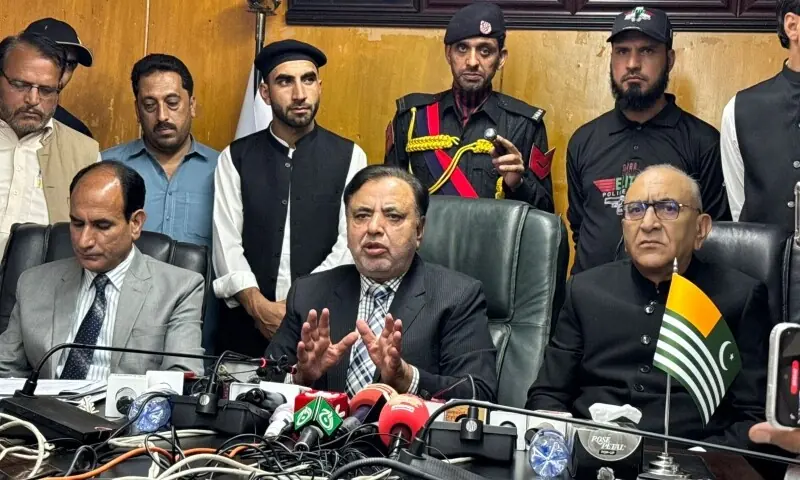
The announcement, delivered at a press conference by Chief Election Commissioner retired Justice Ghulam Mustafa Mughal, laid out a brisk schedule: candidates may file nomination papers beginning June 9, with the deadline set for 4 p.m. on June 19. Scrutiny of those nominations begins June 20, and candidates whose papers are rejected or accepted against their wishes may file appeals through June 24, with hearings scheduled for June 26 and 27. Final decisions on appeals must come by June 29, and candidates wishing to withdraw have until 2 p.m. on June 30.
The full list of contesting candidates will be published July 1, with ballot symbols allocated the following day. Voting on July 27 will run from 8 a.m. to 5 p.m.
But even as the commission moved to project confidence and order, Justice Mughal found himself fielding questions about something harder to schedule away: a sustained protest movement by the Jammu Kashmir Joint Awami Action Committee, a civil society coalition that has staged demonstrations and sit-ins throughout the region in recent months, raising demands over economic rights and governance.
The commissioner did not dismiss the concern. If the protests continued at their current scale and duration, he said, they could interfere with campaign logistics and force revisions to the timetable.
“If the protests or sit-ins continue for a longer period, they may have an impact on election-related activities,” he said. “In such a situation, the Election Commission has the authority to make necessary adjustments to the election schedule.”
He paused, then added: “Elections will be held when the situation is conducive.”
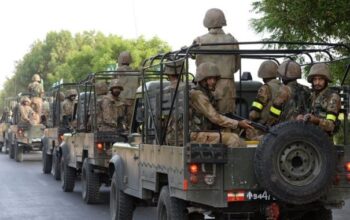
The elections will be conducted under the supervision of the Pakistani army, paramilitary forces, and civil armed forces — an arrangement that reflects both the security realities and the political sensitivities of the region, which lies at the heart of a decades-old territorial dispute between Pakistan and India, each of which administers a portion of the former princely state of Jammu and Kashmir.
Justice Mughal, who was flanked at Friday’s press conference by constitutional member Syed Nazeerul Hassan Gillani, secretary Raja Shakeel Khan, and other commission officials, returned repeatedly to the theme of credibility. He said the commission had been ready from the beginning to conduct the elections and pushed back against suggestions that it had been slow or uncertain.
“Holding elections is our constitutional obligation,” he said, “and we have been fully prepared to discharge that responsibility in letter and spirit.”
On the reliability of the voter rolls — a perennial source of contention in AJK elections — he acknowledged that the shift to a computerized electoral system had not been seamless. Errors crept into the preliminary rolls, including votes that had been inadvertently transferred between constituencies, generating public complaints and political mistrust.
The commission, working alongside the National Database and Registration Authority, spent months reviewing and correcting those rolls. The results of that effort, Justice Mughal said, were now reflected in fresh electoral lists released Thursday.
“I can now say that 99 percent of the electoral rolls are transparent and free from errors,” he said, “providing a sound basis for credible elections.”
The numbers in those rolls tell a story of a territory in demographic flux. The total registered electorate across AJK’s 45 constituencies now stands at 3,804,385 — an increase of roughly 584,000 voters since the 2021 elections, when 3,220,546 were on the rolls. Of those registered, 2,001,730 are male and 1,802,655 are female.
The vast majority of voters — 3,365,839 — are registered in the 33 constituencies that lie within AJK’s territorial boundaries. An additional 438,546 voters are registered in 12 special constituencies set aside for Kashmiri refugees settled elsewhere in Pakistan, a vestige of the region’s unresolved displacement history. Justice Mughal noted that those refugee-seat elections, previously conducted under judicial oversight, would this time be administered by officials of the Election Commission of Pakistan after the judiciary withdrew from the arrangement.
The geographically largest and smallest electorates reflect the territory’s uneven population distribution. LA-7 Bhimber-III, in the southern district of Bhimber, holds the most voters at nearly 130,000. Muzaffarabad-IV, in the regional capital, is the most compact constituency, with just over 68,000 registered voters.
Justice Mughal also announced a series of pre-election restrictions designed to limit the use of government resources for political advantage — a concern that has bedeviled elections across Pakistan and its administered territories. Effective immediately, he said, all postings and transfers of government officials are frozen, and no new government positions may be created without commission approval. The release of electricity infrastructure and water supply pipes — items that ruling parties have historically distributed as election-eve largesse — is similarly banned. Development projects already included in the government’s annual program may proceed, but no new schemes may be sanctioned.
The commission’s tone throughout was one of deliberate reassurance. Justice Mughal, who also served as the region’s chief election commissioner during the relatively peaceful 2016 elections, said he expected the coming vote to match that earlier standard.
“Let me reiterate,” he said, “that the elections will be free, fair and transparent. We will make every effort to ensure that voters can exercise their right to vote freely.”
The last elections, held in July 2021, returned the Pakistan Tehreek-e-Insaf to power in the assembly. Much has changed since.
Copyright © 2021 Independent Pakistan | All rights reserved