By Staff Reporter
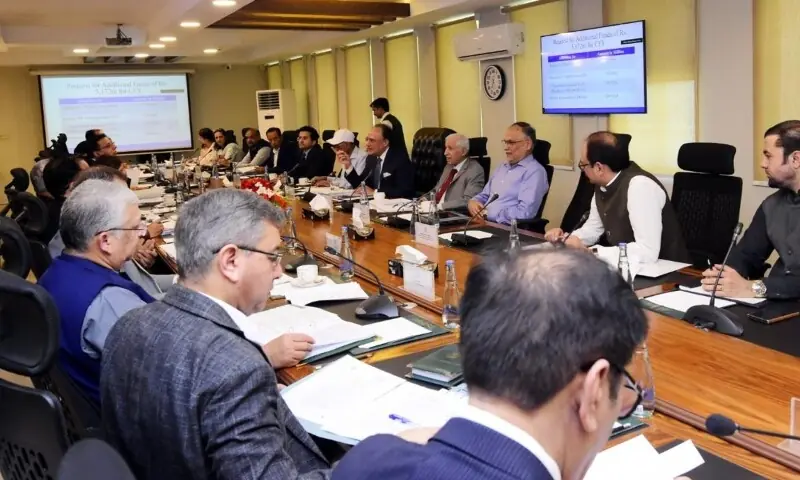
ISLAMABAD: Less than a week before the federal budget is set to be unveiled, the government’s top economic decision-making body approved more than Rs40 billion in supplementary spending grants on Friday, extended a Rs100 billion sovereign-backed borrowing facility to the cash-starved national oil company, and quietly expanded a lucrative bonus program — worth up to six months of additional salary — to several more government ministries.
The Economic Coordination Committee of the cabinet, chaired by Finance Minister Muhammad Aurangzeb, convened as Pakistan’s fiscal managers face mounting pressure on multiple fronts: an International Monetary Fund program that has forced deep cuts to the country’s development budget, an energy sector teetering under a web of unpaid inter-agency debts, and a legislature whose members are determined to protect their constituency funds regardless of the broader austerity drive.
The session underscored the contradictions embedded in Pakistan’s fiscal moment. Even as the government has slashed roughly Rs175 billion from its core development programme — citing IMF-mandated constraints — the committee approved an additional Rs10 billion for parliamentarians’ schemes in the outgoing fiscal year. Officials said the finance minister faced direct pressure from the country’s political leadership to release the funds before the fiscal year closes.
A State Oil Company Running on Empty
The most consequential decision of the day involved Pakistan State Oil, the country’s dominant fuel supplier. The ECC approved letters of comfort and government guarantees totaling Rs100 billion, structured as a syndicated running finance facility split equally between Habib Bank and the Bank of Punjab — Rs50 billion each — to keep PSO solvent and fuel flowing.
The root of PSO’s troubles lies not in the private market but within the government’s own sprawling network of state-owned enterprises. The committee was told that other public-sector companies, primarily gas utilities, owe PSO more than Rs904 billion — a receivables pile so large it has begun to threaten the company’s ability to manage supply chains under what officials described as difficult geopolitical conditions.
Rather than compelling those debtor entities to clear their obligations, the government chose to backstop new borrowing. The Rs100 billion will appear on PSO’s own balance sheet, adding to the company’s debt load while providing near-term liquidity relief.
Bonus Pay Expands Across Ministries
The ECC also extended a special honoraria program — which allows eligible officials to receive up to six months of additional salary for their roles in preparing the federal budget — to three new entities: the Law and Justice Division, the Commerce Division, and the Accountant General of Pakistan Revenue. The benefit had previously been available to roughly a dozen ministries and agencies, including the finance ministry, the Federal Board of Revenue, the planning ministry, the National Assembly, the Senate, and the Prime Minister’s Office. The fiscal cost of Friday’s expansion was not disclosed.
The Cnergyico Dispute
The committee also moved to restructure oversight of a long-running revenue dispute with Cnergyico PK Limited, a private refinery. The company stands accused of collecting petroleum levy payments from consumers but failing to deposit approximately Rs60 billion — including Rs47.5 billion in principal — into the government treasury since 2019. Cnergyico is simultaneously seeking government incentives under a brownfield refinery upgrade policy.
A committee established under the Special Investment Facilitation Council to resolve the matter was reconstituted after the ECC was advised that the inclusion of Cnergyico’s own chief executive on that panel raised conflict-of-interest concerns. A new committee, to be convened by the finance secretary and including representatives from the Law and Justice Division, the Petroleum Division, and SIFC, was formed and tasked with tightening the recovery plan. The Law and Justice Division had previously proposed requiring Cnergyico to deposit any incremental policy incentives into a joint escrow account with the energy regulator, with withdrawals barred until all outstanding levies and surcharges are fully repaid.
A Long List of Supplementary Grants
Beyond the headline decisions, the ECC moved through a lengthy roster of supplementary grants reflecting the government’s routine year-end scramble to fund obligations deferred through the fiscal year.
The Ministry of Interior and Narcotics Control received seven separate grants totaling Rs2.826 billion. Among them: Rs693 million for security arrangements tied to Islamabad peace talks; Rs241 million in compensation following the suicide bombing at Imambargah Khadijah-tul-Kubra in Taralai; Rs800 million for the procurement of fast patrol vessels for the Pakistan Coast Guards; Rs1.884 billion for expansion of the Safe City Islamabad surveillance network; Rs150 million for the National Counter Terrorism Authority; Rs528 million for the Pakistan Land Ports Authority; and Rs414 million for security costs at the Reko Diq copper and gold project.
The Ministry of Defence secured Rs10.15 billion for the Hangor submarine project under the Rafale Aircraft and Force Development Package-2030, a major naval acquisition programme.
Pakistan Television Corporation, the state broadcaster, received Rs733 million to cover staff salaries for June 2026, while the Special Communication Organisation was allocated Rs183.5 million for the installation of telecommunications infrastructure in the Shigar district of Gilgit-Baltistan.
The ECC approved two housing-related grants totaling more than Rs11.5 billion — Rs8.759 billion for urban infrastructure development packages in Karachi and Hyderabad, and Rs2.84 billion for parliamentary schemes in Khyber Pakhtunkhwa. An additional Rs1.3 billion was approved for Phase II-A of the modernisation of the Pakistan Mint.
The Gilgit-Baltistan government received Rs4.377 billion to support current expenditure and what the committee described as priority initiatives launched ahead of elections in the territory.
The Cabinet Division’s Sustainable Development Goals Achievement Programme was granted Rs7.026 billion through a technical supplementary grant. Officials said the funds were needed to prevent delays and cost overruns in ongoing development projects under the programme.
The ECC separately approved the budget estimates of IPO-Pakistan for the coming fiscal year, covering regular expenditure of Rs914.7 million against projected revenue receipts of Rs918 million, as well as a summary from the Ministry of Maritime Affairs concerning the operational continuity of Engro Vopak Terminal Limited.
Copyright © 2021 Independent Pakistan | All rights reserved