By Staff Reporter
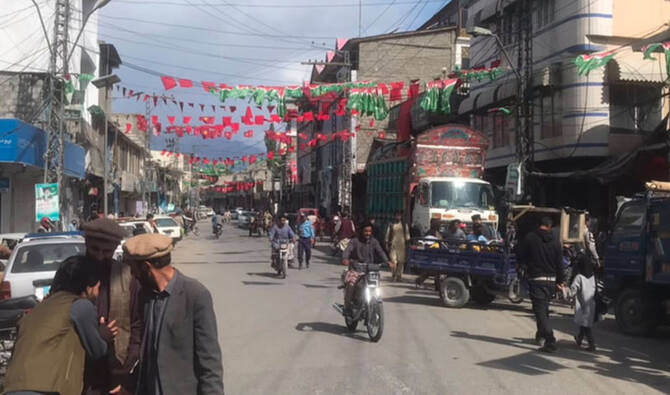
SKARDU: At a busy road cutting through this northern district, cars pass draped in the banners of rival political parties. Election symbols flicker from storefronts and party flags snap in the mountain wind. Gilgit-Baltistan, a dramatic swath of glacier and granite that borders China, Afghanistan, and Indian-administered Kashmir, is preparing to go to the polls for the first time in six years.
But even as the landscape fills with the familiar stage of an election campaign — rallies, posters, loudspeakers — the Pakistan Tehreek-e-Insaf party of former prime minister Iram Khan on Saturday accused the federal government of turning Sunday’s vote into something else entirely: a managed outcome enforced at gunpoint.
The party’s information secretary, Sheikh Waqas Akram, laid out a sweeping indictment of what he called an orchestrated campaign to deny PTI any foothold in the 33-seat Gilgit-Baltistan Legislative Assembly. At the center of his allegations was a single, striking statistic: in a region with a total population of roughly 900,000 people and a local police force of just 5,600 officers, the federal government has deployed more than 13,000 additional security personnel from outside the region — among them 11,000 from Punjab Police, 1,000 from Sindh Police, 700 from the Frontier Constabulary, and 140 from the Islamabad Capital Territory Police.
“This overwhelming presence of external forces, far exceeding the requirements of the local population, lays bare the regime’s alleged intent to seize control of polling stations, disrupt the voting process with the help of local proxies and engineer a pre-determined outcome on election day,” Akram said. “This massive influx of police is not for maintaining peace but for orchestrating large-scale rigging.”
The federal and Gilgit-Baltistan governments did not immediately respond to requests for comment on the PTI’s allegations.
A Region Long Shaped by Federal Power
The elections, originally scheduled for early this year, were delayed four months — the Election Commission cited harsh winter conditions across GB’s mountainous terrain. They come at a moment of unusual national attention for a region that has historically sat at the margins of Pakistani political life.
GB is a semi-autonomous territory that Pakistan has administered since 1947. Its residents are Pakistani citizens but have no representation in the national parliament and remain in a constitutional limbo that predates the country itself: both India and Pakistan claim the entirety of the former princely state of Jammu and Kashmir, of which GB was once a part. The two countries have fought two wars over the territory and continue to face off across a United Nations-mandated Line of Control.
Yet within Pakistan, GB has grown considerably in recent years. Skardu now has an international airport. Millions of tourists arrive each year to trek among the Karakoram peaks, including K2, the world’s second-highest mountain. The China-Pakistan Economic Corridor runs through its valleys, making it a node in Beijing’s Belt and Road initiative.
“The attention of the entire world is focused on Skardu,” said Qaseem Naseem, a local political analyst. “Unlike the past, when only a few major political leaders visited the region, today the central leadership of almost all major political and religious parties in Pakistan are actively campaigning here.”
That attention, Naseem said, has done little to resolve the region’s fundamental grievances. “Even after 78 years, the people of the region are still deprived of full constitutional rights,” he said. “People want to be integrated into the national mainstream.”
The Voters’ Ledger
For many residents, Sunday’s election is less about grand constitutional questions than broken roads and darkened rooms.
Khawaja Khalid, who lives in Skardu, ticked off his concerns matter-of-factly: electricity shortages, a lack of clean drinking water, crumbling infrastructure. “We will support a person who knows how to solve these issues,” he said.
His neighbor Sadiq Sadpara pointed to the roads. “You can see the condition of the roads. All the roads are broken. People have to face a lot of problems.” He added that the region’s schools, while numerous, often sit empty of teachers. And despite Skardu’s emergence as a tourism hub, he said, visitors and locals alike suffer from a lack of basic facilities. “If these issues are not addressed, the problems will continue to increase.”
Naseem, the political analyst, noted one layer of complication that makes reform difficult to deliver: GB is heavily dependent on development funding from the federal government, which has historically shaped how its people vote. “Since Gilgit-Baltistan depends heavily on financial support and development funds from the federal government, voters often prefer parties that are in power at the federal level,” he said.
The pattern has held with unusual consistency. In 2009, the Pakistan Peoples Party won in GB while leading the federal government. In 2015, the Pakistan Muslim League-Nawaz did the same. And in 2020, Imran Khan’s PTI swept the region’s polls while governing in Islamabad. The PPP and PML-N — now partners in the coalition that removed Khan from power and has kept him in prison — are competing aggressively here on Sunday. Both parties have staged a series of rallies across the region in recent days.
“It is an open secret that both the PPP and PML-N are banking on yet another Form 47-style manipulation because they know the people of Gilgit-Baltistan overwhelmingly support Imran Khan and the PTI,” Akram said, using the term that refers to Pakistan’s official election result form and has become, in PTI parlance, a shorthand for alleged ballot-stuffing.
A Catalog of Complaints
Beyond the security deployment, Akram presented a detailed list of alleged pre-election interference. He said internet services and landlines had been disrupted across Gilgit city in recent days — “a classic tactic,” he said, “to sever communication among PTI workers and supporters.” Key party workers, he alleged, had been arrested over the past 48 hours.
He claimed that PTI members of the legislative assembly had been “coerced and bribed” to abandon the party, and that candidates and workers loyal to Khan had been pushed out of the region. PTI’s election symbol, he said, was “arbitrarily banned.”
A last-minute electoral alliance with the Gilgit-Baltistan Democratic Party collapsed, Akram said, after the partner party’s symbol was abruptly withdrawn at midnight through a text message to returning officers, with no written order or legal explanation from the Election Commission. He alleged that postal ballots for PTI candidates had been blocked while those for PPP and PML-N candidates were processed without obstacle.
He further alleged that party leaders had been barred from campaigning on what he called “flimsy and unlawful grounds,” with the Election Commission unable to produce any legal basis for the restrictions when PTI lawyers pressed for one. Most striking, he said, was a remark attributed to the chief election commissioner himself: that PTI candidates should be “thankful” simply for having been allowed to submit their nomination forms.
“This is not an election; it is a state-orchestrated farce designed to crush the democratic will of the people,” Akram said.
Copyright © 2021 Independent Pakistan | All rights reserved