By Staff Reporter
ISLAMABAD: Pakistan’s interior minister landed in Tehran on Saturday carrying personal messages from the country’s prime minister and its most powerful general, as Islamabad scrambled to hold together a ceasefire between the United States and Iran that appeared increasingly at risk of unraveling.
The visit by Interior Minister Mohsin Naqvi came hours after the most serious exchange of fire since an April 8 truce quieted what had been weeks of relentless bombardment across the Gulf. The United States said it had struck Iranian coastal radar installations and downed four attack drones near the Strait of Hormuz. Iran’s Revolutionary Guards answered by firing seven ballistic missiles at Kuwait and Bahrain, where American forces are stationed — six of which were intercepted, the United States said, while the seventh fell short of its target.
By Saturday morning, air-raid sirens had wailed over both Gulf states, and residents in Kuwait and Bahrain reported hearing explosions. Neither government reported mass casualties, but both condemned the strikes as violations of their sovereignty. Egypt, Jordan, and Qatar added their voices to the condemnation.
Into that volatile landscape stepped Naqvi, a security official who has become one of the most improbable diplomatic figures of the conflict — shuttling between Islamabad, and Tehran with a frequency and access that has surprised seasoned observers of South Asian foreign policy.
Before departing, Naqvi met with Prime Minister Shehbaz Sharif in Lahore, where the two men reviewed both the domestic security situation and the minister’s mission abroad. Sharif provided what his office described as specific guidance for the Tehran talks, including instructions related to the ongoing, halting negotiations between Washington and Iran.
Naqvi was also said to be carrying a special message from Field Marshal Syed Asim Munir — Pakistan’s Chief of Army Staff and Chief of Defence Forces — addressed to Iran’s Supreme Leader, Ayatollah Mojtaba Khamenei. Pakistani officials declined to disclose the substance of the communication.
Pakistan has occupied an unusual position since hostilities broke out in late February, when coordinated American and Israeli strikes on Iranian territory triggered a cascade of Iranian retaliatory attacks — including missile barrages on Israeli and American military targets across the region and the closure of the Strait of Hormuz, the narrow chokepoint through which roughly a fifth of the world’s seaborne oil passes. As major powers held back and regional governments sought cover, Islamabad quietly inserted itself as a channel between the two warring capitals.
The April ceasefire, which Pakistan helped broker, has never been stable. Both sides have accused the other of repeated violations. The agreement ended the most intensive phase of daily strikes across Iran and the Gulf but left unresolved the competing blockades — Iran’s closure of the strait, and an American naval blockade of Iranian ports — that have choked global energy supplies and unnerved financial markets for months.
Washington has demanded the strait be reopened and pressed for Iranian concessions on its nuclear program. Tehran has sought sanctions relief, access to frozen assets, and the lifting of the American blockade. The two sides have exchanged proposals through intermediaries, including Pakistan, but have found no common ground.
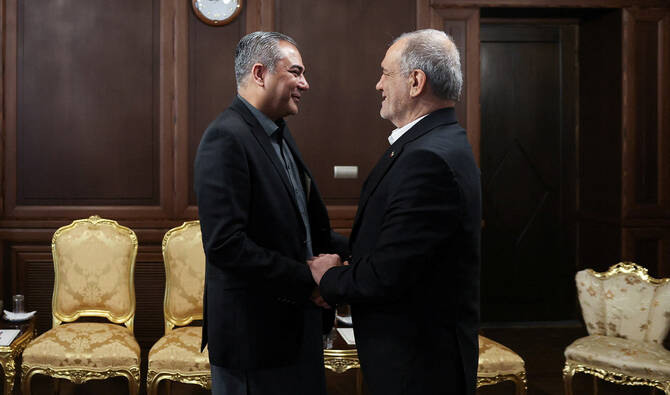
Naqvi’s latest trip to Tehran is his second this month. On May 17, he arrived on a previously unannounced two-day visit that Pakistani diplomatic sources described as an urgent intervention after President Donald Trump rejected Iran’s most recent response to American proposals, threatening to collapse the negotiating framework altogether. During that visit, Naqvi met Iranian President Masoud Pezeshkian for roughly ninety minutes at the Presidential Palace, as well as Parliament Speaker Mohammad Bagher Ghalibaf, Iran’s interior minister, and Foreign Minister Abbas Araghchi.
Ghalibaf used the occasion to deliver a pointed message. Some regional governments, he told his Pakistani visitor, had made the mistake of believing that American military presence would guarantee their security. “Recent events have shown that this presence not only fails to create security but also lays the groundwork for insecurity,” he said, according to the official IRNA news agency.
The current crisis was set off Friday when American forces said they intercepted Iranian drones headed toward the Strait of Hormuz before striking what the Pentagon described as coastal surveillance radar stations at Goruk and on Qeshm Island. Iran’s IRGC told a different story: the confrontation began, they said, when American naval vessels attempted to escort oil tankers through the strait without coordinating with Iranian authorities — an assertion that underscores just how deeply the two sides disagree on the basic facts of their encounter.
The escalation followed a similar exchange earlier in the week. On Monday, American forces carried out strikes near the strait; Iran responded Wednesday with a missile attack that damaged Kuwait’s international airport and resulted in casualties.
For the Gulf states caught in between, the cycle has grown harrowing. Kuwait and Bahrain — both hosting American military installations — now find themselves absorbing the physical and political consequences of a war they have no part in fighting. On Saturday, Bahrain said it had helped intercept the Iranian missiles alongside Kuwaiti forces.
Analysts tracking the negotiations have noted that each round of strikes makes a deal harder to reach. “Every time one of these attacks happens, it hardens political and military positions, and that makes the idea of a negotiated solution that much more fragile,” Al Jazeera’s correspondent in Doha said Saturday. “The longer it goes on, the harder it is for negotiating sides, for mediators, for the GCC not just to recover economically, but to get to a place where the fighting stops.”
Naqvi’s trip also followed meetings this week on the sidelines of the Shanghai Cooperation Organization interior ministers’ conference in Bishkek, Kyrgyzstan, where he held talks with his Iranian counterpart, Eskandar Momeni, on bilateral relations and the regional situation. He briefed Sharif on those conversations before departing for Tehran.
Iran’s Foreign Ministry, for its part, accused the United States Saturday of a “flagrant” violation of the ceasefire, saying American behavior demonstrated not only a lack of will to reduce tensions but an active effort to “seriously endanger the security of the region.” Tehran said Washington bore responsibility for “all the effects and consequences of these illegal actions, as well as any possible escalation of tension.”
American officials did not dispute the strikes but said they were taken to “defend against further attacks.”
Copyright © 2021 Independent Pakistan | All rights reserved