By Staff Reporter
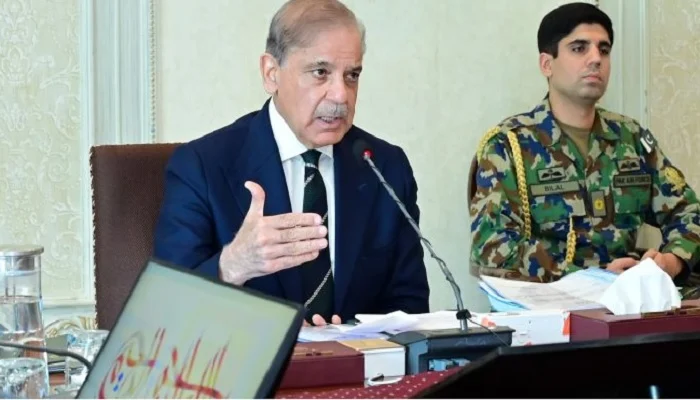
ISLAMABAD: The National Economic Council convenes on Monday under Prime Minister Shehbaz Sharif to overhaul a combined federal and provincial development program worth Rs4.715 trillion, with officials signalling the final numbers could shift substantially from what a subordinate planning body cleared just days ago — a reflection of the competing fiscal pressures bearing down on a government simultaneously managing an IMF bailout and an uneasy coalition.
The NEC, the federation’s highest economic decision-making forum, brings together the four provincial chief ministers and four senior federal ministers under the prime minister’s chairmanship. Its four-item agenda on Monday spans the review of the outgoing fiscal year’s annual plan, approval of development targets for 2026-27, and a presentation of what the Planning Commission describes as an increasingly troubled public investment portfolio.
The meeting comes a week after the Annual Plan Coordination Committee cleared a consolidated development framework that allocated Rs1.126 trillion to the federal Public Sector Development Program and Rs3.138 trillion across provincial annual development plans. Neither figure is expected to survive the NEC unchanged.
Senior government officials said the federal PSDP allocation is likely to be pushed beyond Rs1.3 trillion, while provincial envelopes face trimming. The PSDP summary submitted to the NEC already carries a formal request for an upward revision. The final shape of those changes, officials said, hinges on political negotiations with coalition partners that were still ongoing as of Sunday.
Provinces Under Pressure
At the center of the fiscal arithmetic is Islamabad’s push for additional budgetary space from the provinces — a demand that, if fully met, would fund the Centre’s ambitions without breaching its commitment to deliver a primary surplus of at least 2 percent of GDP, equivalent to more than Rs2.8 trillion, under the terms of Pakistan’s current IMF program.
The federal government had initially sought Rs1.7 trillion in combined fiscal contributions from the provinces — on top of a cash surplus of roughly Rs2 trillion, or about 1.4 percent of GDP, already expected from them for the coming year. That demand has since been walked back by close to a third, to around Rs1 trillion, following resistance from provincial governments that are themselves facing spending constraints.
Despite the squeeze, allocations for schemes tied to coalition partners and ruling party legislators are expected to hold firm. Officials confirmed that Rs87 billion earmarked for coalition partner projects and Rs70 billion set aside for parliamentarians from the Pakistan Muslim League-Nawaz and allied parties are unlikely to be touched.
A Portfolio in Distress
The NEC will also receive a monitoring and evaluation report on mega projects that lays bare the scale of execution failures across Pakistan’s public investment pipeline.
The PSDP 2025-26 portfolio comprised 801 projects — 734 ongoing and 67 new — spread across 40 ministries, divisions and state-owned enterprises. Of the 240 projects selected for monitoring this fiscal year, 170 had been reviewed by March 2026.
The findings were stark. Approximately 25 percent of ongoing projects are running over their original cost estimates, while nearly 79 percent have exceeded their scheduled completion dates, according to the Planning Commission report. The document attributed delays to a familiar constellation of problems: inadequate financing, poor initial project design, bottlenecks in land acquisition, litigation, procurement failures, delayed release of provincial counterpart funds and a shortage of management capacity.
“Analysis indicates that approximately 25 per cent of ongoing projects are facing cost overruns, while nearly 79pc are experiencing time overruns, placing additional burden on public finances and affecting development outcomes,” the report said.
Growth Targets Carry Caveats
On the macro side, the NEC is expected to be briefed on slippages in the current year’s growth trajectory — attributed largely to external factors — before being presented with targets for 2026-27 that the Planning Commission has flagged as conditional.
The government is projecting GDP growth of 4 percent for the next fiscal year, with inflation forecast to ease to 8.2 percent. The commodity-producing sectors are targeted to expand 3.9 percent, driven by 3.8 percent growth in agriculture and a 4.5 percent pickup in large-scale manufacturing.
Within agriculture, recovery is projected across major crops at 3.6 percent, cotton ginning at 2.5 percent and livestock at 3.9 percent. The industrial sector is targeted to grow 4 percent overall, supported by a revival in manufacturing and continued momentum in mining, construction and energy. Services are projected to expand 4.2 percent, with information and communication technology penciled in for the strongest growth at 7.7 percent.
The Planning Commission placed a notable qualifier on all of those projections. “These targets are contingent on effective macroeconomic management and stable external conditions,” it said — an acknowledgement, in bureaucratic language, that the room for error is narrow.
National savings are projected to reach 14.3 percent of GDP, up marginally from 14.1 percent this year, while the investment rate is targeted to climb to 15 percent of GDP from 14.4 percent.
The commission also flagged a specific external sector risk: as import controls are eased and debt repayments accelerate, the current account deficit is expected to widen — a pressure point that could complicate Pakistan’s ability to maintain the reserve buffers its IMF program requires.
The four provincial chief secretaries are also scheduled to present their respective annual development plans to the council, after which the NEC will take up a progress report covering approvals by the Central Development Working Party and the Executive Committee of the National Economic Council between April 2025 and March 2026.
Copyright © 2021 Independent Pakistan | All rights reserved