By Staff Reporter
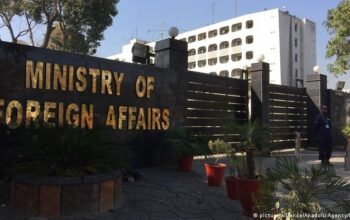
ISLAMABAD: The Foreign Ministry on Monday sharply rebuked members of the British-Pakistani diaspora and several British lawmakers over their comments on unrest in Azad Jammu and Kashmir, telling them to stay out of the country’s internal affairs as at least seven civilians lay dead following clashes between security forces and protesters in the territory.
The rebuke came as authorities in the Pakistan-administered region tightened their grip on the banned Joint Awami Action Committee (JAAC), arresting scores of its leaders, sealing its headquarters, shutting down mobile data services and deploying federal paramilitary reinforcements ahead of a planned demonstration scheduled for Monday.
“We have noted with concern the irresponsible and ill-informed insinuations made by certain members of the diaspora in the UK regarding AJK,” the Foreign Office said in a statement, advising those individuals to “contribute positively to their country of residence” rather than interfere in Pakistani affairs.
The ministry reserved particular sharpness for unnamed British Members of Parliament whose queries it said betrayed “a lack of awareness and disregard for the historical background of the issue.”
“For those still living in colonial times, it bears reiterating that Pakistan is a sovereign and democratic republic that firmly believes in non-interference in the internal affairs of other countries and expects the same from others,” the statement said.
Islamabad also called on the British government to caution individuals it said were supporting proscribed organisations, and urged respect for “the democratic process, judicial decisions, and the rule of law” as enshrined in Pakistani and AJK constitutional frameworks.
The diplomatic broadside followed a bloody weekend in Rawalakot, the principal city of the Poonch division, where tensions ignited after the AJK government declared the JAAC a banned organisation on Friday night, citing what it described as the group’s engagement in terrorism and actions “prejudicial to peace and security” of the state. The proscription came days before JAAC had planned a major protest rally for June 9.
Clashes erupted after a trader was allegedly shot dead during a confrontation with law enforcement on Friday, a death that inflamed already raw tensions on the streets. Officials accused demonstrators of subsequently storming and attacking the Combined Military Hospital in Rawalakot.
Rawalakot Commissioner Sardar Waheed confirmed that four police personnel, including a sub-inspector, were killed in the violence and that 13 officers from the Azad Kashmir Police sustained gunshot wounds. Civilians caught up in the unrest were also injured by shelling, he said, though he maintained that the situation had since stabilised and active clashes had ceased.
Separate local media put the civilian death toll at seven, figures that could not be independently verified due to the communications blackout imposed by authorities. Among those arrested in the sweeping crackdown were prominent JAAC leaders Anjum Zaman and Raja Sohaib Javed.
The AJK authorities advised travellers to postpone visits until at least June 20, citing security concerns. The federal government dispatched Rangers and Frontier Corps personnel to bolster a police force stretched thin by the unrest. Heavy deployments were reported at sensitive sites in Muzaffarabad, the territorial capital, including the High Court, the Legislative Assembly and the Presidency, where Section 144 — prohibiting public gatherings — has been imposed.
The JAAC, which draws much of its support from Kashmiri communities with emotional and familial ties to the United Kingdom, had built its campaign around a central demand: the abolition of 12 seats reserved in the AJK Legislative Assembly for Kashmiri refugees residing in mainland Pakistan, a provision critics argue dilutes the political voice of residents within the territory itself.
The group’s proscription and the subsequent crackdown have drawn attention in British political circles, where a sizeable diaspora of Mirpuri and Kashmiri origin has long maintained close interest in the territory’s affairs — a dynamic that has historically complicated bilateral sensitivities between London and Islamabad.
Copyright © 2021 Independent Pakistan | All rights reserved