By Staff Reporter
RAWALPINDI: The commanders of Pakistan and Lebanon’s armed forces met on Tuesday at Pakistan’s military headquarters to discuss deepening defence cooperation and the deteriorating security landscape across the Middle East, a meeting that came as Islamabad has sought to position itself as a diplomatic interlocutor in the widening conflict between Israel and Iran.
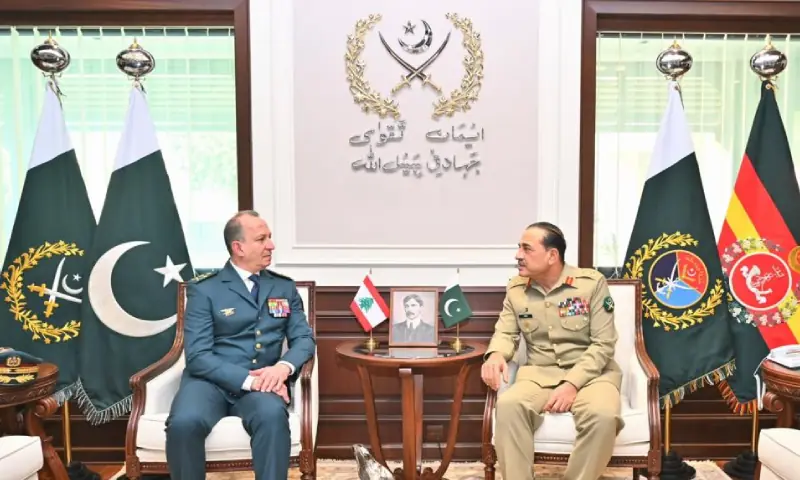
Lebanese Armed Forces Commander-in-Chief Gen. Rodolphe Haykal arrived at General Headquarters in Rawalpindi — the nerve centre of Pakistan’s military establishment — where he was received with a tri-services guard of honour before sitting down with Field Marshal Syed Asim Munir, Pakistan’s chief of army staff and chief of defence staff.
The meeting, according to a statement from Pakistan’s Inter-Services Public Relations directorate, covered “matters of mutual interest, evolving regional security environment, defence cooperation and prospects for enhancing bilateral military relations.” Talks focused in particular on building out training programs, professional exchanges and institutional ties between the two militaries.
Munir used the occasion to underscore what Pakistan views as a durable partnership, reaffirming Islamabad’s “longstanding and cordial relations with Lebanon” and the army’s intent to deepen collaboration with the Lebanese Armed Forces. Haykal, for his part, praised what the statement described as the “professionalism and operational excellence” of Pakistan’s military and recognized its record in United Nations peacekeeping deployments — a sphere in which the two countries share direct history.
Pakistani troops have long served in Lebanon under the UN Interim Force in Lebanon, known as UNIFIL, giving the bilateral relationship a practical dimension beyond ceremonial diplomacy.
Haykal departed for Pakistan on Saturday, with the Lebanese military confirming the trip had come at Munir’s invitation. Beirut offered few additional details on the visit’s purpose or expected duration at the time of his departure.
The timing was conspicuous. Lebanon has remained at the epicentre of regional upheaval linked to the recent Israeli-Iranian confrontation, with Lebanese state institutions — the army among them — under increasing pressure to hold the line on stability as the country navigates its own fragile political and security situation. Pakistan, meanwhile, has been vocal in calling for an end to Israeli military operations in Lebanon and has pursued a more active role in diplomatic efforts to wind down hostilities across the region.
Whether Tuesday’s discussions produced any specific commitments or agreements was not disclosed. The ISPR statement described the encounter in the language of institutional rapport rather than operational outcomes, concluding that the visit “reflects the shared commitment of both armed forces to fostering closer military-to-military cooperation.”
Still, the meeting carried symbolic weight — a signal from two Muslim-majority nations, geographically distant but increasingly aligned in their reading of regional dangers, that military channels between them are open and active.
Copyright © 2021 Independent Pakistan | All rights reserved