By Staff Reporter
ISLAMABAD: Pakistan’s ambassador to the United Nations issued an unambiguous warning to the Afghan Taliban on Monday, telling the Security Council that Islamabad’s patience was running out and that military action targeting terrorist infrastructure on Afghan soil would continue for as long as the Taliban refused to act against militant groups that Pakistan holds responsible for more than 1,200 deaths last year alone.
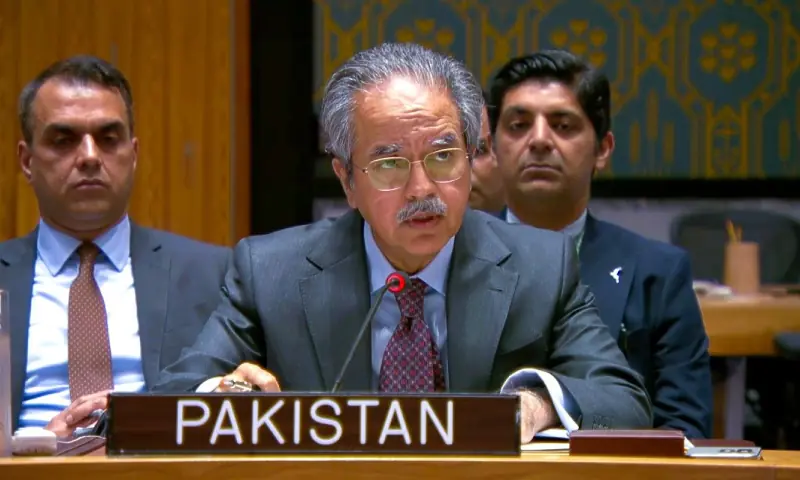
Ambassador Asim Iftikhar Ahmad, addressing the council during a session focused on Afghanistan’s deteriorating security and humanitarian situation, told the fifteen-member body that Pakistan’s singular demand of the Taliban remained simple, if still unmet: “verifiable and non-reversible action” against terrorist organisations operating openly from Afghan territory.
“The window for course correction is narrowing but is still open,” he said. “We hope the Taliban realise this in earnest and cooperate with the international community for the long-term peace and development of Afghanistan and, above all, in the best interest of all Afghans.”
The remarks came as the council reviewed conditions inside Afghanistan nearly five years after the Taliban’s August 2021 return to power — a moment that Pakistani officials had publicly hoped, and privately expected, would usher in a period of reduced militancy along their shared, porous border. That hope, Ahmad made clear, has not been realised.
Pakistan reported more than 5,300 terrorist incidents in 2025 alone, the ambassador said, and identified groups including the Tehreek-i-Taliban Pakistan, the Balochistan Liberation Army and its Majeed Brigade, the Islamic State-Khorasan Province and the East Turkestan Islamic Movement as the principal threats — all, he said, sheltering and operating with impunity inside Afghanistan.
“As a direct result of the freedom with which these terrorist groups operate in Afghanistan, Pakistan has borne the brunt of their attacks,” Ahmad told the council, his tone measured but pointed. “And once again, a significant number of Afghans are found to be involved in terrorism inside Pakistan.”
He cited a specific attack on May 9, in which a vehicle-borne improvised explosive device struck a police post in Khyber Pakhtunkhwa, killing fifteen officers. Pakistani investigators, he said, traced the planning of that attack to militants based in Afghanistan.
Ahmad was speaking in part to defend Pakistan’s military operations in March — strikes that drew international attention and condemnation from Kabul — describing them as targeted exclusively against “terrorist and military support infrastructure” across the border. He did not offer specific details about the scope of those operations but said Pakistan would “respond in self-defence, as and when needed and always in conformity with international law and International Humanitarian Law.”
The envoy was particularly scathing about what he described as the Taliban’s willful complicity in the violence, accusing the Afghan government of providing safe harbor to militant groups and backing them through what he called an alliance of convenience with an outside power — a reference widely understood to mean India, though Ahmad named that country separately and directly during a right-of-reply segment later in the session.
“It is deplorable that the Taliban have reverted to their old tactics of providing safe havens to terrorist groups and chosen the perilous path of complicity, backed by an outside actor — the historic spoiler and instigator of chaos — that has moved fast as an opportunist to wage a proxy war against Pakistan,” he said.
In that right-of-reply exchange, responding to remarks by Afghanistan’s Permanent Representative Nasir Ahmad Faiq, Ambassador Ahmad turned his attention squarely to New Delhi. India, he said, was “solely driven by the singular goal of destabilising Pakistan” through its engagement in Afghanistan. He was equally blunt in his assessment of Pakistan’s capacity to resist.
“Pakistan is well aware of India’s motives and evil designs,” he said. “But we will not allow them to nourish terrorists and threaten our national security. We have stopped them before, and we will do it again — and we will do it always.”
The session also served as a platform for Pakistan to push back against the United Nations itself. Ahmad questioned the neutrality of the UN Assistance Mission in Afghanistan, known as UNAMA, arguing that its recent reporting had framed casualties from Pakistani counter-terrorism operations as civilian deaths without adequately contextualising the attacks that preceded them.
“UNAMA is swift in reporting incidents of cross-border actions and casualties but fails to provide the overall context, which is the grave terrorist threat emanating from Afghanistan and its cross-border impact directed at Pakistan,” he said.
He also criticised the UN secretary-general’s latest report on Afghanistan, saying it “seems to largely externalise the responsibility for Afghanistan’s multifaceted challenges” while ignoring the Taliban’s own role in the country’s unravelling — including, he said, the proliferation of weapons left behind by Western forces after their 2021 withdrawal. Ahmad said Pakistani counter-terrorism operations had seized weaponry in more than 290 instances, tracing much of it to the billions of dollars’ worth of arms abandoned when the former Afghan national government collapsed.
On the humanitarian dimension, Ahmad did not spare the Taliban either. He noted that the UN’s Humanitarian Needs and Response Plan for 2026 was funded at just fourteen percent of its target — a shortfall he attributed directly to the Taliban’s governing failures and their alienation of the international community. He also accused the Taliban of blocking humanitarian goods at the Afghan side of the border even as Pakistan facilitated their passage.
“The Afghan Taliban regime refuses to let them pass and keeps the border closed on its side, even to receive life-saving cargoes,” he said, “which obviously is to the detriment of the Afghan people.”
Pakistan, he noted, has hosted Afghan refugees for more than four decades, absorbing millions of displaced people with what he described as insufficient support from the international community. He called on the UN secretary-general to provide a transparent accounting of pending third-country resettlement cases.
Ahmad closed his formal address by invoking the deep and complicated ties between the two neighbouring nations — geographic, civilizational, religious and ethnic — while making clear that proximity had also brought catastrophic costs.
“No country has suffered more from the consequences of conflict and instability in Afghanistan than Pakistan,” he said. “So we understand — and we also know — that no country stands to benefit more from peace, prosperity and stability in Afghanistan than Pakistan.”
—
Copyright © 2021 Independent Pakistan | All rights reserved