By Staff Reporter
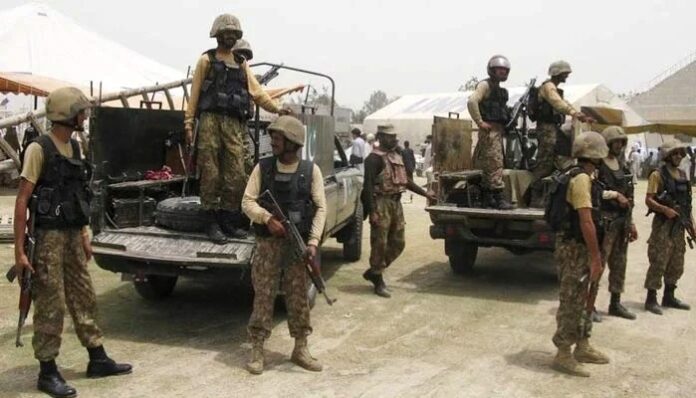
ISLAMABAD: Security forces have killed 48 militants over the past week in a series of intelligence-guided operations in North Waziristan, the military said Saturday, as the army pressed a sweeping counterterrorism campaign in tribal districts that have long been among the country’s most volatile.
The Inter-Services Public Relations directorate, the military’s media arm, said 21 militants were killed in the latest 72-hour push near Miranshah, the district’s main town, following a nearly identical operation last week that killed 27 others in the same general area. Together, the military said, the operations delivered what it called “a significant blow” to the militant network operating there.
Among the dead in the most recent raids, the ISPR said, were four mid-level commanders it identified as Khalid Raza, also known as Salar; a man called Muftoon; another called Musa; and Imran, who went by the alias Ayan. All four, the military said, were sought in connection with attacks on both security personnel and civilians. Weapons and ammunition were recovered from the sites.
The government refers to its adversaries in the tribal belt as “Fitna al-Khawarij” — an Arabic construction invoking a schismatic faction from early Islamic history — and routinely attributes their financing and direction to India. The label is applied principally to the Tehreek-e-Taliban Pakistan, and affiliated groups that have carried out hundreds of attacks in recent years.
“Sanitisation operations continue,” the military said in its statement, pledging to “eliminate holed-up khawarij from these areas.”
The operations in Miranshah come against a backdrop of sharply deteriorating security conditions across the country’s northwest. After two consecutive months in which violence had declined, Pakistan recorded a significant uptick in militant attacks in May, driven primarily by intensified activity in Khyber Pakhtunkhwa and Balochistan, according to the Pakistan Institute for Conflict and Security Studies, a private research organization based in Islamabad.
The Miranshah subdivision was placed under Section 144 — a colonial-era provision that restricts public gatherings and movement — on June 2, for an indefinite period, amid what the district administration described as security concerns. That measure coincided with what officials said was a foiled vehicle-borne suicide attack on a military post near the town. The lockdown order was widely read as a sign of intensifying operations and a precaution against retaliatory strikes.
The violence in North Waziristan fits into a pattern that officials say has been fueled by the Taliban’s return to power in neighbouring Afghanistan in 2021. Since then, attacks in KP and Balochistan have risen steadily, with security forces and law enforcement personnel the most frequent targets. Pakistani officials have repeatedly pressed the Afghan Taliban government to act against militant groups using Afghan territory as sanctuary, without success.
In late May, Pakistani forces killed 11 militants in a separate operation in the Datta Khel area of North Waziristan, about 50 kilometers southwest of Miranshah.
The pace of operations has accelerated in recent weeks. On Wednesday, Information Minister Attaullah Tarar said Pakistan had conducted a “precise and calibrated” strikes across the Afghan border, targeting planning hubs connected to recent attacks in Pakistan. At least 26 militants were killed in those strikes, Tarar said. He cited three specific incidents as precipitating the cross-border action: a June 9 assault on a Federal Constabulary post in Musa Dara; the June 2 suicide car bombing attempt near Miranshah; and a May 9 attack on a police station in Bannu.
The border strikes and the internal operations in North Waziristan represent the sharpest edge “Operation Azm-i-Istehkam” — a campaign authorized by the Federal Apex Committee on the National Action Plan, Pakistan’s highest counterterrorism coordination body.
Tensions along the Afghan frontier have been building for months. In October 2025, Afghan Taliban forces and allied militants launched unprovoked attacks on Pakistani border posts, touching off exchanges that the army labeled “Operation Ghazab lil-Haq.” Pakistani military officials said that operation killed scores of Afghan Taliban operatives and wounded hundreds more. Despite several rounds of talks between Islamabad and Kabul since then, the two sides have failed to reach any agreement, with Pakistani officials saying the Afghan Taliban government has shown little willingness to move against militant networks on its soil.
The military said Saturday that operations in North Waziristan would continue until remaining fighters are cleared from the area.
Copyright © 2021 Independent Pakistan | All rights reserved