By Staff Reporter
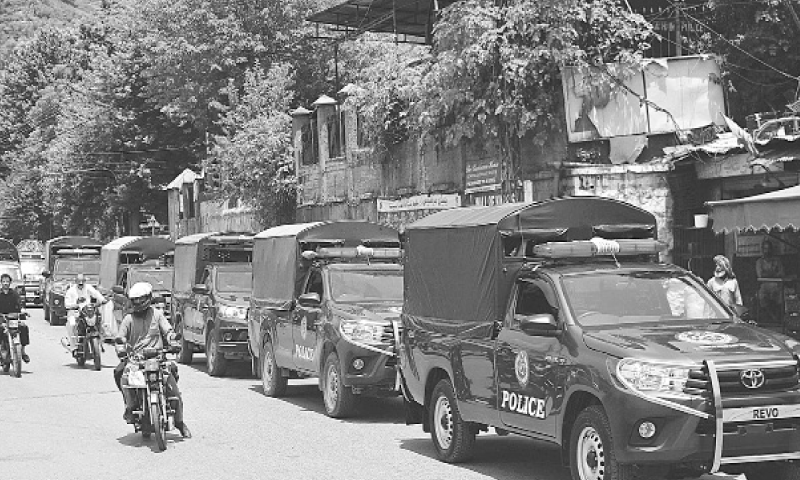
MUZAFFARABAD: Two people were killed and eight others wounded in clashes between protesters and law enforcement in the Azad Kashmir city of Rawalakot in the early hours of Sunday, as a deepening political crisis over forthcoming regional elections exposed significant fractures within Pakistan’s ruling coalition.
The deaths near Eidgah Ground — where the Joint Awami Action Committee (JAAC) has been holding nightly rallies since Wednesday — came on a day when the Pakistan Peoples Party moved conspicuously to distance itself from the election timetable its coalition partners in the PML-N insist must hold.
PPP chairman Bilawal Bhutto-Zardari used a formal statement to appeal to protesters in Azad Jammu and Kashmir to stand down, warning that the continuing unrest was “damaging both the Kashmir cause and Pakistan’s international reputation.” He called on those who had “taken the law into their own hands” to surrender to the authorities and allow, as he put it, “due process to take its course.”
The appeal carried weight beyond its conciliatory language. Bilawal framed it explicitly around the imminent signing of what he described as a Pakistan-mediated peace agreement between the United States and Iran — “a historic moment,” he said — arguing that domestic turmoil in AJK was undermining Pakistan’s credibility at precisely the moment the country was seeking to project diplomatic authority. Critics will note, however, that no such agreement has been publicly confirmed.
“Parliament and the political process — not the streets — are the appropriate forums for addressing and settling such issues,” he said, adding that the PPP would push for a Truth and Reconciliation Commission to address the region’s outstanding grievances.
The chairman also confirmed his party had already formally requested the AJK Election Commission to withdraw what he called its “premature election schedule,” which sets polling for 27 July. He suggested that a blanket ban on the JAAC — proscribed under the Anti-Terrorism Act by the AJK government on 5 June — could be reviewed if federal and regional stakeholders agreed.
The election question
The PPP’s position placed it in direct conflict with its governing partner. Parliamentary Affairs Minister Tariq Fazal Chaudhry of the PML-N was unequivocal: elections would proceed as scheduled. He told a private television channel that his party had not been consulted by the PPP on any postponement, and made clear that the legal and constitutional constraints were binding.
“The current AJK Assembly took its oath on the 3rd of August,” he said. “Elections must therefore be held before the 4th of August.” The 27 July polling date, he argued, was not a matter of political preference but of constitutional necessity, though he left open the possibility that the deadline for submitting nomination papers could be extended.
Chaudhry expressed condolences over the killings in Rawalakot but maintained that elections represented the only legitimate resolution to the region’s tensions, adding that conditions in Mirpur and Muzaffarabad remained largely normal and that unrest was concentrated in Rawalakot.
The AJK Election Commission itself, in a statement issued on Sunday, flatly rejected the PPP’s position. A spokesperson said the schedule had been issued on 5 June in full accordance with constitutional requirements and the Assembly’s tenure, and dismissed what it called “baseless” speculation about a postponement. “Conducting transparent, free and impartial elections on time is a constitutional responsibility of this commission,” the statement read.
The PPP’s AJK wing breaks cover
In Islamabad, PPP’s AJK president Chaudhry Muhammad Yasin went further than his party chairman at a press conference following a meeting of the party’s core committee at Kashmir House. He called on the Election Commission to withdraw the schedule immediately, calling dialogue “unavoidable.”
Yasin said 37 of JAAC’s 38 demands had already been met. The sole outstanding issue, he said, concerned the 12 seats in the AJK Assembly reserved for refugees who migrated from Indian-administered Jammu and Kashmir after 1947 — the question at the heart of the original JAAC protest campaign — and argued that “alternative legal and constitutional avenues” existed to resolve it.
He was pointed in his criticism of the decision to announce the poll schedule just three days before the protest call that ultimately triggered the current unrest. “Under the current circumstances, holding elections appears difficult,” he said. “Twelve refugee seats cannot be more valuable than human lives.”
He also raised the prospect of external exploitation, warning that India could seek to take advantage of the instability. The PPP AJK core committee resolved unanimously to prioritise reconciliation over confrontation.
Senior PPP figure Nayyar Hussain Bukhari offered an additional rationale: elections should not proceed because the holy month of Muharram — whose observances would effectively halt campaigning — was approaching. He called for local government elections in Gilgit-Baltistan to be similarly postponed.
A region under pressure
The JAAC, now banned under anti-terrorism legislation, has been at the centre of a rolling strike that has shuttered businesses across most of Azad Kashmir for six consecutive days, including in the regional capital Muzaffarabad. Mobile phone services in Rawalakot were suspended on Saturday night, while internet access — already cut across the region — has been extended until 20 June.
Information Minister Ataullah Tarar, speaking to reporters outside Parliament House in Islamabad, offered little indication that the federal government was preparing to shift position significantly. “Everyone has the right to protest,” he said, “but taking the law into one’s own hands cannot be allowed.”
The deaths in Rawalakot — confirmed by Poonch Divisional Commissioner Sardar Waheed Khan — raise the stakes considerably. With the Election Commission holding firm, the PML-N insisting on 27 July, and the PPP now publicly calling for the schedule’s withdrawal, the political consensus necessary to resolve the crisis peacefully appears, for now, to be absent.
Copyright © 2021 Independent Pakistan | All rights reserved