By Staff Reporter
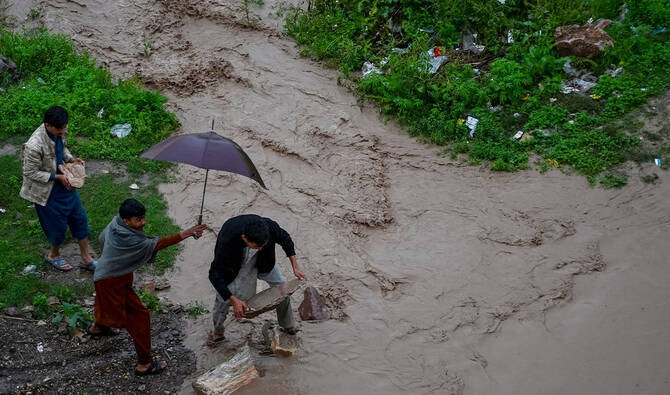
ISLAMABAD: At least ten people have been killed and more than 40 injured across Pakistan after a 72-hour spell of monsoon rains, severe thunderstorms and flash flooding swept through Khyber Pakhtunkhwa and Punjab provinces, leaving a trail of collapsed roofs, overturned vehicles and inundated valleys.
The wave of destruction, forecast by Pakistan’s Meteorological Office for the upper parts of the country between 11 and 13 June, proved deadly across a wide arc of territory — from the mountain districts of Shangla and Mansehra to the agricultural flatlands of Sargodha and Okara, where a bus overturned on a rain-slicked highway and an entire family was pulled from debris in the middle of the night.
In Khyber Pakhtunkhwa, the provincial death toll reached eight, with 33 people injured. The Provincial Disaster Management Authority reported seven fatalities on Saturday alone after roofs and walls gave way in Bannu, Shangla and Mansehra districts. The dead included four men, two children and a woman; the injured comprised seven men, 12 women and 14 children. By Sunday, a further two deaths had been confirmed: Mohammad Abid, 17, was electrocuted during a storm in the Battal area, and rescuers recovered the body of a girl swept away by flash floods in the Davli area.
“The rains, accompanied by thunderstorms and strong winds, caused widespread damage in Siren Valley, where a boy was electrocuted and a girl was swept away by flash floods,” said Ibrar Ali, district emergency officer for Rescue 1122, describing the conditions his teams faced on Saturday evening. Emergency crews worked through the weekend clearing landslide-blocked roads in the Siren Valley, Garhi Habibullah, Balakot and the Kaghan Valley.
Though the swollen Siren and Kunhar rivers had begun receding by Sunday, Ali issued a public warning to tourists drawn to the scenic northern valleys. “Visitors coming to enjoy the pleasant weather and picturesque valleys should exercise caution while travelling and avoid going near rivers and streams, as water levels can rise suddenly due to sporadic rainfall in upstream areas,” he said.
In Punjab, the storms claimed two more lives. On Saturday night in Haveli Lakkha, a roof caved in during a thunderstorm, burying a family under rubble. Neighbours hauled the victims free, but a woman, Shamim Bibi, died from her injuries; two children who were taken to a rural health centre later succumbed, with one confirmed dead. On the Okara-Dipalpur road, a bus overturned while overtaking another vehicle in wet conditions, injuring seven passengers who were transferred to the DHQ South City Hospital.
Further structural failures left nine people injured in Sargodha. A 21-year-old man suffered serious injuries when an iron roof collapsed in the Faisal Town area. In Bhalwal’s Chak 9, an eight-member family — a husband, his wife and six children aged between one and 12 — were trapped under debris after their roof suddenly gave way. Rescue 1122 provided emergency medical assistance before evacuating all of them to local hospitals.
The storms arrive at a moment when Pakistan’s vulnerability to extreme weather has rarely seemed more acute. Parts of the country have seen temperatures exceed 35°C in recent weeks, with intense heat accelerating glacial snowmelt and raising the risk of glacial lake outburst floods — events capable of unleashing catastrophic torrents with little warning. Last year, at least 1,000 people were killed when intense monsoon rains, compounded by excess water released from Indian dams, triggered flash floods across the country.
Against that backdrop, Pakistan’s climate ministry on Sunday announced it had secured Rs2.4 billion — roughly $8.6 million — under the Public Sector Development Programme for fiscal year 2026-27 to strengthen the country’s resilience against floods, droughts and other climate-induced disasters. The funding, which comes into effect on 1 July, will finance four projects covering ecological restoration, green skills training for young people, urban flood resilience and institutional capacity-building.
The bulk of the allocation — Rs2.3 billion — has been assigned to the Up-scaling of Green Pakistan Programme, aimed at expanding forest cover, conserving biodiversity and restoring degraded ecosystems. A further Rs51.6 million has been directed towards training young people in skills suited to a low-carbon economy, Rs50 million earmarked for developing national guidelines to reduce urban flooding, and Rs40.6 million set aside to strengthen the ministry’s technical expertise in areas including climate finance, marine biodiversity and hazardous waste management.
“These investments are aimed at protecting people, restoring ecosystems and ensuring that the country is better prepared to confront emerging threats posed by glacial retreat, glacial lake outburst floods, water stress, heat extremes, forest fires and environmental degradation,” said Saleem Sheikh, a spokesperson for the ministry.
The announcement, however, is likely to do little to quiet Pakistan’s longstanding frustration at the mismatch between its contribution to the climate crisis and the suffering it endures as a result. The country accounts for roughly one per cent of global greenhouse gas emissions yet has experienced some of the most severe climate-related disasters of any nation — a recurring injustice that Pakistani officials have raised repeatedly at international negotiations, where they have urged wealthier countries to provide stronger financial support through loss and damage mechanisms.
Copyright © 2021 Independent Pakistan | All rights reserved