By Staff Reporter
LAHORE: The Pakistan Cricket Board unveiled a sweeping overhaul of its central contract system on Monday, restructuring the financial framework that governs the country’s professional cricketers into five distinct categories while granting dedicated Test specialists the rare freedom to play first-class cricket abroad — a concession that represents, in the board’s own framing, a deliberate wager on the long-term health of the longest format.
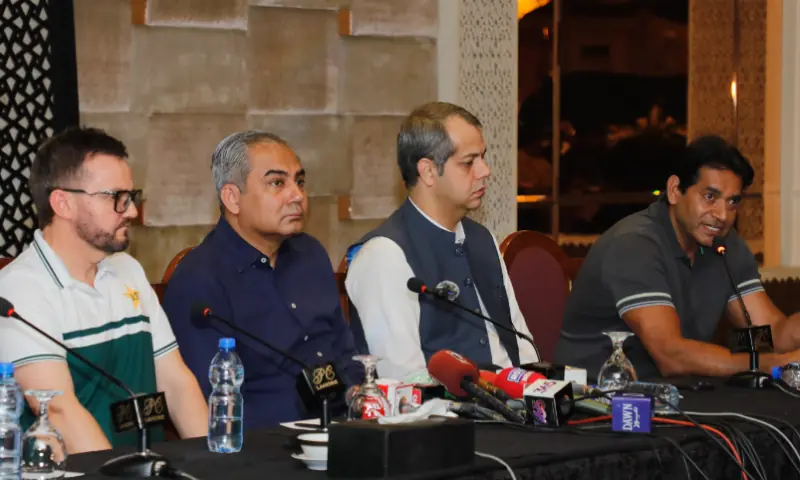
The announcements came at a press conference in Lahore, where PCB chairman Mohsin Naqvi appeared alongside High Performance Centre director Aaqib Javed, white-ball head coach Mike Hesson, chief medical officer Dr Javed Mughal and senior board officials. The new arrangements take effect from 1 July, when the next fiscal year begins.
What Naqvi did not announce was equally telling. Despite having hinted on Saturday that significant changes were imminent within the PCB’s administrative and cricketing structures, neither the national selection committee nor any member of the coaching staff was disturbed. Monday’s press conference was, in the end, a story about money, categories and methodology — not about personnel.
Earlier in the day, Naqvi had addressed all 49 players across Pakistan’s red- and white-ball squads, who are currently in Lahore for training camps, briefing them personally on the new system before it was made public.
A five-track architecture
The old contract structure, which divided players into four categories, has been replaced by a quintet of tracks designed to reflect what the board describes as distinct cricketing identities rather than a single, undifferentiated pool of national assets.
The highest tier — Track AB — covers players selected across both Test and one-day international cricket. The PCB was explicit that inclusion here carries a particular expectation: “The board does not regard an AB cricketer as a short-format player. That call is only made when selection options require it, never as a default.”
Track A is reserved exclusively for red-ball specialists — those committed to Test cricket who will now, for the first time, be permitted to take part in premier first-class competitions overseas, provided those competitions involve four-day red-ball cricket. The franchise T20 circuit remains firmly off limits for this group. “This is the opposite of sending players away to the shorter game,” the board’s statement read. “It is a deliberate investment in red-ball quality. A Test cricketer who spends time in the most demanding first-class environments returns sharper, tougher and better prepared for Pakistan.”
Track BC consolidates white-ball players across the 50-over and Twenty20 formats, absorbing what had previously been a separate ODI category. Track C creates, for the first time, a formally recognised tier for T20 franchise specialists — described as players with “the greatest freedom to pursue franchise cricket around their national commitments.” Track D serves as a development pathway, channelling investment in emerging talent through the National Cricket Academy and the wider high-performance system.
The PCB confirmed that each senior track will contain two internal tiers, enabling players to move up or down based purely on form and output, without being forced to change format. The Development Track will operate as a single tier. Crucially, the board will not publicly disclose how contracts are distributed within or between tracks, describing it as “a selection matter, reviewed each cycle and not a fixed public figure.”
The numbers behind selection
Among the more striking elements of the announcement was Naqvi’s disclosure that selection decisions will henceforth be weighted heavily towards data — 85 per cent analytics against a 15 per cent allowance for the selectors’ own judgment. Fitness assessments, medical evaluations and domestic cricket participation will form the quantitative backbone of the process.
Naqvi was unambiguous about what the new system was designed to eliminate. “Assessment is structured rather than impressionistic,” he said. “The process is documented and no single individual’s preference determines an outcome. Players are recognised for the commitment they make and the cricket they play, and the board can stand behind every decision it takes.”
The chairman acknowledged what most observers already know: that Pakistan’s record in bilateral series has improved of late, while performances at ICC and Asian Cricket Council events have consistently fallen below the standard expected of one of the game’s traditional powers. “Work is underway to improve results in those tournaments as well,” he said, in language that suggested a recognition of the problem without yet offering a remedy.
Voices from the dais
Aaqib Javed, the former Pakistan fast bowler who now serves as both director of the High Performance Centre and a national selector, argued that the restructured contracts would make Test cricket more financially attractive for players, partly through enhanced match fees. He was, however, notably cautious about what could realistically be promised. “No one can guarantee that the team will start winning within a specific timeframe or that it will not lose matches in the future,” he said — a frank admission that process, however refined, does not produce results on demand.
Hesson offered a more optimistic reading. The New Zealander, who oversees Pakistan’s white-ball programme, expressed confidence that the reforms would deliver the desired results over time, though he was similarly light on specifics.
Dr Mughal addressed a question about the public fitness tests that the PCB had previously held for players, saying it was not practical to conduct such assessments in front of the media — a remark that suggested at least one element of the board’s previous transparency exercises has quietly been dropped.
Pakistan have long wrestled with the structural tension between the demands of international cricket and the gravitational pull of the global T20 franchise economy, a tension that has grown sharper as the Indian Premier League, the Big Bash and a dozen competing leagues have drawn players — and agents — toward shorter formats and more lucrative short-term contracts. Monday’s announcement represents the PCB’s most explicit attempt yet to create a framework that acknowledges that reality while insisting on the primacy of Test cricket.
Copyright © 2021 Independent Pakistan | All rights reserved