By Staff Reporter
ISLAMABAD: It took the personal intervention of the prime minister, his deputy and the interior minister to prevent Pakistan’s fragile ruling coalition from fracturing publicly over the federal budget — and even then, the crisis was only partially contained.
Bilawal Bhutto-Zardari, chairman of the Pakistan Peoples Party and the government’s most consequential coalition partner, had made clear he was prepared to boycott the ongoing National Assembly budget session entirely. His party’s lawmakers were already on the floor, their participation increasingly performative — present in body, hostile in word, voting nothing.
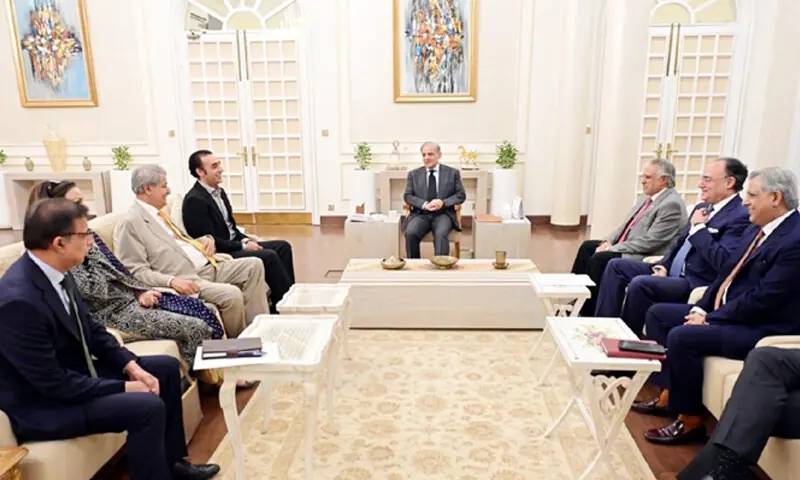
The threat became untenable once it appeared in print. According to sources familiar with the sequence of events, it was the publication of reports that Bhutto-Zardari intended to boycott proceedings that prompted Prime Minister Shehbaz Sharif to pick up the phone. An invitation to the PM House followed swiftly.
What unfolded over the course of that meeting on Wednesday was a careful piece of coalition management — Deputy Prime Minister and Foreign Minister Ishaq Dar and Interior Minister Mohsin Naqvi had already been deployed to coax the PPP leader into attending before any formal gathering was convened. By the time Bhutto-Zardari arrived at the Prime Minister’s residence, accompanied by Senator Sherry Rehman and National Assembly member Syed Naveed Qamar, the contours of an understanding were already being shaped.
The PPP’s grievances were, by all accounts, substantive. Senior party figures had informed Dar that the budget document formally tabled in the house differed in material respects from the version shared with the PPP during pre-budget consultations — a complaint the party had also raised publicly on Tuesday. More specifically, the PPP said it had agreed to support allocations tied to defence expenditure given the heightened security environment following recent regional tensions, but had not endorsed spending it regarded as politically motivated rather than nationally necessary.
A source close to the PPP chairman said the party leader remained unhappy even after agreeing to return to the chamber. “Chairman Bilawal will join the ongoing budget debate by delivering his speech on the floor of the house,” the source confirmed, adding that the address — expected Thursday — would not be a display of solidarity but an airing of grievances. “He will share his concerns and reservations in the budget speech,” the source said.
A separate source offered a more emollient reading, suggesting all outstanding issues had been resolved during the meeting. The discrepancy between the two accounts was itself telling.
The official readout from the Prime Minister’s Office was characteristically anodyne. It noted that Sharif and Bhutto-Zardari had discussed “matters of national importance, the federal budget, development projects and the prevailing regional situation.” Both leaders had agreed, the statement said, that “sustained collaboration between federal and provincial institutions was essential for the timely completion of projects of national importance.” Progress on federal development projects in Sindh — the PPP’s home province and political stronghold — was also reviewed, as were measures to strengthen federation-province ties.
Also present were Finance Minister Muhammad Aurangzeb, Federal Minister for Law and Justice Azam Nazeer Tarar, and Minister for Economic Affairs Ahad Cheema — the economic architecture of a government that cannot afford to lose PPP support on any significant vote.
Bhutto-Zardari used the occasion to thank the prime minister for his backing during the recent government formation process in Gilgit-Baltistan, and offered tribute to both Sharif and Field Marshal Syed Asim Munir for what he described as Pakistan’s diplomatic role in brokering a peace agreement between the United States and Iran, reportedly due to be signed on 19 June.
The broader picture remains one of managed tension. PPP lawmakers have continued to participate in budget debates while subjecting nearly every provision of the finance bill to criticism. The party has not ruled out supporting the government when votes are called, but neither has it offered the kind of unconditional backing that would allow the administration to pass the budget without further negotiation.
Copyright © 2021 Independent Pakistan | All rights reserved