By Staff Reporter
ISLAMABAD: Pakistan is preparing to raise more than $4.5 billion from international bond markets and foreign commercial banks in the coming fiscal year — a sharp and deliberate pivot away from the bilateral financing arrangements with Gulf states and China that have kept the country solvent for much of the past decade.
The scale of the shift, laid out in budget documents and confirmed by Finance Minister Muhammad Aurangzeb on Saturday as he wrapped up the federal budget debate in the National Assembly, is striking. The government plans to raise Rs580 billion ($2.08 billion) from international bond markets in 2026-27, a fivefold increase on the outgoing year’s target. A further Rs681.5 billion ($2.45 billion) is to be borrowed from foreign commercial banks. Together, that amounts to $4.53 billion in commercial borrowing — part of a broader strategy to secure Rs5.54 trillion ($19.9 billion) in total foreign financing, up 26 percent on the current year.
The timing is loaded with context. In April, the United Arab Emirates demanded repayment of its $3.45 billion bilateral loan, forcing Islamabad to arrange an emergency $3 billion deposit from Saudi Arabia to cover the gap. Now, in a budget that runs to Rs18,771 billion in total outlay, the government has made no provision for receipts from the Saudi Fund for Development’s oil facility, the Chinese SAFE deposit, or a Saudi time deposit — omissions the documents do not explain but which, taken together, signal that Islamabad is preparing to stand more independently in global capital markets.
“Our objective is to explore whether a portion of bilateral financing can be replaced with commercial borrowing,” Aurangzeb said. “We do not intend to increase the size of our external debt.”
Pakistan’s external debt already stands at $138 billion, up 1.2 percent from $136 billion a year ago. The government is due to repay Rs1.1 trillion ($3.9 billion) in foreign debt obligations in FY27 — 15 percent more than it paid back in the current year. The minister also confirmed the country is considering further issuances of Panda Bonds, Eurobonds, US dollar-denominated bonds, and what would be its first rupee-linked, dollar-settled instrument.
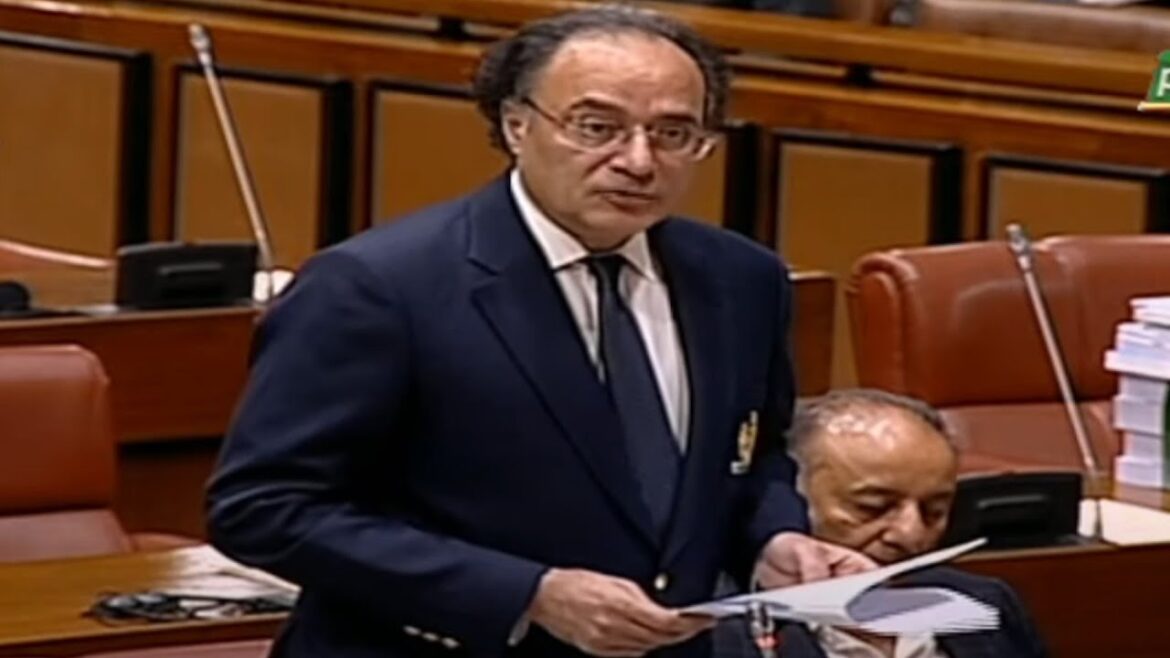
Inside the National Assembly, Aurangzeb moved to close the budget debate in characteristically bullish fashion, swatting away opposition accusations of inconsistencies in the budget documents with visible impatience. A privilege motion had been filed by two legislators, Khawaja Sheraz Mehmood and Azimuddin Zahid, contending that the figures simply did not add up — that GDP data and per capita income calculations were unreliable.
The minister was categorical in his rebuttal. “I want to clarify that no changes at all have been made to the methodology used for reporting the economic indicators,” he said, walking the assembly through the distinction between real GDP — calculated at constant FY2015-16 base-year prices, as PBS reported at 3.7 per cent growth — and nominal GDP, calculated at current market prices. Both methods, he noted, conform to international standards applied consistently across administrations. To prove the point, he offered to present FY18 indicators to the members who raised the concerns, demonstrating methodological continuity across governments.
The nominal picture, in any case, was considerably more impressive: Pakistan’s economy has grown from $408.2 billion to $452.1 billion in a single year — a figure that reflects both real activity and the inflationary expansion of the nominal base.
Aurangzeb’s broader economic pitch rested on a cluster of indicators he presented as evidence of genuine recovery. Large-scale manufacturing grew 6.6 percent in the current fiscal year — the highest rate in four years. The current account recorded a surplus through the first 11 months of FY26. Remittances hit a record $4.25 billion in May alone, putting the government on course for its full-year target of $41 billion. IT exports grew 20 per cent, and Pakistan’s young freelancers generated $1.6 billion in export earnings. On revenue, Aurangzeb offered what he clearly considered his most powerful statistic: it had taken 23 years, from 1988 to 2011, to generate an incremental $14 billion in revenues, and another 13 years to repeat the feat. His government, he claimed, had accomplished the same in two.
For FY27, the growth target has been set at 4 percent, with average inflation projected at 8.2 percent.
The budget’s internal architecture tells its own story about Pakistan’s constraints. Of the total Rs18,771 billion outlay, the single largest allocation — Rs8.054 trillion — goes to mark-up payments alone. Defence takes Rs3 trillion. The federal development programme receives a comparatively modest Rs1 trillion, a reminder of how heavily debt servicing has crowded out investment. That debt overhang, even as Aurangzeb spoke of recovery, shapes everything.
The minister devoted considerable time to what he described as a structural change in how Pakistan taxes its citizens. “We often hear and see that the documented corporate sector and salaried class have to bear most of the tax burden,” he said. “The government has changed this trend, and focused on deepening and broadening rather than burdening.” A new Fixed Asaan Tax Scheme is intended to pull parts of the informal economy into the net, while a revamped tax administration model aims to eliminate direct contact between taxpayers and tax officers in favour of automated audit and compliance processes. Whether such promises survive the mechanics of implementation — Pakistan’s Federal Board of Revenue has heard similar pledges before — remains to be seen.
On agriculture, the government made a genuine effort to sketch an ambitious rural agenda. The Zarkhez scheme provides interest-free, collateral-free loans to 750,000 small farmers, backed by Rs300 billion. A Rs15.8 billion fertiliser support package includes a Rs10 billion subsidy on urea. Duties on tractors, combined harvesters and other farm machinery have been scrapped, at a cost of Rs2 billion in foregone revenue. A Rs7.1 billion cold storage project, built with private sector partners, is intended to reduce post-harvest losses and capture more value in the agricultural supply chain. Rs9.5 billion has also been earmarked for the PM’s Youth Business and Agriculture Loan Scheme, expected to unlock more than Rs109 billion in loans. Pakistan is additionally expanding agricultural cooperation with China, training students and technical experts in Chinese farming practices.
The opposition spent much of Saturday debating the 140 recommendations forwarded by the Senate — a body that, under Pakistan’s constitution, can advise on but not vote down a money bill. The recommendations ranged widely in their ambition.
JUI-F’s Aliya Kamran called for the advance tax on telecom services to be cut from 15 per cent to 8, arguing it would broaden digital access across education, business and employment. She also pushed for GST reductions on food, medicines, educational materials and agricultural inputs, and called for Balochistan to receive special consideration in development allocations — a long-standing grievance that surfaces reliably in every budget cycle.
PTI’s Gohar Ali Khan pressed for a permanent, properly funded disaster management system, pointing to the floods of recent years as evidence of a response architecture built almost entirely on improvisation. His party colleague Asad Qaiser drew a careful distinction between the tobacco crop, which he argued should be treated as agricultural produce, and finished tobacco products, where higher taxes were appropriate. A third PTI voice, Amir Dogar, took aim at the Pakistan Telecommunication (Re-organisation) Amendment Bill 2026, calling it “draconian” — though it was duly noted that PTI members had raised no objection when the same legislation cleared the National Assembly on 11 June.
Aurangzeb closed with a remark that seemed to belong to a different register. He invoked Pakistan’s role as mediator between the United States and Iran — the peace memorandum signed this week — calling it a “golden chapter” in Pakistan’s diplomatic history, and noted that the first tangible benefit had already arrived: a Rs74 per litre reduction in the petrol price and a Rs67 cut in diesel, a welcome dividend for an economy where fuel costs permeate almost everything.
The Finance Bill 2026, incorporating some of the standing committee recommendations, will now proceed through parliament. Whether the broader economic narrative Aurangzeb has constructed — of a country moving purposefully from crisis to credibility — survives the year ahead is a question Pakistan’s creditors, and its 240 million citizens, will be watching with interest.
Copyright © 2021 Independent Pakistan | All rights reserved