By Staff Reporter
ISLAMABAD: Four of the Muslim world’s most significant powers have publicly committed themselves to the fragile diplomatic enterprise seeking a permanent end to the US-Iran conflict, urging a “swift and successful” conclusion to technical negotiations even as delegations from Washington and Tehran gathered on the shores of Lake Lucerne on Sunday for the most substantive talks since an interim agreement was reached earlier this week.
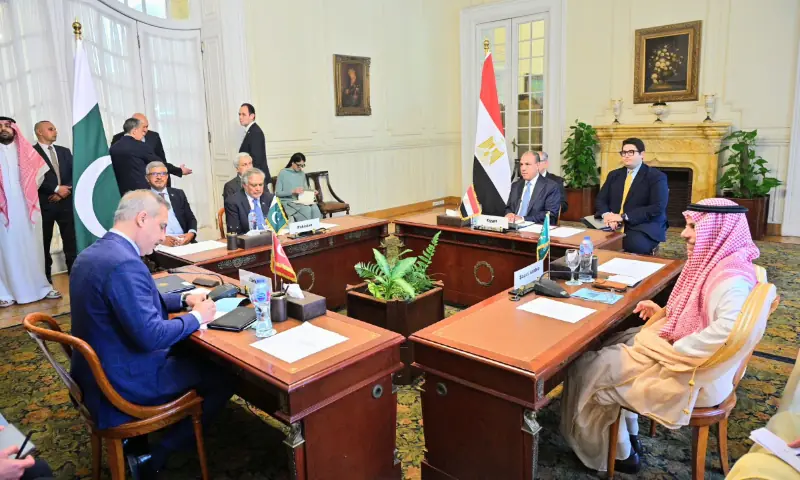
Saudi Arabia, Pakistan, Egypt and Turkey convened in Cairo through the Regional Four framework — a platform established in March expressly to co-ordinate their positions on regional crises — as Pakistan and Qatar, serving as co-mediators, hosted the opening session of what Qatar formally described as the Lake Lucerne Summit. The convergence of diplomatic activity across two continents on the same day captured both the momentum behind the process and the fragility that surrounds it.
The talks in Switzerland represent the first serious attempt to translate the Islamabad Memorandum of Understanding, signed earlier this week between the United States and Iran, into a permanent settlement. That accord starts a 60-day negotiating clock aimed at resolving the outstanding question of Iran’s nuclear programme. In a major concession from Washington, Iran is immediately permitted to sell its oil freely under its terms. The deal also affirms a commitment to Lebanon’s territorial integrity — a direct acknowledgement of Israel’s ongoing military campaign against Hezbollah — and envisages an end to hostilities on all fronts.
Qatar’s foreign ministry confirmed the opening of the summit and the “first meeting of the high-level committee with the participation of representatives from the United States of America, the Islamic Republic of Iran, and the two mediating states, the State of Qatar and the Islamic Republic of Pakistan.” It expressed hope that the proceedings would “lead to a comprehensive and lasting agreement addressing all aspects covered by the Memorandum of Understanding.”
The backdrop, however, remains deeply unsettled. On the eve of the Lucerne talks, Tehran announced it had again closed the Strait of Hormuz — through which roughly a fifth of the world’s traded oil passes — citing Israel’s continuing military campaign in Lebanon. The reclosure, even as diplomatic engagement intensifies, illustrates the extent to which confidence between the parties is still provisional, and how much the final deal will need to address before either side is willing to stand it down.
The conflict, which erupted in late February following US and Israeli strikes on Iran, drew Tehran into retaliatory attacks on Israel, American interests and Gulf infrastructure, and prompted Iran’s initial closure of the strait — triggering the disruption to energy markets, international maritime routes and global supply chains that the R-4 nations described on Sunday as one of the defining risks of the crisis.
In Cairo, Pakistan’s Deputy Prime Minister and Foreign Minister Ishaq Dar joined his Saudi, Egyptian and Turkish counterparts for what was the fourth ministerial gathering of the R-4 grouping, meeting at Egypt’s invitation. The group welcomed the Islamabad accord as a “constructive step towards de-escalation,” in the words of the joint statement released by Pakistan’s Foreign Office, and pressed for negotiations to account for “the concerns of countries of the region, particularly with regard to the security and stability of the Gulf Arab States, as well as the Levant region.”
The ministers praised Pakistan’s mediation role directly. Their statement said they “lauded the instrumental efforts of Pakistan in reaching this historic outcome, along with the support extended by Qatar to bring about a successful conclusion to the negotiations on the MoU.” They described the R-4 itself as an “important platform for structured dialogue, strategic consultation, and policy co-ordination” — language that suggests the grouping intends to remain a permanent feature of the regional landscape rather than a temporary response to a single crisis.
On the sidelines of the Cairo meeting, Dar was received by Egyptian President Abdel Fattah El-Sisi alongside the foreign ministers of Saudi Arabia, Turkey and Egypt. El-Sisi praised Pakistan’s “constructive and responsible” role in promoting dialogue and de-escalation, and expressed hope that the next phase of negotiations would contribute to “lasting peace, security, and prosperity across the wider region.” Dar, for his part, conveyed greetings from Pakistan’s president, prime minister and army chief, and welcomed the Egyptian president’s acceptance of an invitation to visit Islamabad, with both sides expressing a desire for high-level exchanges at the earliest opportunity.
No gathering of regional foreign ministers in the current climate passes without the Palestinian question asserting itself at the centre, and Sunday’s Cairo meeting was no exception. The four nations issued a pointed reaffirmation of Palestinian statehood as the necessary foundation for any lasting regional order, stating that “the Palestinian cause remains at the heart of efforts to achieve a just, comprehensive, and lasting peace in the region.”
They called for the establishment of an independent Palestinian state on the lines of 4 June 1967, with East Jerusalem as its capital, in accordance with relevant UN Security Council resolutions — a formulation that aligns them with longstanding international consensus but places them at direct odds with the current direction of Israeli policy.
The declaration came a day after Israeli strikes in Gaza killed at least six people, among them two children and a cameraman working for broadcaster Al Jazeera, according to Palestinian health officials. The strikes are the latest in a near-daily pattern of attacks that has continued despite an October ceasefire between Israel and Hamas, under which more than 1,000 Palestinians have since been killed, according to Gaza’s Health Ministry. Since Israel’s military offensive began in the aftermath of the Hamas attacks of October 2023, the total Palestinian death toll has reached 73,018. The scale of that figure lends particular weight to the R-4’s insistence that no regional architecture built around a US-Iran deal can come at the cost of Palestinian rights.
Copyright © 2021 Independent Pakistan | All rights reserved