By Staff Reporter
ISLAMABAD: The United States and Iran agreed on Monday on a 60-day roadmap toward a permanent peace settlement after marathon overnight negotiations at a Swiss mountain resort, with Vice President JD Vance hailing a “good foundation” even as inflammatory statements from President Donald Trump thousands of miles away briefly caused Iran’s delegation to refuse to re-enter the negotiating room.
The first round of direct high-level talks between Washington and Tehran, held at the Qatari-owned Burgenstock complex above Lake Lucerne and mediated by Pakistan and Qatar, stretched from Sunday into the early hours of Monday before yielding a clutch of concrete agreements: a deconfliction mechanism to manage the continuing conflict between Israel and Iran-backed Hezbollah in Lebanon, a communications channel intended to ensure safe commercial passage through the Strait of Hormuz, and a commitment by Iran to readmit United Nations nuclear inspectors.
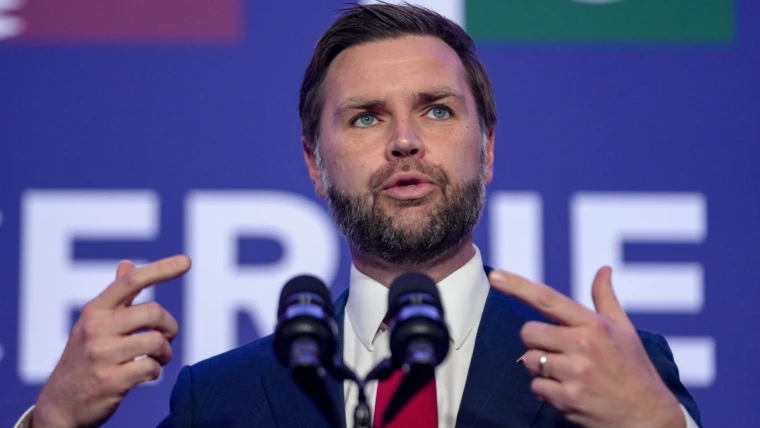
“We laid a very good foundation for a successful final deal,” Vance told reporters at the resort. “The final deal is the house. We set the foundation; we haven’t built the house, but we’ve laid a successful foundation to get to a good place for the American people.”
Flanked by presidential son-in-law Jared Kushner and envoy Steve Witkoff, the vice president framed the talks in expansive terms. “Can we turn over a new leaf?” he asked. “Can we change relations in the Middle East permanently?”
But he was candid about the distance still to travel. “It’s important for all of us to appreciate how much was done, but honestly, there is still a lot to do as we continue to make progress on the nuclear talks, on the economic talks, as we continue to demine the straits and ensure that that flow of traffic continues to pick back up,” he said.
Mediators Pakistan and Qatar issued a joint statement declaring “encouraging progress” and announcing that technical negotiations would continue at the Burgenstock resort through the week. Iran’s senior delegation, led by parliamentary speaker Mohammad Baqer Qalibaf, departed for Tehran. A technical team headed by Deputy Foreign Minister Kazem Gharibabadi — including political, economic and legal experts — remained in Switzerland to begin translating the night’s agreements into operational arrangements.
The Swiss government said the roadmap agreed overnight “creates the conditions for the immediate resumption of new technical discussions,” adding that Bern “remains ready to support this process, in line with its tradition of good offices.”
TRUMP’S SHADOW
The talks were convened to advance the preliminary memorandum of understanding signed last week, the first formal agreement after nearly 40 days of war and weeks of an inconclusive and frequently breached ceasefire. They were disrupted throughout by Trump, who did not attend the summit but intervened repeatedly from afar.
Before talks officially opened, Fox News quoted Trump warning Iranian officials that “you won’t have a country” if they attempted to close the Strait of Hormuz again. He also threatened to take over the waterway and charge vessels a toll of his own. As negotiators worked through the night, he posted on social media: “Iran must immediately stop their highly paid PROXIES in Lebanon from causing trouble. If they don’t, we’ll hit Iran very hard again, just like we did last week, only harder!!!”
Iran’s semi-official Tasnim news agency, citing an informed source, reported that after Trump’s comments became public, Tehran’s delegation “refused to return to the room where talks were held, though messages were traded via the mediators.” Iranian state media said the talks had paused following publication of what it called an “insulting message” from the US president.
Ultimately, Iran stayed. The Iranians remained on site and negotiations continued, a senior US diplomat told reporters on condition of anonymity, not being authorised to comment publicly. “These things are always a little bit messy,” Vance said of the turbulent session.
Tehran, according to Tasnim’s source, made clear that progress on nuclear matters was conditional on Washington first delivering other MOU commitments — the release of frozen assets and authorisation for Iranian oil exports. Iran’s Foreign Ministry spokesman Esmaeil Baqaei confirmed on Monday that “a very brief discussion took place regarding the nuclear issue, but there was no discussion of details,” and that formal nuclear talks had not begun.
HORMUZ AND RELIEF FOR IRAN
The Strait of Hormuz, through which a fifth of the world’s oil and gas flows in peacetime, has become one of the most charged flashpoints of the conflict. Iran closed the strait at the outset of hostilities, sending energy prices sharply higher. On Saturday it again halted maritime traffic, citing continued fighting in Lebanon, though US Central Command disputed the claim. Ship-tracking data from analytics firm Kpler showed only five vessels transiting the waterway on Sunday, down from 26 the day before.
Vance insisted on Monday that the strait “is open,” with “millions and millions of barrels of crude and natural gas flowing through… that weren’t flowing before.” Oil prices fell further after the joint mediators’ statement, with global benchmark Brent crude dropping below $80 a barrel as fears of a sustained supply shock receded.
On the economic front, Vance said Kushner — working alongside Qatari officials — had proposed channelling some unfrozen Iranian assets into purchases of American agricultural goods, specifically soy, corn and wheat, for the Iranian people. Qatar would have oversight of the process, he said.
Iran’s Foreign Minister Abbas Araghchi, posting on social media after the talks, appeared to confirm the broader outlines of the package Tehran had secured: waivers for oil and petrochemical exports, the lifting of a port blockade, the release of some frozen assets and what he described as a “major reconstruction and development plan” for Iran. “Tireless Pakistani and Qatari mediation has delivered major progress to end Lebanon War,” he wrote.
NUCLEAR QUESTION DEFERRED
The thorniest issue on the agenda — the future of Iran’s nuclear programme, including its enriched uranium stockpile and its asserted right to continue enrichment — was barely touched. Baqaei’s confirmation that formal nuclear talks had not begun underlined how far the two sides remain from addressing what has dogged their relationship for decades.
Iranian President Masoud Pezeshkian had vowed before the talks that Tehran would “never back down from the right to enrich uranium.”
Vance, however, pointed to one nuclear-adjacent achievement: Iran’s agreement to invite International Atomic Energy Agency inspectors “back to their country,” which he called “a major milestone and the first step in permanently denuclearising” Iran. Tehran had suspended some cooperation with the IAEA and barred inspectors from key nuclear sites struck by the United States and Israel in the 12-day war of 2025.
The interim deal signed last week opens a 60-day window to resolve the nuclear issue and other entrenched disputes, including the ultimate disposition of frozen Iranian assets.
LEBANON CALMS
On the ground in Lebanon, fighting between Israel and Hezbollah abated on Monday in what Lebanese security officials described as the longest lull since Hezbollah entered the conflict in support of Iran on March 2. There were no Israeli airstrikes reported overnight after a quiet Sunday, and Hezbollah had not announced any attacks on Israeli forces since Saturday evening.
Israel’s military lifted movement restrictions in eight communities near the Lebanese border from 0600 local time (0300 GMT) on Monday, a gesture reflecting reduced tensions. The overall death toll in Lebanon has exceeded 4,100, the country’s health ministry said.
Vance said “very good progress” had been made on a deconfliction mechanism — a direct communications channel among Israel, Hezbollah and Lebanese authorities designed to prevent incidents from escalating. He described it as a new arrangement, though a similar body was established under the Biden administration as part of the November 2024 ceasefire it brokered in Lebanon, and that panel remains in place.
Israeli President Isaac Herzog said Israel was not opposed to a diplomatic resolution but insisted any agreement must guarantee Tehran could not direct funds received under a deal toward military purposes or the arming of regional proxies. Israeli military chief Lieutenant General Eyal Zamir, visiting troops in southern Lebanon on Sunday, said Hezbollah was in a “very difficult position” and that Israel was ready to prevent any attempt to rebuild its forces.
Araghchi flagged Lebanon as the first test of the talks’ durability. “1st real test: Lebanon deconfliction cell,” he wrote, suggesting Tehran would judge the credibility of the entire process by whether the mechanism succeeded in halting the fighting.
Neither Israel nor Hezbollah is a party to the US-Iran memorandum of understanding.
Lebanese President Joseph Aoun discussed ceasefire efforts in a phone call with Vance, Qatar’s prime minister and Kushner, the Lebanese presidency said.
MEDIATORS TAKE A BOW
Pakistan’s Prime Minister Shehbaz Sharif, whose government invested considerable diplomatic capital in brokering the talks alongside Qatar, declared on Monday a “successful conclusion” to the first high-level meeting. “The discussions were held in a positive and constructive atmosphere and yielded encouraging progress,” he wrote on social media, citing agreement on a roadmap, the establishment of a high-level oversight committee and the launch of technical talks. “Pakistan will continue to play its honest and sincere role in advancing dialogue and diplomacy towards a peaceful and lasting resolution,” he said.
Vance said he would return to Washington after speaking to reporters. Kushner and Witkoff were expected to remain engaged with the technical process in the days ahead.
Copyright © 2021 Independent Pakistan | All rights reserved