By Staff Reporter
ISLAMABAD: The United States and Iran agreed on Monday on a 60-day roadmap toward a final deal, concluding an overnight session of high-level talks in Switzerland that survived an Iranian walkout, duelling public threats from Washington and Tehran, and a deepening crisis in Lebanon that placed the entire diplomatic effort under immediate strain.
The agreement, reached under last week’s Islamabad Memorandum of Understanding, establishes a High Level Committee to oversee the negotiations, with working groups on nuclear constraints, sanctions relief, and compliance monitoring. The parties also created a de-confliction cell among the United States, Iran, and Lebanon to enforce what has been an elusive ceasefire there, and opened a direct communications line to protect commercial shipping through the Strait of Hormuz.
“The first session of high level talks under the framework of the Islamabad Memorandum of Understanding have concluded in Burgenstock, Switzerland, with the participation of representatives from the Islamic Republic of Iran, the United States of America, and the two mediating parties, the State of Qatar and the Islamic Republic of Pakistan,” Qatar and Pakistan, the mediating parties, said in a joint statement released by the Qatari foreign ministry.
“The Lake Lucerne Summit was conducted in a positive and constructive atmosphere. Encouraging progress has been made, including the creation of a mechanism for further technical talks.”
“Chief negotiator will report regularly to the High Level Committee and lead working groups focused on nuclear, sanctions, and a monitoring and dispute resolution group to ensure the effective implementation of the MoU, and on other matters.”
The statement said the High Level Committee “has agreed upon a roadmap towards reaching a final deal within 60 days, laying the foundation for the immediate commencement of further technical talks.”
It also noted the creation of a communication channel between the parties. “In addition, a communication line between the parties has been formed for the period mentioned in paragraph 5 of the MoU to avoid incidents and miscommunication with the aim of safe passage for commercial vessels through the Strait of Hormuz.”
A separate mechanism was established for Lebanon. “Moreover, the parties agreed on the creation of a de-confliction cell, between the parties, the Lebanese Republic and facilitated by the Mediators, to ensure the adherence of the termination of military operations in Lebanon as per the MoU,” the statement said. “The mediating parties will continue to do their utmost to ensure that the negotiations continue to be conducted in a constructive atmosphere with the aim of reaching a final deal.”
Technical talks are to continue through the week at Bürgenstock, a Qatari-owned resort complex on a ridge above Lake Lucerne.
The agreement came despite a night in which the talks appeared at several points to be unraveling. Iran’s Islamic Revolutionary Guard Corps declared Saturday that it was again closing the Strait of Hormuz, citing Israel’s continued military strikes in Lebanon as a violation of last week’s ceasefire terms. The effect on shipping was immediate: analytics firm Kpler counted five vessels transiting the strait Sunday against 26 the previous day.
Iran’s delegation briefly abandoned the negotiating room on Sunday after President Trump posted on Truth Social threatening to strike Iran “very hard again, just like we did last week, only harder!!!,” according to Iran’s semi-official Tasnim news agency. Further communication was routed through Qatari and Pakistani mediators. Trump also told Fox News he had warned Iranian officials they “won’t have a country” if they tried to close the strait again.
Iran’s chief negotiator, Mohammad Bagher Ghalibaf, responded on X. “Don’t they think that if their threats had any effect, they wouldn’t be in this desperate situation today?” he wrote. “No matter how much they talk, it is we who take action.”
A senior American diplomat disputed that Iran’s delegation had walked out. “The Iranians never left and are still here meeting and negotiating deep into the night,” he said. “We’ve talked about the Strait, Lebanon, nuclear issues, and details of implementing the MOU.”
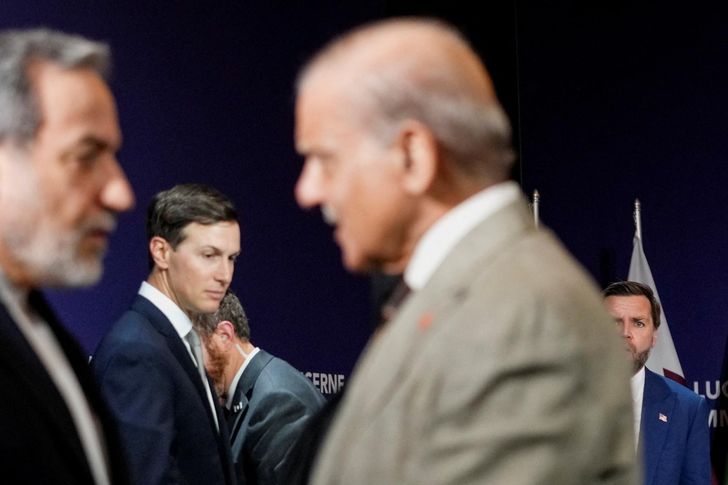
Vice President JD Vance led the American delegation alongside Jared Kushner and special envoy Steve Witkoff. He had arrived on Sunday after delaying his departure from Washington by several days for logistical reasons. Before the talks formally began, he told reporters that the reopening of the strait and the halting of Iran’s nuclear program had already been “accomplished” under last week’s agreement. “The question before us is now how much more can we accomplish together,” he said.
He also said Trump had “asked us to turn over a new leaf to transform our relationship with the people of Iran” — a statement made as the president was simultaneously threatening new strikes on Tehran.
Iranian Foreign Minister Abbas Araqchi, who accompanied Ghalibaf, said on X after talks concluded that Iran had secured waivers for oil and petrochemical exports, the release of some frozen assets, the lifting of a blockade on Iranian ports, and the start of a reconstruction plan. He described the Lebanon de-confliction mechanism as “the first real test” of the agreement.
That test has not yet been passed. The ceasefire in Lebanon, declared by Washington on Friday, has failed to take hold. The Lebanese Ministry of Health reported Sunday that Israeli attacks have killed 4,106 people and wounded 12,153 since Israel launched its campaign against the Iranian-backed Hezbollah movement on March 2. More than one million Lebanese have fled their homes.
Israeli Prime Minister Benjamin Netanyahu said Sunday that Israel would remain in southern Lebanon indefinitely. “We established a security zone in Lebanon, and we shall keep it as long as is necessary to protect our people,” he told reporters in Jerusalem. His military chief, Lt. Gen. Eyal Zamir, visiting troops in the south, said they needed to “be prepared with high readiness to renew combat activity.”
Hezbollah attacks have killed at least six Israeli soldiers and wounded 20 others over the past several days. Hezbollah leader Naim Qassem rejected any Israeli military presence in the south.
Iran has said it will not reopen the strait or engage substantively on nuclear matters until Israel withdraws from Lebanon and ends its strikes. An adviser to Supreme Leader Ayatollah Mojtaba Khamenei warned that unless the deal’s terms were honored, “the flow of energy through the region would remain halted.”
The US military disputed that the strait was closed, saying it “remains open” and that “Iran does not control” it. Brent crude futures rose more than a dollar to $81.66 a barrel in early Monday trading regardless.
The war began Feb. 28 with coordinated US and Israeli strikes on Iran. Oil prices had fallen sharply since last week’s memorandum on expectations the strait would reopen. Trump has said he agreed to the deal specifically to avert a global economic collapse from high energy prices.
Also present at Bürgenstock were Pakistani Prime Minister Shehbaz Sharif, his country’s army chief, and Qatari Prime Minister Sheikh Mohammed bin Abdulrahman Al Thani. Pakistan hosted an earlier round of US-Iran negotiations and has mediated throughout the conflict. Sharif said he hoped talks would produce “a wonderful paper in our hands that will promote peace, progress and prosperity around the globe.”
Copyright © 2021 Independent Pakistan | All rights reserved