By Staff Reporter
MUZAFFARABAD: Traders and transport operators in Azad Jammu and Kashmir’s Muzaffarabad division announced on Saturday they would end weeks of commercial paralysis from Sunday, formally distancing themselves from the proscribed agitation body whose expanding political demands they said had overstepped the concerns of ordinary business.
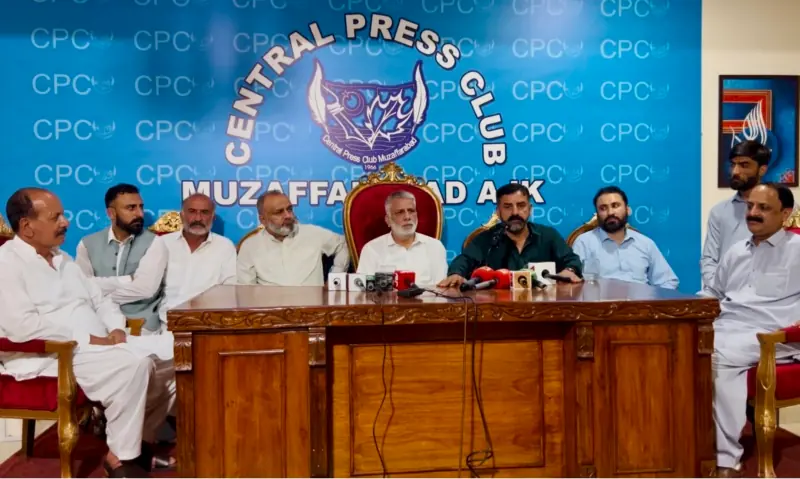
The announcement, made at a joint press conference at the Central Press Club, marked the first significant fracture in the shutdown that has gripped parts of the Azad Kashmir since the Joint Awami Action Committee (JAAC) escalated its campaign in early June. Shop fronts in several Muzaffarabad neighbourhoods began reopening on Saturday afternoon as word spread, though trade remained sparse.
Representatives of the Markazi Anjuman-i-Tajiran Muzaffarabad, the Madina Market Traders Association and the Divisional Transport Operators Union said they had acted after the regional administration assured them of security guarantees and uninterrupted supplies of diesel and petrol — the shortages of which they said had made it impossible for bus and truck operators to safely put vehicles on the road in any case.
“Now that the administration has assured us of fuel supplies and security, public transport across Muzaffarabad division will resume from Sunday,” said Khawaja Azam Rasool, president of the transport union, who also serves as administrator of Muzaffarabad Municipal Corporation. He said transport had halted not out of solidarity with any strike, but because road blockades had left valuable vehicles exposed to damage.
The JAAC, a civil society coalition that emerged from years of grievances over electricity tariffs and subsidised flour in the impoverished territory, was declared a proscribed organisation by the AJK regional government on June 5 under the First Schedule of the region’s anti-terrorism act. Authorities launched a crackdown the following day, arresting scores of its leaders, and later placed 147 of its activists on the Fourth Schedule of the same legislation. A series of sit-ins had brought sections of the region to a standstill earlier this month.
The traders and transporters, who had backed the JAAC for nearly three years while it pursued economic relief, said the movement lost their support after June 9, when it broadened its charter to include demands for the abolition of 12 seats in AJK’s Legislative Assembly reserved for refugees from Indian-occupied Jammu and Kashmir who settled in mainland Pakistan after 1947.
That demand carries particular political weight ahead of elections scheduled in AJK on July 27.
“The issue of the 12 reserved seats is a constitutional matter that can only be resolved by the elected assembly. It is not for traders to decide,” said Raja Abrar Mustafa, president of the Madina Market Traders Association. “We stood with them as long as they remained on the right course. But after the organisation was proscribed and matters began moving in another direction, we collectively decided that we would neither remain part of it nor continue supporting it.”
Gohar Kashmiri, senior vice chairman of the Markazi Anjuman-i-Tajiran Muzaffarabad, said traders had delivered concrete results for ordinary citizens during the movement’s economic phase — securing reduced electricity tariffs and subsidised flour — but had not been consulted when the campaign pivoted. “Negotiations require flexibility from both sides if disputes are to be resolved,” he said, adding that challenging the authority of the state was unacceptable regardless of the underlying cause.
Parliamentary Affairs Minister Tariq Fazal Chaudhry has said the government fulfilled 35 of the 38 demands agreed with the JAAC in an accord reached last October.
Rasool, who said he had personally served on the JAAC’s core committee, echoed the sentiment that constitutional disputes over legislative seat allocations had no bearing on the interests of the transport and trading communities, whose concerns centred on taxation, municipal services and the practical conditions of doing business.
He urged participants at the ongoing sit-in in Rawalakot, in Poonch division, to disassociate from what he characterised as a faction that had hijacked the broader movement.
Pressure was also building from residents in Poonch, where more than 100 people demonstrated in the town of Hajira on Saturday, demanding that JAAC activists remove barricades from the two main roads linking the town with Rawalakot and Abbaspur. Demonstrators warned they would clear the blockades themselves on Sunday if they were not lifted, and would reopen local businesses regardless.
The press conference in Muzaffarabad was also attended by office-bearers of the Barbers and Beauticians Association and the Poultry Dealers Association, among others. All called for internet services — severed during the unrest — to be restored to allow commercial activity to resume fully.
Copyright © 2021 Independent Pakistan | All rights reserved