By Staff Reporter
ISLAMABAD: Iran and the United States have agreed to halt military strikes against each other and will meet in Qatar on Tuesday for direct negotiations over control of the Strait of Hormuz, US media reported on Sunday, offering a fragile opening after one of the most dangerous weekends of a conflict that has shaken global energy markets and rattled shipping throughout the Gulf.
The reports from Axios and CNN came hours after an intense exchange of fire in which the United States bombed Iranian military installations and Iran retaliated with missile and drone strikes on US bases in Kuwait and Bahrain — attacks that both Gulf states condemned and that prompted Bahrain to seek an emergency United Nations Security Council session.
“We decided to stop all the kinetic activity,” a senior US official told Axios, using military parlance for strikes. A second official said both sides would stand down “for now” and that vessels could move freely pending further discussions. A third source familiar with the matter confirmed the two sides would convene in Doha on Tuesday. The White House did not comment.
The ceasefire agreement, if it holds, would be the latest attempt to rescue a 14-point memorandum of understanding brokered by Pakistan and signed on June 18 that was meant to end a war launched by the United States and Israel against Iran on February 28, reopen the Strait of Hormuz and buy time for nuclear talks. The accord started a 60-day negotiating clock.
But the peace effort has been under severe strain from the outset. Despite the memorandum, which committed Tehran to allowing free passage of commercial vessels and Washington to lifting its blockade of Iranian ports, both sides have continued to trade accusations and fire.
Strikes, counterstrikes and an ultimatum from Trump
The latest cycle of violence was triggered on Thursday when an Iranian strike on a cargo vessel in the Strait of Hormuz prompted the US Central Command to hit Iranian military targets on Friday. On Saturday, a Panama-flagged tanker, the Kiku, was struck by an Iranian drone, drawing another round of US air strikes on Iranian surveillance infrastructure, communications systems, air defence positions, drone storage sites and mine-laying facilities. Explosions were reported in the southern Iranian port area of Sirik.
“Iran was given a chance to honor the ceasefire agreement but elected not to,” US Central Command said in a statement.
Hours later, Iran’s Islamic Revolutionary Guard Corps said its naval and air forces had launched a joint missile and drone operation against US military installations in Kuwait and Bahrain.
Kuwait’s army said its air defences had intercepted two ballistic missiles without casualties. In Bahrain, air raid sirens sounded twice; authorities reported that an Iranian strike damaged a residential building in Muharraq province with no casualties. Bahrain called the attacks a “dangerous escalation” and urged the UN Security Council to convene urgently.
A US official confirmed that Iranian munitions had targeted American facilities but said there were no reported US casualties or significant damage, adding that the situation remained fluid. Qatar separately said one of its nationals was killed and another wounded after a vessel was struck by shrapnel during military operations on Saturday, without specifying who was responsible.
The exchanges came shortly after President Donald Trump issued a stark warning on his Truth Social platform. “There may come a point when we are no longer able to be reasonable, and will be forced to militarily complete the job that we very successfully started,” Trump wrote. “If that happens, the Islamic Republic of Iran will no longer exist!”
Iran’s Revolutionary Guards responded in kind, warning that American bases in the region “will experience hell in the coming days” and saying the US strikes would “result in the complete halt of all diplomatic processes.”
Disagreement over the Strait
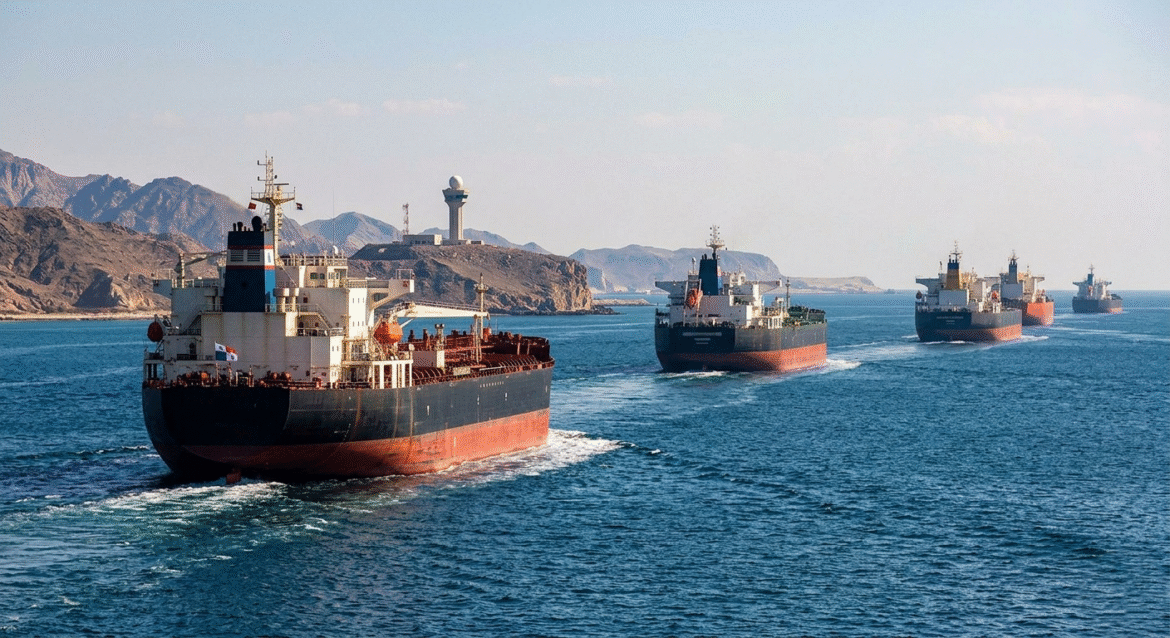
At the centre of the dispute is a fundamental disagreement over who controls passage through the Strait of Hormuz, the narrow chokepoint between the Persian Gulf and the Gulf of Oman through which, under normal conditions, roughly one-fifth of the world’s oil and liquefied natural gas passes.
Under the June 18 memorandum, Iran agreed to allow “safe passage of commercial vessels with no charge, for 60 days only, from the Persian Gulf to the Sea of Oman, and vice versa.” But Tehran has insisted that ships use a lane running along its coastline and has warned it intends to eventually impose transit fees — a position the United States and Gulf Arab states have rejected. The Strait is regarded internationally as a global waterway, despite passing through the territorial waters of Iran and Oman.
Washington has backed an alternative southern route along Oman’s coast developed in conjunction with the International Maritime Organization — a move that has infuriated Tehran. Iran’s Revolutionary Guards said the IMO corridor was announced without consulting Tehran and warned vessels against using it.
Speaking in Baghdad, Iranian Foreign Minister Abbas Araghchi said the Strait of Hormuz would remain under Iran’s “total oversight and management” for the next 30 days, and that any effort to create parallel arrangements would “lead to more complicated situations and delays in the reopening of the Strait of Hormuz, and will increase the tensions, as we witnessed in the past two nights.”
He called on all parties to adhere to the memorandum and proposed a new regional security framework involving Gulf states, explicitly excluding outside powers.
Mehdi Fazaeili, a member of the Office of Preservation and Publication of the Works of Iran’s Supreme Leader, said Iran had not attended technical talks scheduled for Sunday because some conditions remained unmet, including access to Iranian funds that had been unfrozen under the agreement.
The IRGC’s navy command was blunt: “America’s blind shots at Sirik will not resolve our dominance over the Strait of Hormuz. But our shots at violators will remind the rest of the vessels of the clear passage route.”
Shipping resumes cautiously
Despite the continuing attacks, the strategic waterway has seen some resumption of traffic. Hundreds of vessels stranded in the strait over recent weeks — including tankers laden with crude — have begun moving, pushing oil prices back toward pre-war levels. On Sunday morning, CMA CGM’s container ship Galapagos exited the strait in what the French shipping giant described as “an important milestone in a regional context that remains complex and requires constant vigilance.”
Pakistan scrambles to preserve the deal
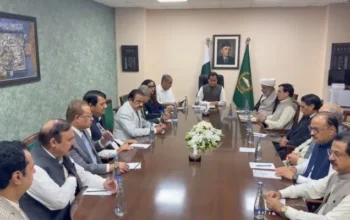
Pakistan, which led the diplomatic push that produced the Islamabad memorandum alongside Qatar, Saudi Arabia and other regional states, moved urgently on Sunday to shore up the agreement.
Deputy Prime Minister and Foreign Minister Ishaq Dar held telephone conversations with the foreign ministers of Saudi Arabia, Bahrain, Iran, Britain and the European Union’s foreign policy chief, Kaja Kallas, over the preceding 48 hours.
Kallas expressed “serious concerns” over the ceasefire violations and stressed the importance of keeping communication channels open between the parties. She also praised Pakistan’s role in facilitating the memorandum.
Bahrain’s Foreign Minister, Dr Abdullatif bin Rashid Al Zayani, said he would travel to Pakistan to personally thank Prime Minister Shehbaz Sharif and Chief of Army Staff Field Marshal Syed Asim Munir for their mediation efforts. Saudi Foreign Minister Prince Faisal bin Farhan Al Saud also conveyed his intention to visit Islamabad at the earliest opportunity.
Dar reaffirmed Pakistan’s commitment to working toward a comprehensive regional peace framework. “FM Dar reiterated Pakistan’s resolve to continue working toward prevalence of peace in the region in pursuance of the Islamabad MoU,” the foreign office said in a statement.
Prime Minister Shehbaz Sharif said on Saturday that the right of free maritime passage was “an absolute necessity for the entire world.”
Lebanon adds to the pressure
The Gulf crisis was compounded by renewed fighting in Lebanon, where Israel said on Sunday it had struck Hezbollah positions in the Nabatieh area, killing militants armed with rocket-propelled grenades and dismantling a rocket launcher, a day after agreeing to a fresh US-brokered ceasefire with Beirut.
Hezbollah lawmaker Hassan Fadlallah predicted the Lebanon agreement — which includes provisions to disarm the group — would not be implemented, warning of potential “internal conflict.” Iran called the Israeli strikes a “blatant violation” of the truce and said Israel’s withdrawal from Lebanese territory was a prerequisite for any lasting settlement. Iranian Foreign Ministry spokesman Esmaeil Baghaei said a clear timetable for the withdrawal was essential.
Araghchi, speaking in Baghdad, called on Washington to press Israel to end its operations in Lebanon, saying the interim deal with the US made Israel’s withdrawal and the halt of its strikes mandatory, and that it was Washington’s responsibility to enforce compliance.
Analysts see a long road ahead
With Tuesday’s Doha talks unconfirmed by either government, analysts cautioned against optimism.
“For Iran, a drawn-out negotiation accompanied by controlled pressure in the strait can work to its advantage,” said H.A. Hellyer of the Royal United Services Institute, a London think tank.
One round of direct mediated talks, led by US Vice President JD Vance and Iranian parliamentary speaker Mohammad Baqer Ghalibaf, was held in Switzerland last week, during which Washington waived some sanctions on Tehran. But fighting has since resumed and, by this weekend, intensified sharply.
Major differences persist between the two sides on the future security architecture of the Strait, sanctions relief and the interpretation of key clauses of the memorandum. Pakistan said it remained in close contact with all parties, and diplomatic sources in Islamabad expressed particular concern that the latest exchanges could derail efforts to transform the ceasefire into a broader political settlement.
Copyright © 2021 Independent Pakistan | All rights reserved