By Staff Reporter
KARACHI: An injured militant captured after a deadly assault on a Pakistan Rangers camp in Karachi has told interrogators that he and his accomplices were trained in Afghanistan and crossed into Pakistan under a logistics network organised by the banned Jamaat-ul-Ahrar group, security sources said on Sunday.
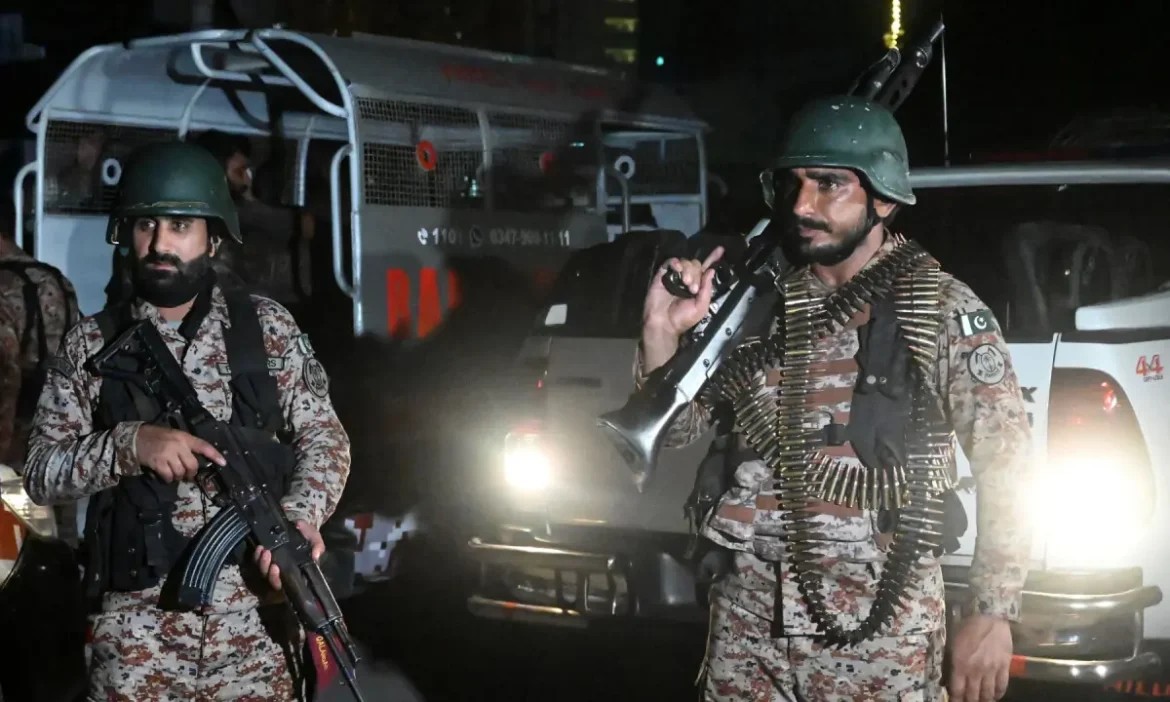
The attack on the Rangers (Sindh) camp in the Gulistan-i-Jauhar neighbourhood late Saturday killed three security personnel and wounded four others before troops repelled the assault, killing three attackers and arresting a fourth.
The captured suspect identified himself as Usman Ali, a member of Jamaat-ul-Ahrar (JuA), and told investigators he had travelled to Pakistan from Jalalabad in eastern Afghanistan with three associates — Abdul Hadi, Janan and Umar Farooq — arriving seven days before the attack.
According to the sources, Ali said the group was sheltered in an under-construction building by Abdul Hadi, described as a resident of Bajaur, in Pakistan’s northwest. He told interrogators that Hadi had operated in Karachi previously and was familiar with the area, and that the weapons used were sourced by Hadi from Waziristan. Hadi was killed during the security forces’ response.
Ali said Janan threw the explosive device at the camp’s main gate before the group attempted to breach the perimeter. He told investigators he was shot while trying to flee. The military said assailants detonated a blast at the main gate in an attempt to force entry before troops repelled the assault.
The suspect told interrogators the group received militant training in Afghanistan under an instructor identified as Umar Qari, including instruction in the assembly of suicide vests. He named the group’s Afghanistan-based commander as “Ahrar Maulvi.” All logistical arrangements for the Karachi operation, he said, had been finalised in Afghanistan prior to the group’s departure.
The Inter-Services Public Relations (ISPR), the Pakistani military’s media wing, said Sunday that the attack was carried out by “Khwarij belonging to Indian proxy, Jamaat ul Ahrar.” Islamabad and its military establishment have repeatedly accused New Delhi-backed proxies of sponsoring militant attacks, a charge India has not publicly responded to.
Formed in 2014 when Abdul Wali Khan, also known as Omar Khalid Khorasani, broke from the banned Tehreek-i-Taliban Pakistan (TTP), JuA later rejoined the TTP fold in 2024. According to the United Nations Security Council, the group is based in Nangarhar province in eastern Afghanistan, with most of its commanders and operatives hailing from Pakistan’s former Mohmand Agency, dispersed after Pakistani military operations and continuing to launch attacks across the border. Khorasani was killed in a car bomb attack in Afghanistan in August 2022.
Funeral prayers for the three slain Rangers personnel were held in Karachi on Sunday, attended by Federal Interior Minister Mohsin Naqvi, Sindh Governor Nehal Hashmi and Sindh Chief Minister Syed Murad Ali Shah. The bodies were subsequently dispatched to their hometowns for burial with full military honours.
The attack comes at a period of sustained militant pressure on Pakistani security forces. Information Minister Attaullah Tarar earlier this month cited a string of attacks, including a June 11 assault on a Federal Constabulary post in Peshawar’s Musa Dara area, a foiled vehicle-borne suicide attack on a military post in North Waziristan on June 2, and a May 9 suicide bombing at a Bannu security post that killed 15 police officers.
Pakistan has long pressed the Taliban administration in Kabul to act against militant groups operating from Afghan territory, arguing it has presented irrefutable evidence of cross-border networks. Those appeals have thus far yielded no substantive action, Pakistani officials and security analysts say.
Islamabad has pointed to a marked surge in militant activity in the Khyber Pakhtunkhwa and Balochistan provinces since the Taliban’s return to power in Afghanistan in August 2021. Border clashes between Pakistani forces and Taliban-affiliated militants erupted in October 2025 after what Islamabad described as unprovoked attacks on its border posts. Multiple rounds of talks between the two sides have so far failed to produce an agreement, with Pakistani officials blaming Kabul’s reluctance to act against militant groups sheltering on Afghan soil.
Copyright © 2021 Independent Pakistan | All rights reserved