By Staff Reporter
ISLAMABAD: Pakistan’s military said on Wednesday they had shot down four drones launched from Afghanistan into the southwestern province of Balochistan, and warned that any further cross-border attacks would be met with a “swift, decisive and overwhelming” military response.
The military’s media wing, the Inter-Services Public Relations (ISPR), said in a statement that the drones were launched from Afghan territory on Tuesday and were intercepted before reaching their targets. It accused Afghanistan’s Taliban administration of backing militant groups operating from areas under its control.
“The Afghan Taliban regime launched four rudimentary drones across the border in Balochistan as part of their patronisation and support of terrorist outfits operating from inside their controlled territories,” the ISPR said.
According to the statement, the aircraft were detected by Pakistan’s air defence systems and neutralised using what it described as sophisticated countermeasures, preventing any of the four from completing their intended strikes.
There was no immediate comment from Taliban authorities in Kabul on Tuesday’s incident specifically, though Afghanistan’s Taliban-run Defence Ministry has in recent days said it carried out strikes on sites in Pakistan’s Balochistan and Khyber Pakhtunkhwa provinces that it described as Islamic State hideouts.
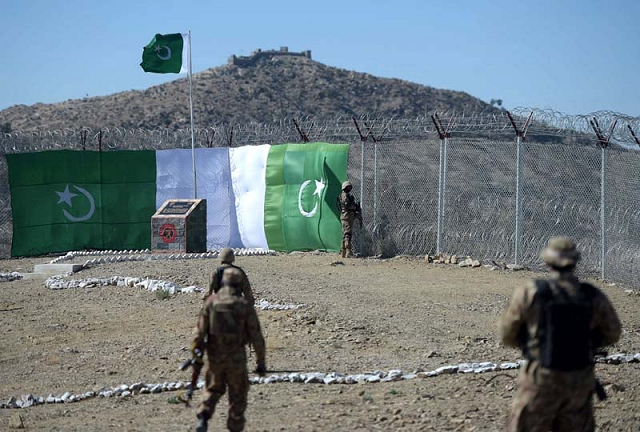
The exchange is the latest flashpoint in an escalating conflict between the two neighbours, one that has drawn in air strikes, artillery and, increasingly, low-cost drones on both sides of a porous, mountainous frontier. Pakistan carried out air strikes inside Afghanistan on Sunday that, according to the United Nations, killed 28 civilians. Kabul has said its own strikes and border operations were a response to those attacks and to what it casts as repeated Pakistani incursions.
The two governments agreed a ceasefire in October after a week of intense border fighting, the worst since the Taliban returned to power in 2021, brokered with the help of Qatar and Turkey. That truce has frayed in the months since, with Pakistan pressing Kabul to act against the Pakistani Taliban, formally known as Tehreek-e-Taliban Pakistan (TTP), which it accuses of operating from Afghan soil with the Taliban government’s tacit support. Afghan officials have repeatedly denied harbouring the group or any other armed organisation hostile to Pakistan.
Wednesday’s ISPR statement was sharply worded even by the standards of recent exchanges between the two militaries. It accused the Taliban administration of using the drone launches to distract from its own governance failures.
“Such gimmicks of the Afghan Taliban regime are aimed at misleading the Afghan population suffering under their oppressive regime,” the statement said, adding that the Taliban should “eschew sponsorship of terrorism and adhere to the principle of peaceful coexistence” rather than what it called “hollow rhetoric.”
The military said any future provocation would fall under Operation Ghazab-lil-Haq, the name Pakistan has given to its ongoing military campaign against cross-border threats since fighting intensified earlier this year.
“The Pakistan armed forces remain fully vigilant and capable of defending every inch of the motherland,” the ISPR said. “Any misadventures or cross-border provocations threatening the sovereignty of Pakistan and endangering our people will continue to be met with swift, decisive, and overwhelming responses under Operation Ghazab-lil-Haq.”
It added: “If the Afghan Taliban continue to provoke Pakistan, they would receive a befitting response, which would cost them heavily.”
Small, commercially derived drones modified to carry explosives have become an increasingly common feature of the conflict since February, when Pakistani officials say Afghan-linked forces began deploying them regularly against targets in Khyber Pakhtunkhwa and Balochistan. Pakistan has consistently described the devices as rudimentary and locally assembled, while acknowledging that intercepting them has required sustained use of its air defence network along the border.
The Pakistan-Afghanistan border, known as the Durand Line, has been a source of dispute since Pakistan’s founding in 1947. Islamabad has long accused successive Afghan governments, including the Taliban since its 2021 takeover, of allowing anti-Pakistan militants to operate from its territory.
Copyright © 2021 Independent Pakistan | All rights reserved