By Staff Reporter
ISLAMABAD: More than 100 civil society figures from India and Pakistan issued a joint appeal on Tuesday urging Prime Ministers Narendra Modi and Shehbaz Sharif to pursue sustained dialogue and rebuild ties between the nuclear-armed neighbours, arguing that prolonged hostility is costing both nations opportunity and stability.
The appeal, signed by 116 people including former diplomats, politicians, academics and rights advocates, called on the two governments to restore full diplomatic relations, resume visa services and reopen channels for trade and travel that have been curtailed for years amid recurring tension between the countries.
The initiative was organised by O.P. Shah, head of the New Delhi-based Centre for Peace and Progress. Signatories said continued acrimony was undermining prospects for the roughly one-fifth of the world’s population who live in the two countries, particularly the young.
“India and Pakistan combined are home to nearly one-fifth of humanity,” the signatories wrote in appeals addressed separately to Modi and Sharif. “The people of both countries deserve a future defined by peace, development, connectivity and cooperation, rather than perpetual mistrust and confrontation.”
Pakistani signatories included former foreign minister Khurshid Mahmud Kasuri, former ambassador to New Delhi Ashraf Jehangir Qazi, physicist and academic Pervez Hoodbhoy, former senator Farhatullah Babar, and civil society figures Salima Hashmi, Mohammad Mehdi and educationist A.H. Nayyar.
On the Indian side, signatories included Jammu and Kashmir politicians Farooq Abdullah, Mirwaiz Umar Farooq and Mehbooba Mufti, Congress party figure Mani Shankar Aiyar, academic Manoj Jha, former Research and Analysis Wing chief A.S. Dulat, Jawhar Sircar, Saifuddin Soz and Apoorvanand.
Diplomatic and security measures
The appeal urged both capitals to reinstate high commissioners in Islamabad and New Delhi and to reopen bilateral talks on outstanding disputes, including Jammu and Kashmir. It called for measures on demilitarisation and de-escalation, pointing to the framework negotiated between 2004 and 2007 as a possible starting point for renewed engagement.
That period saw back-channel diplomacy between the two governments explore a settlement on Kashmir, though talks stalled and were never formalised.
Trade and travel links
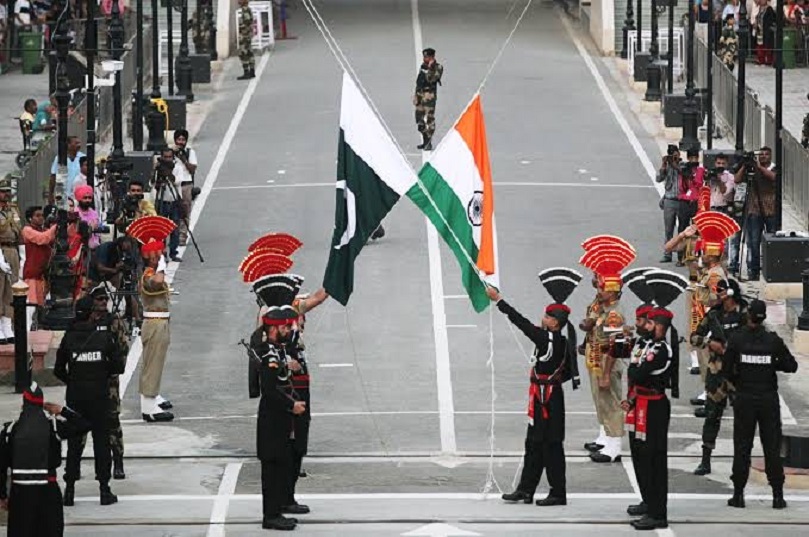
The signatories called for reopening the Wagah-Attari land border crossing and resuming cross-border transport links, including the Srinagar-Muzaffarabad and Lahore-Delhi bus services and the Samjhauta Express and Thar Express train services. They also urged that travel be permitted along the Kargil-Skardu route in the disputed Kashmir region, and that both countries reopen their airspace to commercial carriers.
On trade, the appeal sought the reopening of commercial channels, reinstatement of Most Favoured Nation trading status, and steps toward broader regional economic integration.
Pakistan withdrew Most Favoured Nation status arrangements with India following New Delhi’s 2019 decision to revoke the special constitutional status of Jammu and Kashmir, a move that also prompted Islamabad to downgrade diplomatic relations and suspend trade.
People-to-people contact
The signatories said easing travel restrictions was essential to reducing tension and addressing mutual distrust, and called for the two governments to promote pilgrimage tourism and visits to shared heritage sites. They pointed to the Kartarpur Sahib corridor, which allows Indian Sikh pilgrims to visit a shrine in Pakistan, and the Sharada Peeth temple site in Pakistan-administered Kashmir’s Neelum Valley, as possible first steps.
The appeal also called for lifting restrictions on media outlets and digital platforms, allowing journalists from each country to travel and work freely, and encouraging delegation exchanges to counter disinformation between the two populations.
“We respectfully request you to listen to the aspirations of common people and choose engagement over isolation, dialogue over hostility and cooperation over confrontation,” the appeal concluded.
There was no immediate response from the offices of Modi or Sharif to the appeal.
Relations between India and Pakistan have been strained for decades over the disputed Kashmir region, which both countries claim in full but administer in part, and have deteriorated further in recent years amid periodic military and diplomatic flare-ups.
Copyright © 2021 Independent Pakistan | All rights reserved