By Staff Reporter
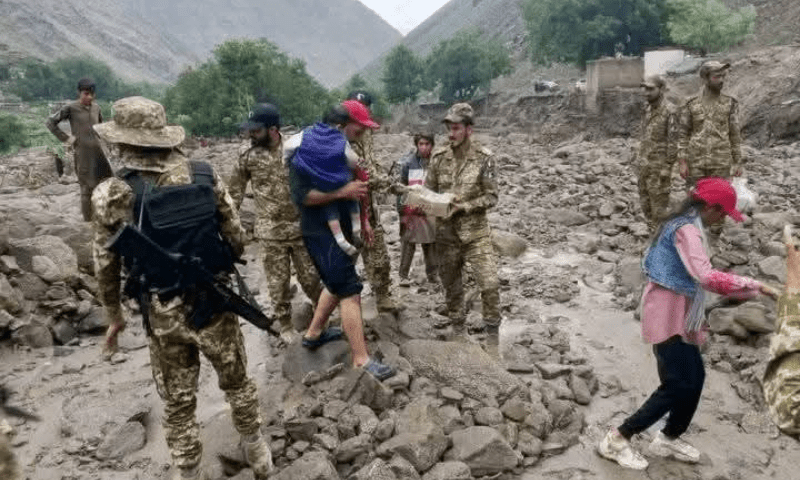
ISLAMABAD: Emergency crews pulled more than 200 stranded travelers to safety late Tuesday after flash flooding tore through a mountain highway in northwestern Pakistan, the latest and largest rescue in a monsoon season that has already killed 18 people nationwide.
The floodwaters, swollen by torrential rain and carrying thick loads of mud and debris, overran the Drosh-Ashirat road in Lower Chitral at several points, marooning passenger vehicles between washouts with nowhere to go. No one was hurt, according to Rescue 1122, the government emergency service that led the response.
“Rescue 1122 Lower Chitral carried out a timely operation during the flash flood and safely rescued more than 200 passengers,” the agency said in a statement.
The rescue began, as these operations often do in Chitral’s remote valleys, with watchmen who happened to be closest to the trouble. Teams posted at the Sheshikoh and Bregnesar watch posts were the first to reach the scene, wading into the crisis before word had even fully reached district headquarters. Reinforcements followed once it became clear the flooding was too extensive for a handful of responders to manage alone.
For six hours, crews worked across four flood zones — Kalkatak, Kaldam Gol, Sawir and Ashirat — pulling travelers from vehicles trapped in the muck and ferrying them to solid ground. Twenty Rescue 1122 personnel took part, backed by three ambulances and a disaster response vehicle. Along the way, they freed four passenger vehicles that debris had pinned in place, clearing them so stranded travelers could resume their journeys once the road reopened. Throughout, rescue officials said they coordinated with the National Highway Authority and district administrators to reopen the route and keep the public safe.
The flooding was driven by rainfall that, while not extreme by the season’s standards, proved enough to destabilize the steep terrain. The Pakistan Meteorological Department recorded 33 millimeters of rain in Mirkhani, in Lower Chitral, over the preceding 24 hours — the heaviest total in the area — while nearby Drosh received just 3 millimeters, underscoring how localized and unpredictable the mountain storms can be.
A season already turning deadly
The Chitral rescue is the most dramatic single event so far in what has become an increasingly punishing monsoon season for Pakistan. The National Disaster Management Authority says 18 people have been killed and 61 injured in rain-related incidents across the country since June 26, with 104 houses damaged and 163 head of livestock lost.
Those figures build on an already grim toll. Pakistan’s Khyber Pakhtunkhwa Provincial Disaster Management Authority reported July 2 that seven people — two men, four children and one woman — had died over the preceding 48 hours alone, after roofs and walls collapsed under the weight of heavy rain, windstorms and flash flooding. Nineteen others were hurt, among them 11 children. Those incidents struck seven districts: Khyber, Lower Dir, Mardan, Shangla, Bajaur, Lower Chitral and Upper Dir. In all, 38 houses were damaged — 36 partially, two beyond repair.
Pakistan’s monsoon season, which runs from June through September, has long brought flash floods, landslides and collapsed homes to the country’s mountainous north and its low-lying river plains. But officials and scientists say the pattern is worsening. Rising temperatures are accelerating the melt of Himalayan and Karakoram glaciers, feeding rivers and streams that can turn violent with little warning, while the rains themselves have grown less predictable and more extreme — a shift researchers attribute to climate change.
The National Disaster Management Authority sounded the alarm last month over the mounting threat of glacial lake outburst floods — sudden, often catastrophic releases of water when ice-dammed lakes give way. The agency has urged local authorities to draft evacuation plans and keep emergency crews ready to deploy on short notice.
More rain expected
There is little sign of relief ahead. The Meteorological Department forecast rain, thunderstorms and strong winds Wednesday across much of Khyber Pakhtunkhwa province, including both Upper and Lower Dir, Upper and Lower Chitral, Swat, Shangla, Malakand and Buner. Forecasters warned of similar conditions, with isolated storms, in Bajaur, Upper and Lower Kohistan, Kolai-Palas, Torghar, Battagram, Mansehra, Abbottabad and Haripur.
Rain was also expected to reach Mardan, Swabi, Mohmand, Khyber, Peshawar, Nowshera, Charsadda, Kohat, Karak, Hangu, Kurram, Orakzai, Bannu, Lakki Marwat and Dera Ismail Khan, along with the more remote districts of Tank, North Waziristan and South Waziristan, where gusty winds and isolated thunderstorms were forecast. The Met Office cautioned that dust storms and heavy downpours remain possible through the forecast period.
Even as the storms move in, the province’s plains are bracing for a different hazard: punishing heat. Most districts were expected to stay hot, dry and humid Wednesday. A day earlier, Dera Ismail Khan reached 41 degrees Celsius, with Bannu and Peshawar close behind at 40 degrees. Farther into the mountains, where the flooding struck, temperatures ran far cooler — 36 degrees in Chitral, 28 in Kalam and 26 in Malam Jabba — a reminder of the extreme climatic range packed into a single Pakistani province, and the range of hazards its emergency responders are being asked to manage at once.
Copyright © 2021 Independent Pakistan | All rights reserved