By Staff Reporter
ISLAMABAD: Pakistan’s top military commander, Field Marshal Asim Munir, said on Wednesday that the armed forces remain fully alert to efforts by hostile intelligence agencies to destabilize the country through state-sponsored proxies, and that terrorism launched from across the border will be confronted with the full power of the state.
In a statement issued by the Inter-Services Public Relations directorate, Munir stressed that such proxy networks would not be permitted to damage Pakistan’s internal security or its economic progress. The remarks came as security forces responded to a string of deadly attacks in Balochistan that have left dozens of civilians, police officers and troops dead in recent days.
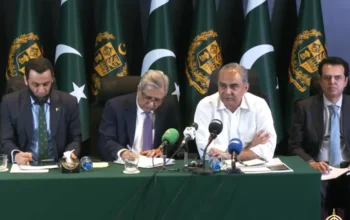
Earlier Wednesday, ISPR Director General Lt. Gen. Ahmed Sharif Chaudhry told reporters that four civilians, 27 policemen and 11 security personnel had been killed since July 5 in attacks and follow-up operations across the province. Security forces, he said, had killed 54 terrorists during the same period.
The violence has included an armed assault on the outskirts of Quetta on July 5, an attack on a police post in Ziarat on July 6, and an ambush on an army convoy in Bela on Wednesday.
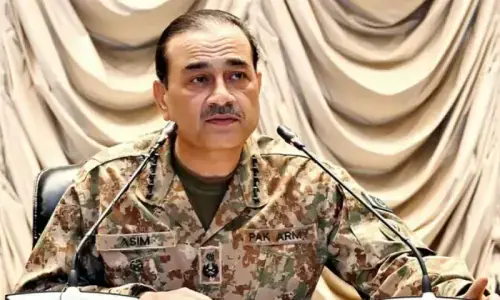
Munir delivered his comments during an address to officers completing the National Security and War Course at the National Defence University in the capital. The course draws participants from all three services of the armed forces. He was received at the university by its president.
In his speech, Munir noted the changing character of warfare and the need for clear strategic thinking and strong institutions to meet complex threats. He praised the National Defence University for preparing both military and civilian leaders to handle hybrid, conventional and sub-conventional challenges with foresight and resolve.
The armed forces, he said, are updating their operational and development plans to keep pace with the evolving nature of conflict.
“Wars are not won through media rhetoric or political sloganeering but through faith, unity and discipline,” Munir said, according to the ISPR statement.
He expressed confidence in the professionalism, morale and operational readiness of Pakistan’s armed forces and urged the graduating officers to uphold integrity, selfless service and unwavering commitment to the nation.
The military’s public comments on Wednesday came against a backdrop of mixed security trends. Data compiled by the Pakistan Institute for Conflict and Security Studies showed that, despite the recent high-profile attacks in Balochistan, overall anti-state violence and related incidents across Pakistan declined in June. The province itself recorded 49 attacks last month, down from 71 in May — a 31 percent drop, according to the institute’s figures.
Munir’s address at the National Defence University placed the recent violence in the wider context of what the military describes as externally supported subversion. He reiterated that proxy networks operating under the direction of hostile intelligence agencies would not be allowed to succeed.
The chief of army staff and chief of defence forces has repeatedly framed Pakistan’s security challenges as requiring both kinetic responses and institutional strength. Wednesday’s remarks followed that pattern, combining a direct warning on cross-border terrorism with a call for discipline and unity among the officer corps.
The attacks in Balochistan since July 5 have drawn renewed attention to long-standing militant activity in the resource-rich but restive province. Security officials have linked some of the violence to groups they say receive support from across the border.
Munir’s appearance at the National Defence University was his latest public engagement on the armed forces’ readiness to confront both traditional and emerging threats. The graduating class he addressed will soon take up senior positions across the military and in civilian institutions that deal with national security.
Copyright © 2021 Independent Pakistan | All rights reserved