By Staff Reporter
ISLAMABAD: President Trump declared on Wednesday that the fragile ceasefire ending the war between the United States and Iran was finished, threatening a new round of American strikes even as he left the door open, however narrowly, to further talks.
Speaking to reporters on the sidelines of a NATO summit in Turkey, Trump said the memorandum of understanding that had paused the fighting since last month could no longer be counted on, following an overnight exchange of attacks between American and Iranian forces that pushed oil prices sharply higher and rattled a region already exhausted by five months of war.
“As far as I’m concerned, it’s over,” Trump said when asked whether the truce still held. “It’s just a waste of time dealing with them.”
Hours later, ahead of a meeting with Ukrainian President Volodymyr Zelenskiy, he went further, previewing what he described as an imminent American response to the previous night’s fighting.
“I’ll give a little warning: We’re going to hit them hard tonight,” Trump told reporters.
The threats capped a chaotic 24 hours across the Gulf. Iranian forces had struck at least three commercial tankers in the Strait of Hormuz on Tuesday, prompting American strikes on Iranian military targets that the Pentagon said hit more than 80 sites, including air-defense systems, coastal radar installations, and roughly 60 small boats operated by Iran’s Revolutionary Guard. Iran, in turn, struck U.S. military installations in Bahrain and Kuwait early Wednesday, setting off missile alerts across both countries before dawn.
Trump did not say whether the United States intended a full return to war, nor did he clarify whether negotiations toward a lasting settlement — the stated purpose of the memorandum signed last month — would continue in any form. He suggested American negotiators were welcome to keep talking but made clear he held out little hope.
“I’ll let our wonderful negotiators keep talking if they want, but I don’t see it. I don’t like these people,” he said.
On the core issue that started the war — Iran’s nuclear ambitions — Trump repeated a demand he has made since American and Israeli strikes began in late February, while signaling he may no longer see a negotiated path as necessary to enforce it.
“They’ll never build a nuclear weapon under our deal, but I don’t know if we’re going to have a deal,” he said. “We may just do it without a deal, because you know what, it’s easier, because these people, what they lie and they cheat.”
A fragile truce unravels
The renewed fighting strikes at the heart of an agreement that had, for a few weeks, allowed something resembling normalcy to return to one of the world’s most important shipping corridors. The Strait of Hormuz carries roughly a fifth of the world’s traded oil and natural gas, and nearly all of it — some 90 percent of Iran’s crude exports alone — moves past Kharg Island, the terminal Trump has previously threatened to seize outright.
Iranian state media reported a wave of explosions Wednesday across multiple locations, including six in the island of Qeshm, seven in the city of Sirik, and additional strikes in the major port of Bandar Abbas. Iran also reported blasts in the coastal city of Bushehr, home to the country’s only civilian nuclear power plant and situated near Kharg Island itself. State media said a member of the Revolutionary Guards had been killed in the strikes, and Iran’s foreign ministry said monitoring and observation posts along the southern coast had also been hit.
The U.S. Central Command said the strikes were intended, in its words, to degrade Iran’s ability to continue attacking commercial vessels moving through the corridor. NATO Secretary General Mark Rutte, appearing alongside Trump at the summit, called the American response “absolutely necessary.”
Iran’s retaliation came within hours. The Revolutionary Guard said it had struck American military facilities in both Bahrain and Kuwait; an Agence France-Presse journalist reported hearing explosions in Bahrain. Kuwait said its forces intercepted two ballistic missiles and 13 drones fired from Iran, while Iranian forces separately struck at Sheikh Isa air base in Bahrain, according to Iran’s military.
For residents across the Gulf, the fighting reopened wounds that had only begun to close. “The spectre of war is looming once more,” said Nawal Saad, a Bahraini civil servant, who said she did not want to relive the fear of earlier in the conflict. Hamad Althunayyan, an assistant professor at Kuwait University, said Iran appeared to view Bahrain and Kuwait as accessible, low-cost targets for pressure — a read on Tehran’s strategic thinking that has become familiar since the war’s outbreak.
Oman, which sits across the strait from Iran and has tried since the war began to preserve its standing as a neutral mediator, condemned the strikes on Bahrain and Kuwait as well as the earlier attacks on shipping — without directly blaming Tehran. That position has grown harder to sustain as Oman simultaneously negotiates with Iran over how the strait itself should be administered going forward, with Washington pushing for unrestricted passage and Iran insisting on the right to charge fees and dictate shipping routes.
A dispute over control of the strait
The immediate spark for this week’s escalation traces to a dispute that has simmered since the cease-fire took effect: who controls passage through Hormuz, and on what terms.
Under the interim agreement, ships were to be permitted through the strait without paying fees for 60 days. But Iran has signaled repeatedly that it intends to charge for passage once that window closes and has pressed vessels to use routes it designates rather than a corridor Oman proposed hugging its own coastline. All three tankers struck this week — including a Qatari liquefied natural gas vessel — were reportedly sailing near the Omani route rather than Iran’s preferred passage.
Qatar, which helped broker the original cease-fire, put the blame for the tanker attack squarely on Tehran. “The targeting of the Qatari vessel ‘Al-Rekayyat’ while transiting near the Strait of Hormuz constitutes an unacceptable attack on the security and safety of international maritime navigation,” Doha’s foreign ministry spokesman, Majed Al Ansari, wrote on social media, adding that Iran would be held “fully legally responsible” for the attack and any resulting damage.
Andreas Krieg, a security expert at King’s College London, described Iran’s actions as an unmistakable warning to any tanker considering an alternative route. “Iran is sending a clear signal that no alternative will be accepted,” Krieg said, calling the strikes on ships using the Omani corridor “a clear violation” of both the cease-fire and international law.
Even so, some analysts cautioned against reading Wednesday’s rhetoric as confirmation the war was resuming outright. “I think Trump’s rhetoric is, as usual, hyperbolic, and doesn’t necessarily mean that the MoU has collapsed,” said Ali Vaez, Iran project director at the International Crisis Group. He argued that both sides were, in effect, using force to settle terms the original memorandum had left vague. “Both sides are trying to negotiate the fine print of the MoU through the use of force because the MoU left a lot of issues either unresolved or ambiguous,” Vaez said. “When Iran tries to enforce its control over the strait, it doesn’t matter who violates it. They believe this is the most important achievement that they have had in this war. They’ve shed blood for it. And they’re not going to give it away.”
Markets react, shipping stalls
The financial toll was immediate. Brent crude, the international benchmark, jumped roughly 8 percent Wednesday to $80.09 a barrel after Trump’s comments — still well below the nearly $120 peak reached earlier in the war, but a sharp reversal after prices had only recently drifted back down to pre-war levels. The increase raised fresh concern that a prolonged closure of the strait could reignite inflation just as it appeared to be cooling, complicating the path for the Federal Reserve and other central banks weighing interest-rate decisions.
Shipping data showed at least four oil and gas tankers turning back rather than risk the transit, and the International Maritime Organization’s chief, Arsenio Dominguez, said Wednesday that nearly 6,000 seafarers remained stranded in the region as a result of the fighting.
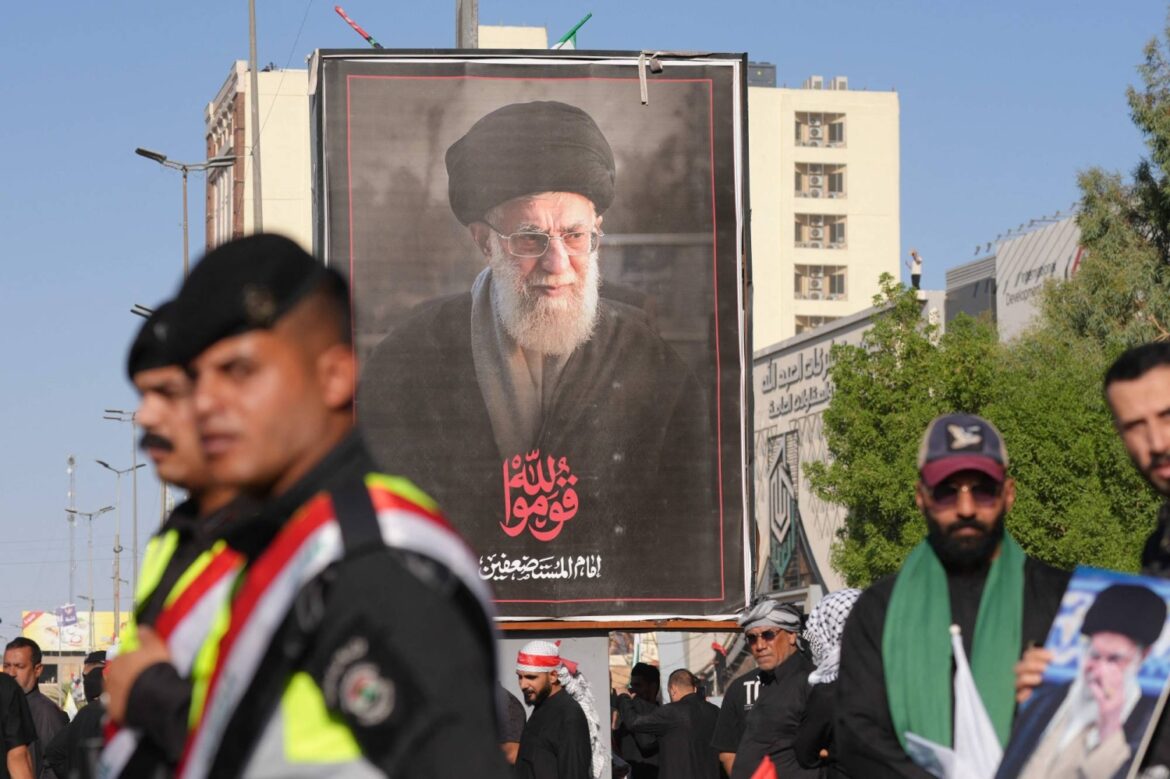
The renewed violence arrived at a delicate moment in Iran’s internal politics. Talks toward a permanent settlement had been expected to resume only after the conclusion of funeral ceremonies for Iran’s Supreme Leader, Ayatollah Ali Khamenei, who was killed on Feb. 28 in the opening strikes of the war. Those ceremonies, which were scheduled to conclude Thursday, had been intended as a period of relative calm.
Iranian President Masoud Pezeshkian and other senior Iranian and Iraqi officials attended funeral observances Wednesday in Najaf, Iraq, with additional prayers planned at the Imam Hussein shrine in Karbala. Khamenei’s body is expected to be returned to Iran for burial Thursday at the Imam Reza shrine in Mashhad, his birthplace. Iranian state television separately aired footage it said showed wreckage at Khamenei’s residential compound in Tehran, damage inflicted during the earliest days of the war in February.
Copyright © 2021 Independent Pakistan | All rights reserved