By Staff Reporter
ISLAMABAD: The United States and Iran exchanged another round of strikes this week, the most serious escalation since the two countries signed an interim peace agreement last month, as Tehran buried its assassinated supreme leader and mediators in Islamabad scrambled to keep a fragile ceasefire from collapsing entirely.
American forces struck roughly 90 military targets inside Iran, including air defence systems and coastal missile infrastructure, according to US Central Command, which said the operation was intended to curb Tehran’s ability to threaten commercial shipping through the Strait of Hormuz. Iran responded within hours, launching drones and missiles at American military installations in Bahrain, Kuwait, and Qatar — the first time since the truce took hold that Tehran has publicly acknowledged targeting Qatari soil.
The exchange has left the Islamabad Memorandum of Understanding, the 14-point framework Pakistan spent months negotiating between Washington and Tehran, in its most precarious position since it was signed on June 17. It also intensified fears that a war that has already killed thousands and choked off one of the world’s most critical oil corridors could widen further, just as Iran completed a week of funeral processions for Ayatollah Ali Khamenei, the supreme leader killed alongside several top commanders when the United States and Israel opened the war with a surprise attack on Feb. 28.
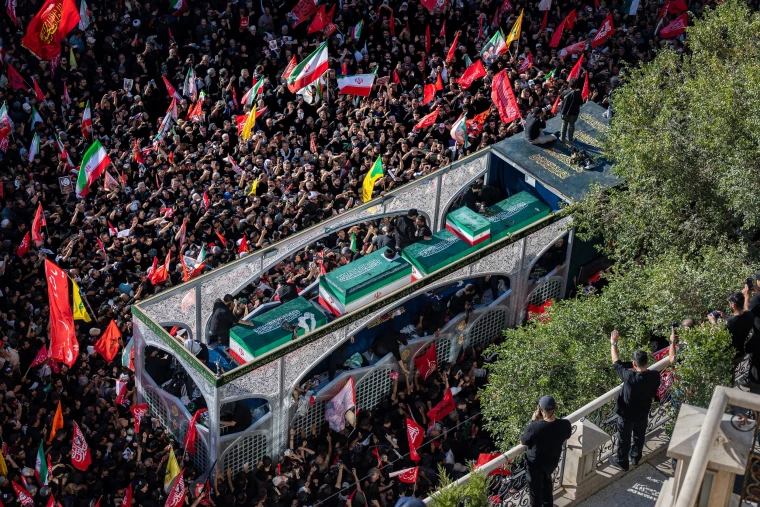
Khamenei’s burial was completed early Friday at the Imam Reza Shrine in Mashhad, his hometown, according to Iran’s state IRNA news agency, following six days of processions that carried his coffin through Tehran, Qom, and the Iraqi holy cities of Najaf and Karbala. Four family members killed alongside him, including a daughter, son-in-law, and daughter-in-law, were buried in the same ceremony. Enormous crowds packed the shrine’s courtyard through the day, some chanting for revenge against President Trump and holding signs reading “Kill Trump.” Mojtaba Khamenei, who succeeded his father as supreme leader within days of the killing, has not appeared in public since, and Iranian officials have said only that he was wounded in the strike that killed his father.
Diplomatic fallout
Iranian Foreign Minister Abbas Araghchi telephoned Pakistan’s army chief, Field Marshal Asim Munir, on Thursday to formally protest the American strikes, according to Iran’s Foreign Ministry. Araghchi accused the United States of violating both the United Nations Charter and the terms of the Islamabad memorandum, and warned against further American “adventurism” in the region, the ministry said. He made similar calls that day to his counterparts in Oman and Turkey to discuss the deteriorating situation in the strait.
Pakistan, which brokered the original April 8 ceasefire and later the more detailed June agreement after Munir spent weeks shuttling between Washington and Tehran, has not issued its own account of the Araghchi call and has kept its public statements notably measured throughout the mediation. Pakistan’s Foreign Ministry, responding a day earlier to Trump’s declaration that the interim deal was “over,” urged all parties to honor their commitments under the memorandum, calling it “an enduring foundation for understanding, mutual respect and shared prosperity for the region and beyond.”
Mohammad Bagher Ghalibaf, the speaker of Iran’s parliament and Tehran’s chief negotiator in the talks, was more combative in a post on the social platform X. “America still hasn’t learned that bullying and breaking promises are no longer cost-free,” he wrote. “Let me put it plainly: if you strike, you’ll get hit.” He added that the Strait of Hormuz would remain open only on Iranian terms, not under what he called American threats.
Trump, addressing reporters after leaving a NATO summit in Turkey, said Wednesday that Iran had reached out seeking a new arrangement but that he remained skeptical of Tehran’s intentions. “I just don’t know if they’re worthy of making a deal,” he said. “I don’t know that they’re going to honor the deal, that’s the problem.” In a separate outburst directed at Iranian officials, he said, “I don’t want to deal with them anymore, they’re scum. You know what scum is? They’re scum. They’re sick people.” Araghchi responded on X that Iran would not answer “vulgarity with vulgarity, but with action: fearlessly and with great valour.”
The current flare-up began Tuesday, when Iran fired on three commercial tankers transiting the Strait of Hormuz, prompting Washington to revoke a license that had allowed limited Iranian oil sales and to launch what Central Command described as a first wave of strikes against roughly 80 targets, including more than 60 vessels belonging to Iran’s Islamic Revolutionary Guard Corps. A second, larger round of American strikes followed Thursday.
Casualties and damage
Iran’s Health Ministry said Thursday that the two days of American strikes had killed 14 people and wounded 78 others, most of them members of the armed forces, with 47 of the wounded still hospitalized. Iranian officials said American aircraft had also struck the area near Bushehr, the site of Iran’s only nuclear power plant, hours after Central Command said it had concluded its latest round of strikes; the Pentagon did not immediately respond to a request for comment on that claim. Iranian state media reported strikes for the first time since April against Iranian bridges, including a railway bridge in Golestan province and two bridges along the route to Mashhad, though officials said the damage did not delay Khamenei’s funeral proceedings. Power outages were reported in the port city of Chabahar, where two of three damaged transmission lines were quickly restored.
In the Gulf states, Kuwait’s military said falling debris wounded one person as its air defenses intercepted three ballistic missiles, a cruise missile, and ten drones. Bahrain, home to the US Navy’s Fifth Fleet, said it intercepted incoming fire without specifying further, and air raid sirens sounded there at least three times Thursday. Jordan, where the United States maintains troops and aircraft, also sounded sirens, though its government said all incoming fire was intercepted. There was no immediate report of damage in Qatar.
Shipping traffic collapses
The renewed hostilities have devastated shipping traffic through the strait, which carried roughly a fifth of the world’s traded oil and natural gas before the war began. Only a handful of tankers made the transit in the early hours of Thursday, according to data from the analytics firm Kpler, down from an average of about 30 ships a day in recent weeks and far below the 125 to 140 ships that typically passed through before February. Phil Belcher, marine director at the tanker owners’ group Intertanko, said traffic on the strait’s southern route had fallen into “single figures,” a sharp reversal from what he described as an “exuberance of optimism” that followed last month’s signing of the Islamabad agreement.
“This cycle of violence, this cycle of up-and-down, positive-negative news, it’s having an enormous impact both on business and on the seafarers themselves,” Belcher said.
A Qatari LNG tanker, the Al Rekayyat, remained stranded near Oman’s coast awaiting salvage after a projectile strike Tuesday sparked a fire in its engine room; its crew was evacuated safely, and industry officials said its cargo appeared secure despite earlier fears of an explosion. Two other vessels, a Saudi-flagged crude carrier and a Liberian-flagged tanker, were also targeted in Tuesday’s attacks. War-risk underwriters have since advised some shipping companies to pause voyages through the strait altogether while they reassess policy terms, according to insurance industry sources.
“Tanker traffic through the Strait of Hormuz has essentially stopped, which tells you more about risk perception right now than any statement from Washington or Tehran,” Jorge Leon, head of geopolitical analysis at the consultancy Rystad Energy, wrote in a research note.
A fractured Iranian leadership, and a region on edge
Analysts following the talks say the renewed strikes may reflect divisions within Iran’s leadership between hard-liners intent on retaining control over the strait as leverage against the West and pragmatists eager to finalize a permanent settlement that would lift international sanctions and ease the country’s economic strain. Iranian Deputy Foreign Minister Kazem Gharibabadi, one of Tehran’s lead negotiators, dismissed Trump’s declaration that the interim deal was finished as “not a sign of power but an admission of the failure” of American policy toward Iran.
The escalation has also drawn in Israel, which fought its own war against Iran twice in the past year but was not a party to the Islamabad negotiations. Israeli Defense Minister Israel Katz said Thursday that his country’s military remained on alert to resume its campaign against Iran “with even greater force” if necessary. Prime Minister Benjamin Netanyahu, speaking at the same ceremony, said Iran had been significantly weakened by two rounds of Israeli strikes but cautioned that the broader conflict was not over. “The Iranian axis is weaker than ever before, while Israel is stronger than ever before,” Netanyahu said. “We proved that the long arm of the Israeli Air Force can reach anywhere, from Yemen to Iran. Yet we must also acknowledge that the campaign is not over.”
Negotiators had been expected to resume talks on the toughest unresolved issues in the Islamabad framework — a full reopening of the strait and the future of Iran’s disputed nuclear program — once Khamenei’s funeral concluded. With the burial now complete but the ceasefire in serious doubt, it remains unclear when, or whether, those talks will proceed. The 60-day negotiating window established under the memorandum has not yet expired, though Trump said Wednesday he considered further talks “a waste of time.”
Copyright © 2021 Independent Pakistan | All rights reserved