By Staff Reporter
ISLAMABAD: Pakistan and the United States made significant progress toward a reciprocal trade agreement during two days of talks in Washington, according to Pakistan’s foreign ministry, as officials from both countries work to lock in a durable framework before a temporary tariff measure lapses later this month.
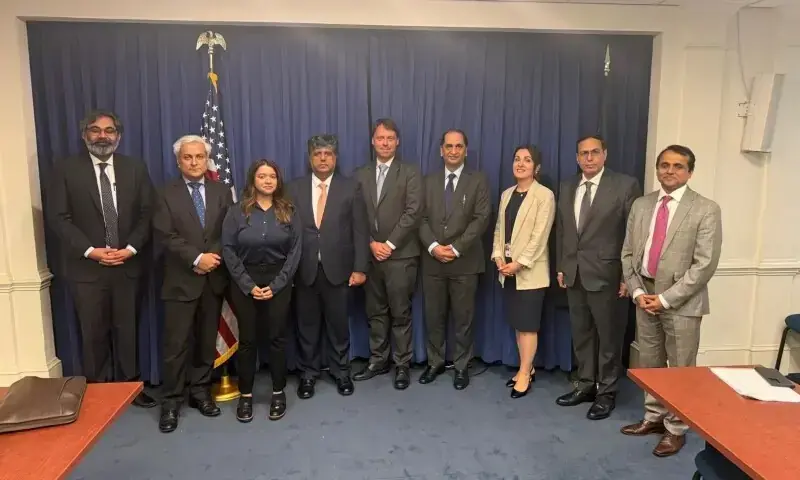
The negotiations, held Thursday and Friday, were led by Pakistani Commerce Secretary Jawad Paul and come as a 10% US tariff imposed under Section 122 of the Trade Act of 1974 is due to expire July 24. Both sides are seeking to replace a series of stopgap trade measures — imposed and revised repeatedly over the past 15 months — with a more permanent bilateral arrangement.
Paul characterized the talks as positive and pointed to substantial progress in the negotiations, Foreign Office spokesperson Tahir Andrabi said Saturday on X, citing the commerce secretary. Andrabi, who took part in the discussions, described the atmosphere as cordial, with both sides narrowing differences and building consensus toward an early conclusion of the agreement.
Pakistan’s delegation also included Nadeem Chaudhary, secretary for overseas Pakistanis and human resource development, and Mohammad Ashfaq, joint secretary for tariff policy, with officials from other ministries joining virtually, according to the Foreign Office.
Beyond tariffs, the talks touched on broader economic cooperation spanning energy, information technology, mining and investment, according to officials familiar with the discussions. Islamabad and Washington have both signaled interest in deepening ties in critical minerals and emerging economic sectors, while Pakistan continues to push for expanded market access for its exporters in the US, particularly in industries it views as having strong growth potential.
The stakes are considerable for Pakistan, whose economy leans heavily on the US market. The country is Pakistan’s largest single-country export destination, and Pakistan ranks as the second-largest importer of US cotton — a trade relationship that underscores what’s at risk if negotiators fail to reach a durable deal.
A tariff saga with multiple twists
The current round of talks caps more than a year of legal and regulatory turbulence that has repeatedly reshaped the tariff landscape facing Pakistani exporters.
The dispute traces back to April 2025, when President Donald Trump invoked the International Emergency Economic Powers Act to impose a 29% tariff on Pakistani exports as part of a sweeping package of global trade measures. Subsequent talks between Pakistani officials and the Office of the US Trade Representative brought that rate down to 19%.
That arrangement was thrown into question in February, when the US Supreme Court ruled 6-3 that the White House had exceeded its constitutional authority in imposing broad tariffs under the emergency powers law, effectively invalidating the measure. The Trump administration responded by invoking Section 122 of the Trade Act of 1974, which allows for a temporary global tariff of up to 10% for as long as 150 days — the measure now set to expire July 24.
Adding another layer of complexity, the USTR last month proposed a separate 10% tariff covering Pakistan and 59 other economies, stemming from a Section 301 investigation into forced-labor standards and import restrictions. Pakistan has submitted legal and regulatory documentation contesting that proposal, including a filing made Wednesday, just ahead of this week’s talks.
Trump, announcing the finalization of an earlier trade arrangement with Pakistan in August, said the two countries would work together on developing their substantial oil reserves — a sign of the broader economic partnership both governments have said they want to build beyond tariff negotiations alone.
With the Section 122 deadline approaching and the Section 301 dispute still unresolved, both governments face pressure to convert this week’s progress into a formal agreement that offers exporters and investors greater certainty than the shifting measures of the past year.
Copyright © 2021 Independent Pakistan | All rights reserved