By Staff Reporter
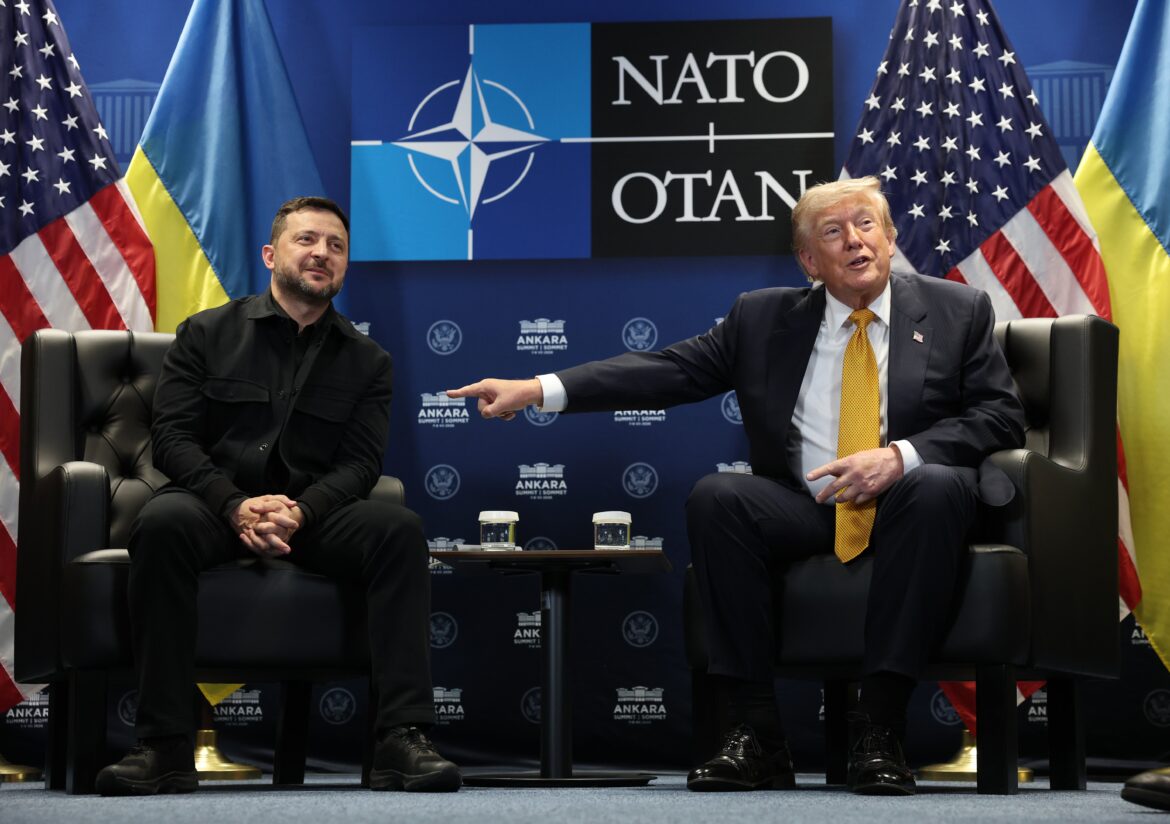
There is a version of this story in which US President Donald Trump stands in Ankara, flanked by the assembled grandees of the Atlantic alliance, and says something statesmanlike about Patriot missile defence systems. There is another version — the one that actually happened — in which he does that too, but somewhere in the middle invents a country.
It is Wednesday, and Trump is sitting next to Volodymyr Zelenskyy at Nato’s summit in the Turkish capital, taking questions from reporters. Someone asks about licensing Patriot interceptor technology to Europe. It is a perfectly sensible question about a perfectly sensible piece of hardware, and for a while Trump treats it as such. He likes defensive weapons better than offensive ones, he says. Patriots are the best. He has a story about this. He told it yesterday, but he will tell it again, because that is simply what happens to stories in Trump’s mouth: they get told again, and each retelling is its own small adventure.
The story concerns the USS Abraham Lincoln, “one of the most beautiful” aircraft carriers in the world, one of the biggest too, which came under sustained missile fire a couple of months back. This part is true. Iran’s Revolutionary Guard did claim to have struck the Lincoln with ballistic missiles. What happens next is that Trump, reaching for the name of the country that fired them, produces instead something that has never existed in the history of nations.
“We had 111 missiles shot by the Islamic Republic of Japan,” he says. “They were shot at the aircraft carrier over a period of about one hour, 111 missiles going to a very expensive ship.”
There is a beat. Nobody in Ankara stands up to point out that Japan is not, in fact, an Islamic republic, that its state religions — to the extent it has any — run to Shinto and Buddhism, and that its relationship with the United States has for eighty years been one of the more emphatically peaceful alliances going. Trump ploughs on. Every one of the 111 missiles was shot down, he says, mostly by Patriots, “but by other means also.” He is pleased with this outcome. He does not appear to notice that the outcome he is describing involves a Pacific democracy that manufactures the Nissan Leaf somehow acquiring, in the space of one sentence, both a theocracy and a grudge.
Here the day might have settled into ordinary chaos, but Trump is not finished. Moments later, still in the same appearance, he turns towards the man sitting next to him — the actual, physically present president of Ukraine — and asks the room if anyone has “a question for President Putin.” Zelenskyy, who has spent three and a half years being extremely famous for not being Vladimir Putin, says nothing that has been reported. Reporters laugh. Trump recovers by suggesting he will pass any Putin-related questions on to Putin himself, which is one way of solving a problem you have just invented.
It does not stop there, because at Nato summits problems apparently come in threes, or in this case considerably more. Trump refers to the 2015 nuclear agreement with Iran as the “JCPOC” rather than the JCPOA, a small acronym doing a large amount of quiet work. He calls TikTok “Tic Tac,” which is either a slip of the tongue or a candid admission about what he actually thinks of the app. And he describes Turkey, the country hosting the summit, the country whose president is sitting somewhere in the vicinity being called a great many complimentary things, as a “great company” — before, to his credit, correcting himself to “country.” Turkey, it should be said, is a country. It has been one for some time.
By the standards of a man who has built an entire second career out of describing his predecessor’s verbal stumbles in intricate, uncharitable detail, this is quite a collection to assemble in a single afternoon. Trump has spent years insisting that Joe Biden could not talk and could not walk. He repeated the charge again at Ankara, in the same appearance, shortly after informing the world that Japan is an Islamic republic currently engaged in an aircraft-carrier-adjacent hostility with the United States. There is a species of political comedy that requires no jokes at all, only a transcript and a functioning memory, and Wednesday supplied both in abundance.
The White House, asked whether the president might like to clarify any of this, declined the invitation. Instead it offered an assessment of the day that bore only a glancing relationship to the day itself. Press secretary Karoline Leavitt said the president had delivered “a marathon, high-energy performance,” holding four separate press availabilities plus a solo press conference, taking “unscripted questions… on a wide range of topics.” He had, she said, “commanded every room” and given allies “some much-needed tough love.” All of which may well be true. It is also true that one of the rooms he commanded now contains a fictional Asian theocracy, and no amount of tough love is going to un-invent it.
Online, people did what people do, which is to seize on eleven words and refuse to let go. The Islamic Republic of Japan acquired, within hours, the internet’s fastest possible form of statehood: it became a bit. There were jokes about anime under sharia law, about a seventy-year defence alliance apparently unable to survive one press conference, about what exactly a president needs to say these days before anyone in his own party uses the word “acuity” out loud.
Users traded memes about sharia law arriving in Akihabara. Someone rebranded Japanese anime “Hala-nime,” on the theory that a nation now understood to be an Islamic republic surely produced its cartoons with moral instruction in mind. Someone else produced an image of Prime Minister Sanae Takaichi in a green burqa, cherry blossoms improbably blooming behind her. A Reddit thread in r/japan pondered, with mock solemnity, why there had been a halal ramen shop in Asakusa all along — clearly, in retrospect, cover for something. One widely shared post filed an obituary for the late Prime Minister Shinzo Abe as a “shaheed leader” of the newly discovered republic. Another user, more plaintively, said he’d had to explain to his son over breakfast that the boy had technically been born in the Islamic Republic of Japan.
Some of it was cruel. Most of it, this being the internet, missed the more useful observation entirely, which is that a man contesting his own mental fitness on a nearly weekly basis has just handed his critics their evidence gift-wrapped, on camera, at a Nato summit, twice within the same three minutes.
Nobody has yet worked out what the Islamic Republic of Japan’s foreign policy is. Nobody needs to. It doesn’t have one. It doesn’t have anything, except a very confused afternoon in Ankara and a president who, for one sentence, genuinely seemed to believe otherwise.
Copyright © 2021 Independent Pakistan | All rights reserved