By Staff Reporter
ISLAMABAD: A landmark ruling this week from Pakistan’s newly formed Federal Constitutional Court has upended nearly a decade of court-ordered demolitions across this sprawling port city, finding that the country’s Supreme Court exceeded its authority when it launched a sweeping campaign against illegal construction that eventually claimed one of Karachi’s most recognisable buildings.
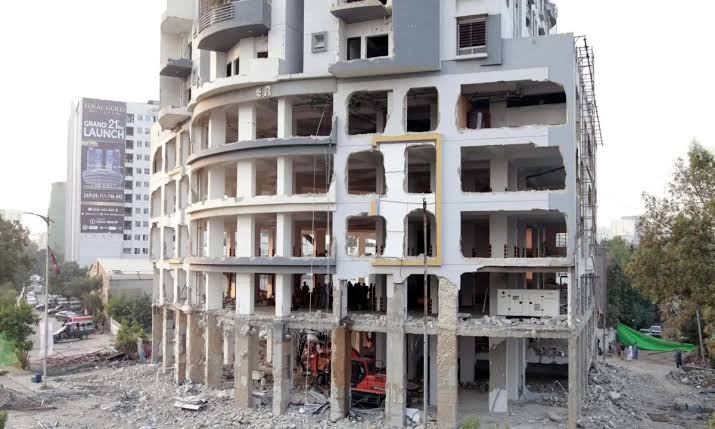
The decision, issued on Thursday, recalls two Supreme Court orders from December 2018 and January 2019 that had authorized Sindh provincial authorities to tear down buildings found to violate construction codes — a campaign that grew, over several years, from a single disputed building into a citywide enforcement drive. Among its casualties was the 15-story Nasla Tower on Sharae Faisal, whose demolition became a flashpoint in Karachi’s long-running battles over unchecked development and regulatory failure.
In its ruling, the two-judge bench did not dispute that illegal construction has been a persistent problem in Karachi, or that the original demolition orders were animated by genuine civic concern. But the court found that the Supreme Court, in the course of hearing a single appeal, had drifted far outside the bounds of the case actually before it — and in doing so, had trespassed on ground that belongs to the provincial government, not the judiciary.
“When a court is seized of a matter, it must remain confined to the issue at hand,” the bench wrote, adding that judges ought not undertake inquiries unnecessary to resolving the dispute in front of them. Enforcement of building codes, the court found, is fundamentally an executive function — one requiring due process case by case, not blanket judicial directives issued from the bench.
Justice Aamer Farooq, who wrote the court’s opinion, was joined by Justice Syed Arshad Hussain Shah on the panel, which inherited the case after Pakistan’s 27th constitutional amendment transferred a wide swath of pending Supreme Court matters to the newly created Federal Constitutional Court.
A case that outgrew itself
The origins of the dispute trace back a decade, to a far narrower question than the one that eventually reshaped Karachi’s skyline litigation.
In November 2016, the Sindh High Court ordered the Sindh Building Control Authority to demolish a multistory building in Lyari’s Mussa Lane, ruling it had been constructed illegally. The building’s owner appealed to the Supreme Court, and by all appearances, the case seemed headed toward a conventional resolution: one building, one violation, one court order.
Instead, the case began to expand. Hearings continued through 2017, with the Supreme Court issuing a series of orders targeting illegal construction elsewhere in the city and instructing that officials from the building authority face consequences for their role in permitting it.
Then, in July 2018, the proceedings shifted decisively. A bench that included then-Justice Gulzar Ahmed — who would later become chief justice — ordered the building authority to produce a comprehensive list of every unapproved structure in Lyari Town. By December of that year, the court had concluded that the problem was not confined to Lyari at all, but extended across Karachi, and it directed the removal of officials found to have enabled the violations.
The following month, in January 2019, the same bench went further still, ordering the demolition of marriage halls, markets, and shopping centers operating in Jam Sadiq Ali Park and directing provincial authorities to bring the entire city back into conformity with its original master plan.
What had begun as a single appeal over a single building in Lyari had, within roughly two years, become a citywide mandate touching thousands of properties.
“Continuous mandamus”
That expansion, the Federal Constitutional Court found this week, is precisely where the process broke down.
The court described the Supreme Court’s posture during those years using a legal term — “continuous mandamus” — that refers to a court retaining ongoing supervisory authority over an issue, rather than resolving a discrete dispute and stepping back. That role, the bench found, was never the Supreme Court’s to claim in a case that began as a routine building-code appeal.
The broader directives issued in December 2018 and January 2019, the court concluded, were not necessary to resolve the narrow controversy that had actually been placed before the justices — the Mussa Lane building. Everything that followed from those directives, however far-reaching its consequences for the city, rested on that same unstable foundation.
The human toll of that expansion had been considerable. Between 2019 and 2025, a wave of individuals and organizations — including the Association of Builders and Developers — sought to intervene in the case, arguing they had been swept up in enforcement actions never contemplated when the litigation began. Those applications remained unresolved for years, carried forward until the case ultimately landed before the Federal Constitutional Court following its creation.
Not a pardon for illegal construction
The court was careful to draw a distinction between curbing judicial overreach and excusing the underlying violations that triggered the demolitions in the first place.
Nothing in Thursday’s ruling legalizes illegal construction in Karachi, the bench emphasized, nor does it grant any retroactive cover to buildings erected without proper approval. Pakistan already has a legal framework, along with regulatory bodies, specifically tasked with policing construction violations, the court noted — and the Sindh government and its agencies remain constitutionally and statutorily obligated to enforce it.
What the ruling forecloses is the shortcut: the practice of relying on reports from the building authority alone, filtered through a court that had assigned itself sweeping supervisory power, to order demolitions without the individualized due process each case requires.
With that reasoning, the court formally recalled the December 2018 and January 2019 orders in their entirety, along with every report, proceeding, and pending enforcement action that had flowed from them in the years since.
A separate word on public space
In a notable addendum to the ruling, Justice Shah wrote separately to underscore what he described as an urgent and unresolved concern — the protection of Karachi’s dwindling public spaces.
Justice Shah wrote that safeguarding the fundamental rights of the city’s residents remains paramount, and that residents are entitled to public amenities that support a healthy, safe, and dignified life — among them parks, playgrounds, green belts, footpaths, public beaches, libraries, community centers, and educational and healthcare institutions.
Those assets, he wrote, are inseparable from residents’ right to life and human dignity, and must be protected from encroachment, misuse, or arbitrary conversion to other purposes. No policy, executive instruction, or administrative order, he added, can be used to diminish rights already reflected in the city’s approved master plans — a safeguard, he wrote, that can be altered only through constitutional and legal process, not administrative fiat.
Justice Shah’s note calls on every relevant department, agency, and local authority in Karachi to ensure those public spaces are preserved, maintained, and kept accessible — not just for current residents, he wrote, but for generations still to come.
Copyright © 2021 Independent Pakistan | All rights reserved