By Staff Reporter
ISLAMABAD: The federal government ordered disaster management authorities into a state of heightened readiness on Friday, as meteorologists forecast a weekend of heavy rain, windstorms and thunderstorms likely to trigger flash flooding, landslides and dangerous river surges across the country’s northern and mountainous regions.
The dual warnings — one from the Pakistan Meteorological Department, the other from the National Disaster Management Authority — reflect mounting concern over what officials are calling an increasingly volatile start to the 2026 monsoon season, with the greatest hazards concentrated in Gilgit-Baltistan, Khyber Pakhtunkhwa and Azad Kashmir.
According to the meteorological department, moist air currents pushing in from the Arabian Sea have been steadily intensifying and were expected to strengthen further Saturday evening, colliding with a westerly weather system approaching from the west. The convergence is expected to produce widespread rain, gusting winds and thunderstorms — with pockets of heavy downpour — through the weekend and into early next week.
The department forecast the most severe conditions in the mountainous districts along the Line of Control and the northern frontier: Neelum Valley, Muzaffarabad, Rawalakot, Poonch, Hattian, Bagh, Haveli, Sudhanoti, Kotli, Bhimber and Mirpur are expected to see isolated heavy rainfall from Friday night through Monday.
A similar band of storms was forecast Saturday and Sunday for a long stretch of Khyber Pakhtunkhwa, including Dir, Chitral, Swat, Kohistan, Malakand, Nowshera, Charsadda, Karak, Tank, Lakki Marwat, Swabi, Shangla, Battagram, Buner, Kohat, Kurram, Dera Ismail Khan, Bannu, Waziristan, Bajaur, Mohmand, Khyber, Orakzai, Mansehra, Abbottabad, Haripur, Peshawar, Mardan and Hangu.
Farther south, forecasters said scattered storms with isolated heavy rain would move through the Punjab corridor over the weekend, affecting Islamabad, Rawalpindi, Murree and the Galiyat hill stations, along with Attock, Chakwal, Jhelum, Mandi Bahauddin, Gujrat, Gujranwala, Hafizabad, Wazirabad, Faisalabad, Khushab, Sargodha, Lahore, Sheikhupura, Sialkot, Narowal, Sahiwal, Jhang, Toba Tek Singh, Nankana Sahib, Chiniot and Okara. Meteorologists warned that heavy downpours could cause localized urban flooding in several of the region’s largest cities, including Islamabad, Rawalpindi, Peshawar, Gujranwala, Lahore and Faisalabad.
Storms were expected to arrive later, beginning Saturday night into Sunday, in a belt of central and southern Punjab districts — Noor Pur Thal, Bhakkar, Mianwali, Layyah, Bahawalpur, Bahawalnagar, Dera Ghazi Khan, Multan, Khanewal, Lodhran, Muzaffargarh, Kot Addu, Rahim Yar Khan and Rajanpur — with occasional breaks in the rain.
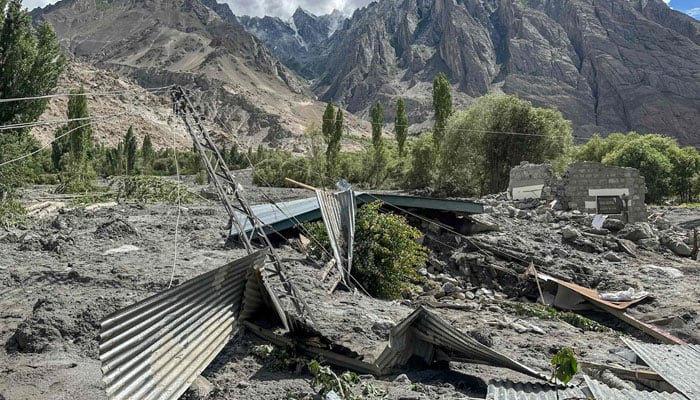
In the far north, the meteorological department forecast rain, windstorms and thunderstorms from Saturday night through Monday across the glacier-fed districts of Diamer, Astore, Ghizer, Skardu, Hunza, Gilgit, Ghanche and Shigar — the same territory federal disaster officials identified as most vulnerable to glacial lake outburst floods.
Isolated storms were also expected Saturday and Sunday in Balochistan’s Zhob, Sherani, Kohlu, Barkhan, Dera Bugti and Khuzdar districts. Sindh, by contrast, was forecast to remain largely hot and humid, with the exception of Tharparkar, Sukkur, Shikarpur, Larkana, Dadu and Jacobabad, where isolated rain is expected Sunday and Monday.
Weather officials cautioned that the hot, humid conditions gripping much of the country in recent days are likely to ease as the storm system moves through.
Storm damage, landslide risk cited
The meteorological department warned that high winds and lightning could damage weak infrastructure, including solar panels, electric poles and billboards, and cautioned that landslides were possible in vulnerable stretches of upper Khyber Pakhtunkhwa, Gilgit-Baltistan and Kashmir over the weekend. Officials also warned that water levels could rise sharply in local streams across those regions and in the hill torrents that feed into Dera Ghazi Khan.
The department urged tourists and travelers to avoid unnecessary trips during the forecast period and asked farmers to adjust crop management and livestock care to account for the incoming weather.
Federal government orders nationwide readiness
The forecast landed the same day Pakistan’s federal government convened an emergency session to review the country’s monsoon preparedness, underscoring the scale of concern inside the government over the flood risk building across multiple provinces.
The Emergency Response Committee met Friday at the National Disaster Management Authority’s headquarters in Islamabad to assess provincial and district-level readiness for the 2026 monsoon season. Planning Minister Ahsan Iqbal chaired the meeting remotely, joined by Climate Change Minister Musadik Malik and NDMA Chairman Lt. Gen. Inam Haider Malik.
Provincial chief secretaries and disaster management officials briefed the committee on contingency planning, resource deployment and public awareness efforts already underway. Much of the discussion centered on flood plains, urban centers, hill torrent regions, coastal belts and glacier-fed valleys — areas officials identified as facing the greatest exposure to flash flooding and glacial lake outburst floods this season.
The committee directed authorities nationwide to maintain a high state of readiness for the duration of the monsoon, emphasizing uninterrupted communication between agencies, rapid mobilization of resources and immediate activation of local contingency plans to safeguard lives, property and critical infrastructure.
Northern routes closed to nonessential travel
In a separate advisory, Pakistan’s National Emergency Operations Centre instructed tourists and nonessential travelers to stay off mountain routes in the country’s north from July 10 through July 14, citing an immediate, high-risk threat from glacial flooding and landslides.
The center said landslide alerts would remain in effect from Saturday through Monday, while flood and river surge warnings would apply across Gilgit-Baltistan, Khyber Pakhtunkhwa and Azad Kashmir through Tuesday. Officials said rising temperatures combined with sustained heavy rain could trigger glacial lake outburst floods, debris flows, sudden river surges and rockfalls in glacial valleys and hill torrent regions already considered vulnerable.
The disaster management authority named a number of high-risk zones, including Badswat, Ashkoman, Hinarchi, Yasin, Khaplu, Hisper Hoper, Gultang and surrounding areas, and flagged several roads as particularly dangerous: the Jaglot-Skardu and Hunza-Gojal highways, the Gilgit-Ghizer road, and routes leading to Naltar, Bagrot and Hermosh.
The emergency operations center urged travelers to steer clear of glacial lakes, river channels, known flood paths and roads prone to landslides, warning that bank erosion and sudden debris flows could cause conditions to deteriorate quickly. District administrations were instructed to mobilize emergency response teams and issue warnings on the ground as conditions warrant.
Copyright © 2021 Independent Pakistan | All rights reserved