By Staff Reporter
ISLAMABAD: Pakistani weather officials on Saturday warned that a fresh storm system moving into the country’s northern mountains this week could trigger sudden, destructive flooding from glacial lakes, the latest in a string of alerts this summer as the region grapples with a punishing combination of heat and rain.
The Pakistan Meteorological Department said an incoming westerly weather system was expected to bring cloudy skies, heavy rain, and thunderstorms to the glaciated valleys of Gilgit-Baltistan and Khyber Pakhtunkhwa over the coming week. Daytime temperatures in those valleys are already running above normal, the department said, and the combination of unusual warmth and fresh precipitation is likely to sharply accelerate the melting of snow and ice across the region.
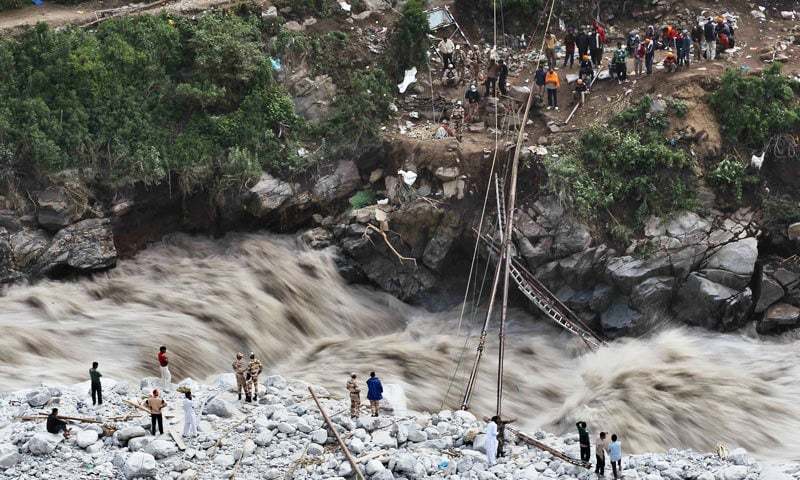
The warning is not an isolated one. It is at least the fourth glacial-flood alert the meteorological department and Pakistan’s National Disaster Management Authority have issued since early June, as an unusually hot, wet monsoon season has kept the country’s northern mountains under near-constant watch. On Friday, disaster management officials separately ordered tourists and other non-essential travellers to stay out of large stretches of the north entirely through July 14, citing an immediate risk of landslides and glacial flooding along some of the region’s most heavily travelled roads.
At the center of Saturday’s warning is a phenomenon known as a glacial lake outburst flood, or GLOF, in which a lake formed by glacial meltwater bursts through the wall of ice or rock debris holding it back, sending a wall of water and debris crashing down mountain valleys with little warning. The floods can destroy homes, roads, and bridges within minutes and have killed residents of Pakistan’s northern valleys in recent years.
More than 7.1 million people living in Gilgit-Baltistan and Khyber Pakhtunkhwa are considered vulnerable to the hazard, according to Pakistan’s Ministry of Climate Change. The United Nations Development Programme, which has worked with Pakistani authorities on flood preparedness in the region, has identified more than 3,000 glacial lakes across the two provinces, of which 33 have been assessed as being at high risk of a sudden outburst.
The meteorological department said Saturday that river levels across the affected valleys were likely to remain high in the coming days, with existing glacial lakes expected to expand and new ones likely to form as meltwater volumes increase. Low-lying settlements and villages along riverbanks face a heightened risk of sudden inundation, the department said, and flash flooding remains a significant danger in areas already known to be susceptible.
Officials also warned that the rapid growth of glacial lakes could put new strain on the natural dams — typically formed from ice or accumulated rock and soil, known as moraine — that hold the lakes in place, raising the odds that one could give way. Thawing permafrost in the region, combined with the surge of surface water expected from the storm, could also send heavy flows of mud and debris down mountain slopes, the department said, a hazard distinct from but related to the flooding threat.
The meteorological department urged people living in or visiting the affected valleys to stay well back from riverbanks, streambeds, and the mountain drainage channels known locally as nullahs, and to watch closely for any sudden or gradual change in water levels. The agency also advised against camping, trekking, or lingering near rivers, streams, glacial lakes, and narrow mountain valleys for the duration of the forecast, and cautioned people to avoid unstable slopes where melting snow could set off landslides or debris flows. Residents were told to keep close watch on official forecasts and alerts as the storm approaches, and disaster management agencies were directed to maintain round-the-clock monitoring and take whatever precautions are necessary.
The disaster management authority’s advisory issued Friday went further, naming specific high-risk zones and roadways it wants travelers to avoid through the middle of next week, including the Jaglot-Skardu, Hunza-Gojal, and Gilgit-Ghizer routes, along with the Naltar, Bagrot, and Hermosh valleys. The agency said landslide warnings would remain in effect through Monday, with flood and river-surge warnings extending across Gilgit-Baltistan, Khyber Pakhtunkhwa, and Azad Kashmir through Tuesday.
The warnings underscore the scale of Pakistan’s exposure to glacial hazards. The country is home to more than 13,000 glaciers, by far the largest concentration of glacial ice found anywhere outside the polar regions, spread across the Karakoram, Himalayan, and Hindu Kush mountain ranges that converge in its north. But researchers have found that roughly 10,000 of those glaciers, concentrated in Gilgit-Baltistan and the Chitral region of Khyber Pakhtunkhwa, are now retreating as temperatures climb, a trend scientists attribute to climate change.
That retreat has already produced destructive floods in the region. In August 2025, a glacial outburst from the Shishper Glacier tore through a mountain drainage channel known as Hassanabad Nullah, sweeping away a portion of the Karakoram Highway and destroying private property. A separate glacial burst that same month in Gilgit-Baltistan’s Ghizer district forced the evacuation of some 200 people and blocked the Ghizer River for hours, according to regional rescue officials, though an early-warning system in place at the time meant no lives were lost. Days earlier, a glacial burst in the region’s Bagrot Valley had killed one person and injured his father.
Pakistan’s National Emergencies Operation Centre had already flagged the broader risk months in advance. In February, the agency issued an advisory warning that the period from March through September carried an elevated threat of glacial flooding nationwide, citing forecasts for rising temperatures, shifting weather patterns, and the possibility of an early heat wave settling over the country’s north.
Copyright © 2021 Independent Pakistan | All rights reserved