By Staff Reporter
MUZAFFARABAD: A man was killed, and several others were hurt on Saturday when protesters clashed with law enforcement personnel on a mountain road connecting two district capitals in Azad Kashmir, the latest and deadliest flashpoint in a monthslong standoff that shows no sign of easing before a government deadline expires this week.
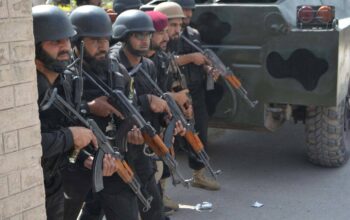
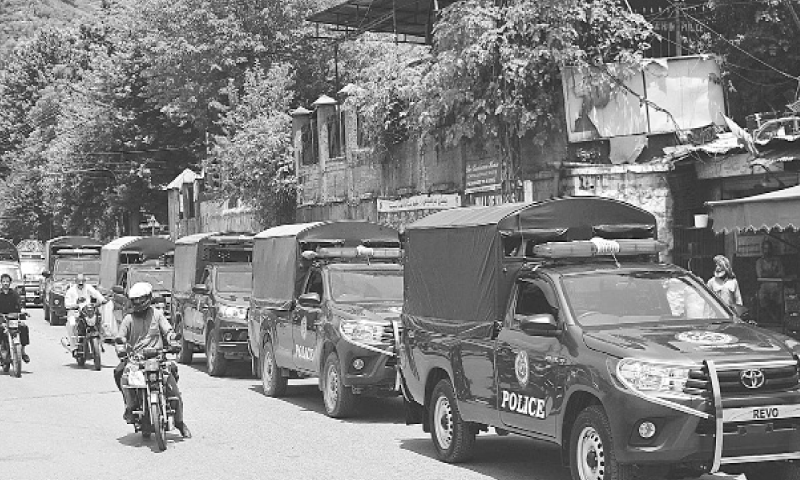
The violence broke out along the road linking Arja and Rawalakot, in Poonch district, after officials sent police to reoccupy an abandoned post at a junction known as Jindala Cross, where the highway to Rawalakot splits toward a bridge over the Jhelum River.
Sardar Waheed Khan, the divisional commissioner for Poonch, said the post needed to be restored because activists with the Joint Awami Action Committee, a protest movement the government banned last month, had effectively seized control of the junction, blocking travel between the two towns and, in his account, harassing people who tried to pass.
“The activists were misbehaving with everyone, necessitating the restoration of the previously abandoned police post located nearby,” Khan said. He said some protesters responded to the police deployment by throwing stones at law enforcement vehicles.
The commissioner also pointed to an earlier episode at the same intersection. On July 1, a local trade association leader, Nasir Arbab, and his cousin were assaulted, according to authorities, as they tried to clear obstacles from the road so an ambulance carrying a body from Rawalpindi could reach the bridge crossing. Arbab’s family has said he was abducted by committee activists, held against his will and tortured before being left by the roadside; photographs circulated by relatives on social media appeared to show bruising and other injuries consistent with that account. In the aftermath, traders in Arja called off a shutdown strike that had lasted for weeks and reopened their businesses.
A movement’s demands shift
The Joint Awami Action Committee, widely known by its acronym JAAC, has held rallies and sit-ins across the territory since early June. Its focus has moved considerably since the campaign began. What started as a protest over the cost of flour and electricity — a characterization offered by one government official — has hardened into a demand that the region’s legislative assembly eliminate 12 seats set aside for refugees who fled Indian-administered Kashmir after the 1947 partition of British India.
The committee contends that those reserved seats let political parties based in mainland Pakistan tilt the formation of governments in Azad Kashmir. Its position was dealt a legal blow last month when the region’s Supreme Court ruled that the seats are constitutionally protected and cannot be abolished through executive or administrative action alone, leaving the committee’s central demand in a kind of legal holding pattern even as street protests continued to build.
The government’s response has been to outlaw the group. On June 5, regional authorities placed JAAC on the First Schedule of the territory’s anti-terrorism law, formally designating it a proscribed organization. The crackdown widened the following day, with dozens of committee leaders arrested; 147 activists have since been placed under a more restrictive section of the same statute. The group has continued to organize despite the ban.
A pattern of violence
Saturday’s clash was not an isolated case. Last month, at least seven people — four police officers and three protesters — died in fighting in Rawalakot, where officials said JAAC supporters attacked law enforcement personnel and laid siege to a military-run hospital. The committee has denied that account, accusing security forces instead of opening fire on demonstrators who were protesting peacefully.
Liaqat Ali Malik, the AJK inspector-general of police, said 92 police officers have been injured since the unrest began last month, many of them by gunfire. “This is not a peaceful protest anymore,” Malik said. “It is an armed conflict.”
Disruption, described two ways
The protests, along with a series of business strikes and road blockades, have disrupted daily life across large parts of Azad Kashmir — though officials and committee leaders differ sharply on how extensive that disruption has been.
Malik said the region’s major roads have largely stayed open. “Jhelum is fully open. Muzaffarabad is fully open. Kotli is fully open. Haveli is fully open,” he said, adding that most of the interruptions have been confined to sections of Mirpur district.
Liaqat Hayat, a National Awami Party member who has helped organize the sit-in in Rawalakot, offered a different account, describing a supply chain strained less by deliberate blockades than by fear. He said truck drivers have become reluctant to enter the region out of concern that they will be stopped or harassed, a hesitancy that he said has left store shelves bare soon after deliveries arrive. “Transporters are afraid to travel because they fear being stopped, harassed or delayed by the authorities,” Hayat said. “When supplies do reach the markets, people buy everything quickly and the shelves are empty within a short time.”
Hayat rejected any suggestion that the committee was intentionally choking off essential goods, arguing that maintaining public access to supplies is central to the movement’s credibility. “We want essential goods to continue reaching people because if ordinary citizens suffer, public opinion will naturally turn against us,” he said.
A spokesperson for the AJK police offered yet another explanation, alleging that committee members have looted delivery trucks and assaulted drivers, and said police intend to restore normal supply routes and clear remaining blockades. The spokesperson further alleged that committee members used firearms on July 4 to intimidate the public and to advance a narrative that the state had launched a crackdown against them, and said the group’s leadership now has only one option left: to surrender to law enforcement.
No talks, and no agreement on why not
There was no sign that negotiations between the two sides were imminent, and each side blamed the other for the impasse, even though a July 8 deadline had just passed.
Malik questioned what any negotiation would even address, pointing to what he described as a protest movement that has repeatedly turned violent. “What negotiations should we hold?” he asked.
Hayat said the government has shown no genuine interest in dialogue since the movement began in early June. “There has been no serious indication from the government that it wants negotiations,” he said. “No committee has been formed and no formal offer for talks has been made.” He said that could change quickly if officials were willing. “If the government appoints representatives, negotiations could begin within 12 hours,” he said.
The committee has said that if there is no serious engagement by the deadline, it will announce its next move the following day — a decision Hayat said could include a long march on the regional capital, Muzaffarabad, potentially beginning July 13.
A geopolitical undercurrent
The standoff has also taken on an international dimension. At a news conference in Muzaffarabad this week, Muhammad Rashid Hanif, secretary of the AJK Information Department, said state institutions have credible evidence that Indian funding is behind the committee’s campaign. He named Amjad Ayub Mirza, a UK-based activist, as someone he said had been mobilised to advance what Hanif called an anti-Pakistan agenda among overseas Kashmiris.
Hanif urged residents to reject what he described as a disinformation campaign circulating on social media and to engage instead with the formal political process. He traced the movement’s origins to a grassroots campaign that emerged after the coronavirus pandemic in 2023, one that he said the government had taken seriously and worked to address. Over time, he said, individuals with a more specific political agenda gained greater influence within the committee, and its tactics shifted accordingly.
“This apparent human rights movement has held the entire region hostage,” Hanif said, adding that in the Poonch region, committee members have made daily life difficult through harassment and intimidation. “They tried to misdirect the youth, replacing the pen with the baton,” he said.
Hanif displayed images to reporters that he said showed committee members blocking roads with felled trees, targeting hospitals and making statements critical of Pakistan. He put the economic toll of the unrest at 15 billion rupees in losses to a government he described as already operating with limited resources.
He also alleged that some of the committee’s foreign-based leadership have floated the idea of an independent Kashmiri state, recounting having been told that other territories with smaller populations than Kashmir’s have achieved independence. He noted that JAAC was never formally registered as an organization in the region. Hanif further alleged that committee members have used civilians, including women and children, as human shields during confrontations with authorities — an allegation that could not be independently verified and that the committee has not addressed in comparable terms.
The unrest arrives weeks ahead of legislative elections scheduled for July 27 in Azad Jammu and Kashmir, a territory within the broader Kashmir region that is claimed in its entirety by both India and Pakistan and administered in separate portions by each. How the standoff is resolved — or whether it is resolved at all — in the coming weeks is likely to shape the political climate heading into that vote.
Copyright © 2021 Independent Pakistan | All rights reserved