By Staff Reporter
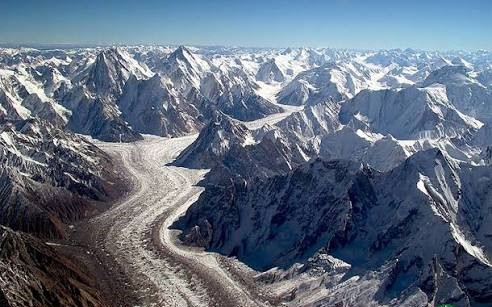
GILGIT: The government of Gilgit-Baltistan announced on Saturday that it will establish a new authority dedicated to protecting the region’s glaciers, a step officials described as essential to confronting the accelerating effects of climate change in one of the most glaciated landscapes outside the polar regions.
The announcement came from Chief Minister Amjad Hussain during a briefing with the region’s Forest and Wildlife Department, and it arrived on the same day that Pakistan’s national weather agency issued a fresh flood warning for the same mountainous terrain — underscoring the urgency behind the initiative.
Hussain said a specialised committee will be assembled to draft detailed recommendations for the new Glaciers Protection Authority, which will then be presented to the appropriate government forum for approval. He framed the effort as part of a broader push to preserve the region’s forests, which he said play a direct role in blunting the impact of climate change and safeguarding glaciers from further deterioration.
“Forestry is important to mitigate climate change impacts and for protection of glaciers,” Hussain told department officials.
The chief minister did not offer a timeline for when the committee would complete its work or when the authority might formally begin operating. He said the goal is also to position the region to draw support from international organisations already engaged in glacier and climate research.
A warning system under strain
The push to create a dedicated glacier authority reflects a mounting crisis playing out in real time across Gilgit-Baltistan. Rising daytime temperatures have accelerated the melt of the region’s glaciers, swelling rivers and streams and triggering mudflows that have already caused damage in low-lying communities downstream.
The Pakistan Meteorological Department added to those concerns Saturday, issuing a widespread alert warning of the potential for glacial lake outburst floods — sudden, often catastrophic releases of water known in the region by the shorthand GLOF — across both Gilgit-Baltistan and the neighbouring province of Khyber Pakhtunkhwa. The agency said a new westerly weather system moving through the region over the coming week is expected to bring a mix of rain and thunderstorms to areas already registering above-normal temperatures.
That combination, the department said, creates conditions ripe for rapid snow and ice melt across the region’s glaciated valleys.
Forecasters cautioned that river levels are likely to stay dangerously elevated in the days ahead, and that existing glacial lakes could grow larger while new ones form as meltwater accumulates. Officials are particularly concerned about the natural ice and debris dams that hold many of these lakes in place; as the lakes expand, those dams can become unstable, raising the risk of a sudden and severe outburst flood.
The department also warned that warming ground temperatures, combined with excess surface water, could set off mud and debris flows barreling down mountain slopes — a hazard distinct from, but related to, the flood risk posed by the glacial lakes themselves.
In light of those threats, the agency urged residents and travelers in snow-covered and glaciated valleys to keep away from riverbanks, streambeds and local waterways, and to watch closely for any sudden or gradual shifts in water levels. It also advised against camping, trekking or lingering near rivers, streams, glacial lakes or narrow mountain valleys until the threat passes, and warned people to avoid unstable slopes where melting snow could trigger landslides.
The meteorological department called on residents to stay current with its forecasts and alerts, and directed disaster management agencies across the region to remain on continuous alert and move quickly on any necessary precautions.
Emergency officials say systems are in place
Zakir Hussain, director general of the Gilgit-Baltistan Disaster Management Authority, said Saturday that his agency is prepared to respond to any outburst flood that may occur.
He said the region’s Emergency Response Centre is staffed around the clock, and that control rooms operated by deputy commissioners in every district remain active at all hours. The authority also stays in close contact with community-based committees formed specifically to manage disaster risk at the local level, he said.
Those community networks are part of a broader early warning system developed under the Glof-II project, an international initiative aimed at reducing the risk posed by glacial lake outburst floods. Zakir Hussain said the project has established 17 community centers across the region, where residents receive training on how to respond if a flood strikes, including how to communicate quickly with emergency officials.
He said his agency is already carrying out relief work in areas affected by the current monsoon season, under a contingency plan mobilised for that purpose. Should conditions worsen, he added, the authority has both the staffing and a backup plan to respond.
“For reinforcement, the GBDMA has sufficient staff; if anything happens, we also have a backup plan,” Zakir Hussain said.
He said 174 early warning systems are currently installed and functioning throughout Gilgit-Baltistan. Those systems, he explained, are installed and maintained by the national meteorological department, which relays forecasts and alerts to the relevant authorities as conditions develop.
Zakir Hussain acknowledged that his agency, along with Pakistan’s National Disaster Management Authority and other provincial disaster bodies, does not have the technical expertise to operate the early warning systems directly or to generate weather forecasts on its own. Instead, he said, those organizations are responsible for accurately relaying the information and predictions issued by the meteorological department to the public and to local officials.
To keep pace with the fast-moving situation, he said, his agency compiles updated situation reports on conditions in every district on a daily basis.
Copyright © 2021 Independent Pakistan | All rights reserved