By Staff Reporter
ISLAMABAD: The United States and Iran pounded each other’s forces for a second consecutive day on Monday, with American warplanes and drones striking dozens of targets across Iran and Tehran answering with missile and drone attacks on US military installations spread across five Gulf countries, plunging a monthlong ceasefire deeper into crisis and sending oil prices sharply higher.
The exchange, far broader in scope than earlier rounds of strikes, reached American allies that had largely been spared until now. Iran’s Revolutionary Guards said they struck a US-linked airbase in Jordan, a drone command center in Bahrain, radar installations in Oman, and a jet maintenance facility in Qatar — a country that had insisted for weeks it would not serve as a mediator between Washington and Tehran while itself under fire. Three people, including a child, were wounded there by falling shrapnel, Qatari officials said, calling Iran “fully legally responsible” for the strikes.
The intensifying violence has cast serious doubt over an interim accord signed last month that had briefly reopened the Strait of Hormuz to commercial traffic and set both sides on a 60-day path toward a comprehensive settlement. That truce now appears to be unraveling in real time, even as Pakistan, Qatar, and Oman continue working urgently behind the scenes to keep the diplomatic channel open.
“The role of the mediators is to continue their efforts to prevent an escalation of tensions,” Iranian Foreign Ministry spokesperson Esmaeil Baghaei told reporters in Tehran on Monday, adding that his government remained in active contact with all three mediating nations. “We will use all means at our disposal to defend our national interests,” he said, without disclosing whether another formal round of negotiations with Washington was being scheduled.
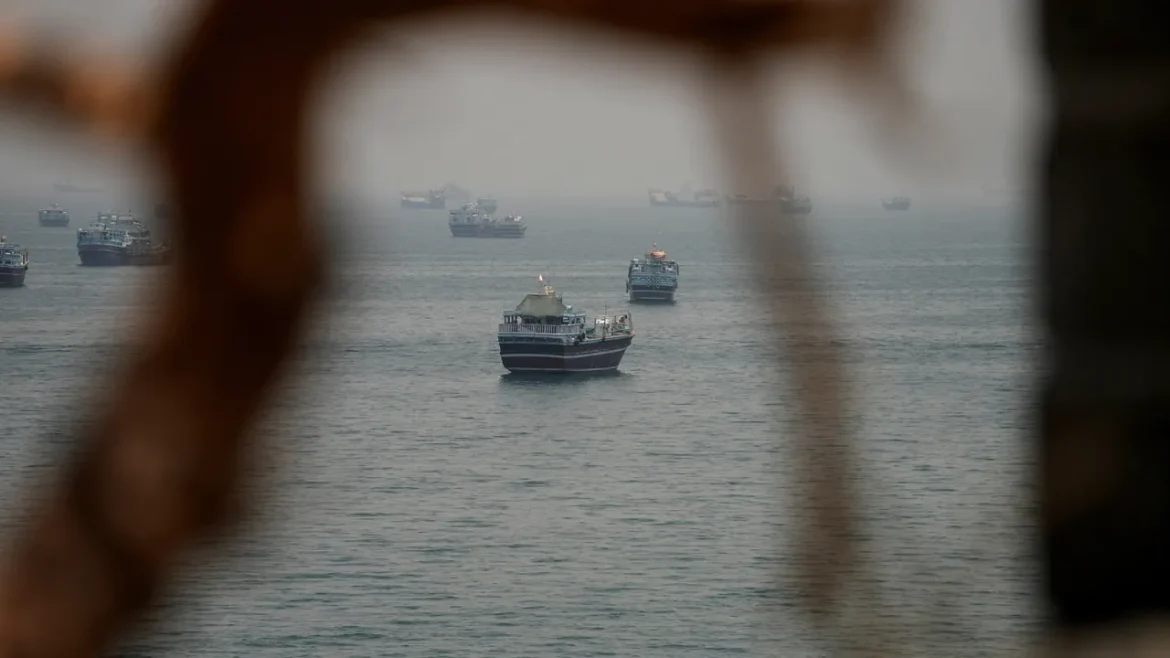
The renewed fighting has reopened the question of who controls one of the world’s most important commercial arteries. Before the war began in late February, the Strait of Hormuz carried roughly one-fifth of the globe’s daily oil and liquefied natural gas shipments. Ship-tracking data compiled by the analytics firm Kpler showed only six vessels transited the strait on Sunday, the lowest one-day count in five weeks, as shipping operators grew increasingly wary of sailing into a war zone.
Brent crude jumped more than 3 percent in early trading on Monday, climbing above $78 a barrel, while the US benchmark West Texas Intermediate rose a similar margin to trade near $74. Both figures marked a sharp reversal from the price declines that followed last month’s ceasefire announcement, and analysts said the market was now pricing in a real chance that the strait could remain effectively closed to shipping for an extended period.
“The focus will remain on the number of inbound tankers, as a lower number could impact production,” said Giovanni Staunovo, an analyst at UBS. “So currently we see a risk premium, as well as a disruption risk, supporting prices.”
A DIPLOMATIC BREAKTHROUGH UNDONE
The current crisis traces back to an agreement that, only weeks ago, had appeared to offer a genuine off-ramp from the war. Pakistan and Qatar had played leading roles in brokering what became known as the Islamabad Memorandum of Understanding, an interim accord that halted hostilities in June, reopened the Strait of Hormuz to commercial vessels, and committed Washington and Tehran to negotiating a comprehensive settlement within 60 days.
Follow-up talks in June brought American and Iranian negotiators together with Pakistani and Qatari mediators in Bürgenstock, Switzerland, for the first high-level session on implementing that agreement. The parties emerged having agreed to form a high-level oversight committee, establish working groups on the nuclear file, sanctions, and dispute resolution, and open direct communication channels intended to head off military incidents and protect commercial navigation through the strait. They also endorsed a broader roadmap toward a final settlement and agreed to keep talking at the technical level — discussions that continued afterward in Doha, where Pakistani officials said progress had been made on implementing parts of the Islamabad accord, though no date was set for a further round.
Oman, which has served for years as a back-channel between Washington and Tehran even when formal diplomacy has broken down elsewhere, has continued its own parallel conversations with Iranian officials. Foreign Minister Abbas Araghchi and his Omani counterpart met on Saturday in Muscat specifically to discuss arrangements for managing the strait, though Iran’s Foreign Ministry said afterward that the talks had failed to produce results because of what it called “overt and covert” pressure from Washington on Oman.
That accusation came alongside a broader condemnation from Tehran. In a statement on Monday, Iran’s Foreign Ministry said the weekend’s American strikes had “caused the return of insecurity” to the strait and had “rendered futile” months of effort to reduce tensions and build a lasting peace in the region.
Pakistan, for its part, has pressed both sides toward restraint since the fighting resumed, warning that a return to full-scale war would threaten not just regional stability but the broader economic health of the Middle East. Deputy Prime Minister and Foreign Minister Ishaq Dar spoke by phone on Sunday with Araghchi and urged de-escalation. “Dialogue and diplomacy remain the only viable path to resolving disputes and achieving lasting peace,” Dar said afterward.
WEEKEND OF ESCALATING STRIKES
The latest rupture began late Saturday, when Iran announced it had closed the Strait of Hormuz altogether after firing what it described as a warning shot at a commercial vessel that had strayed from an authorized shipping lane. The ship caught fire and its crew was forced to abandon it. India said one of its nationals was missing after the attack on the container ship, identified as the GFS Galaxy, off the coast of Oman; Omani authorities said 23 crew members had been rescued. A second vessel was disabled in similar fashion on Sunday, according to Iranian officials.
Iran’s Revolutionary Guards declared afterward that the strait “would be closed until further notice and until the end of American interventions in this region,” according to the state news agency IRNA. Iran’s newly created Persian Gulf Strait Authority said permits for passage would be issued only once “stability and calm” had been restored. US Central Command flatly rejected the claim, insisting on the social platform X that the waterway remained “open to all vessels seeking to lawfully transit” and that American forces were positioned to guarantee that access. “Iran does not control the strait,” the command said. “Traffic is flowing.”
The Pentagon’s assurances did little to calm shipping operators. Qatar advised all vessels in its waters — including leisure boats, fishing boats, and jet skis — to suspend activity altogether. The US Navy-led Joint Maritime Information Center continued to advise that an alternate southern route near Oman remained open for two-way traffic despite what it termed a severe security threat.
American forces responded Saturday with a wave of strikes that Central Command said hit 140 Iranian military targets, bringing the total struck over three nights of fighting that week to more than 300 — an effort the command said was aimed at degrading “Iran’s ability to attack civilian mariners and commercial vessels freely transiting the strait.” Iran answered within hours. Its Revolutionary Guards said they had destroyed a command-and-control center and drone hangars at a base in Jordan, a longtime US security partner; struck a radar site and, later, rocket-launcher systems in Kuwait; hit facilities supporting US aircraft carrier operations and refueling in Oman; and destroyed a jet maintenance center and command facility in Qatar.
The barrage that followed Sunday night into Monday marked a further escalation in both pace and geographic reach. Central Command said it launched a fresh wave of strikes at 5 p.m. Eastern time Sunday — 9 p.m. GMT — describing the operation in a subsequent post as a series of “offensive strikes” that hit “dozens of targets at multiple locations with precision munitions to degrade Iran’s ability to continue attacking international shipping.” For the first time, the command said, American forces used one-way attack sea drones alongside fighter aircraft, naval vessels, and aerial drones to hit Iranian air-defense systems, coastal radar sites, missile and drone capabilities, and small boats. A Central Command spokesperson, Tim Hawkins, said American aircraft shot down an Iranian cruise missile and a one-way attack drone during the fighting.
Iranian state media reported that the American strikes struck wide areas of southern and western Iran, including Qeshm Island and the port city of Bandar Abbas near the strait, along with sites in Khuzestan province along the Iraqi border. An agricultural water pumping station in the city of Mahshahr was hit, according to an Iranian official cited by state media; the deputy governor of Khuzestan province told the IRNA news agency that one person was killed and four others injured in that province.
Iran’s response reached further than in previous rounds. The Revolutionary Guards said their forces struck Jordan’s Prince Hassan Air Base, setting fire to fuel storage tanks and ammunition depots used by the US military there, in what the Guards described as the first phase of retaliation. In the second phase, Iran said it struck a military installation at Bahrain’s Sheikh Isa base; while the US Fifth Fleet is headquartered in Bahrain, its headquarters is not located at Sheikh Isa, though the Bahraini base has hosted American military aircraft and operations. Iran also claimed strikes on the Ali Al Salem and Ahmad Al Jaber bases in Kuwait, both Kuwaiti facilities that host US forces. Iranian naval forces, separately, said they had targeted and destroyed American military facilities in Jafirah, Bahrain, and had destroyed a long-range airborne radar system and a ship-detection radar system in Oman. An Iranian air-defense unit also said it shot down a US drone — described as a Low-Cost Uncrewed Combat Attack System — near Bandar Abbas on Monday, according to the Mehr news agency. The United States had not responded publicly to that claim as of Monday.
Beyond the Gulf states, the fighting also touched the United Arab Emirates, which had not come under attack since early May; its air defenses engaged incoming missiles and drones, officials there said. Bahrain said it intercepted several aerial attacks, Jordan reported missile strikes on its territory, and Oman said it had been targeted by drones and had summoned Iran’s ambassador to protest strikes in two of its regions. Kuwait’s army reported damage from the fighting and said an attack on an oil drilling platform there had injured a worker. The US Embassy in Oman told American citizens in the towns of Duqm and Musandam to shelter in place.
Sunday evening’s fighting had followed a similar pattern: Iran reported strikes on two of its own southern islands, while Kuwait said its border posts and an offshore oil platform had come under attack. Iranian state media reported explosions in several port cities that evening, including around Sirik and Bandar Abbas and nearby Qeshm Island.
TRUMP DECLARES CEASE-FIRE OVER, EYES CONTROL OF STRAIT
The immediate trigger for the weekend’s escalation traces to earlier in the week, when President Trump declared that the ceasefire reached alongside last month’s interim accord had effectively collapsed, while leaving open the possibility of further negotiations. “We had a deal. It was a done deal, and then they broke it. They always break it,” Trump said. “We’ve had 10 deals with these people, and so we’re just going to hit them very hard.”
In a phone interview with Fox News’ “Fox & Friends” on Monday, Trump went further, suggesting the United States should take direct control of the Strait of Hormuz and be compensated for the arrangement. “We’re going to keep the strait, and we’ll probably run it. We’ll become the guardian of the strait. Maybe we’ll call it the guardian angel of the strait. And we should be reimbursed for that,” he said. “We’re going to guard it. We’re going to get paid for guarding it — a lot of money,” he added, arguing that other nations benefiting from secure passage through the waterway were wealthy enough to help cover the cost. “We’re going to be reimbursed, because the other nations are very wealthy. They’re on our side, and we can’t be expected to do that for nothing.”
In a separate, brief phone conversation with Reuters on Sunday, Trump characterized the American military campaign in blunter terms. “We’re beating them up,” he said.
Washington had already moved earlier in the week to tighten economic pressure on Tehran, revoking on Tuesday a license that had permitted limited sales of Iranian crude oil — a step Araghchi said Saturday amounted to a violation of the interim deal.
Iran’s chief negotiator, Mohammad Bagher Ghalibaf, responded to the intensifying campaign with a pointed message posted to social media on Sunday, accompanied by an image of the section of the US-Iran memorandum dealing with reopening the strait. “The era of one-sided deals is OVER,” he wrote. “We told you: keep your word or pay the price. Reality is knocking.” Control of the waterway has become, in effect, the central point of leverage in the broader conflict. An adviser to Iran’s supreme leader said on Sunday that command of the strait was worth more to Tehran than “dozens of atomic bombs.”
MARKETS BRACE FOR A LONGER DISRUPTION
The economic consequences have rippled well beyond the Gulf. Analysts at ANZ noted that shipping operators were growing markedly more cautious, with inbound vessel movements slowing sharply as security concerns mounted. Goldman Sachs, in a research note, estimated that expanded pipeline capacity elsewhere in the Middle East could eventually shield more than 60 percent of prewar Gulf oil exports from any future disruption at Hormuz by the end of 2028 — though that relief remains years away. The bank’s base-case forecast assumes bypass pipeline capacity will grow by 3.8 million barrels per day by the end of 2027 and by a cumulative 7.3 million barrels per day by the end of 2028, pushing total capacity able to avoid the strait past 14 million barrels a day.
In the meantime, Iranian oil supplies held offshore have been accumulating even as Tehran ramped up exports during the brief ceasefire period, traders said, because Chinese independent refiners — long among the largest buyers of discounted Iranian crude — have increasingly turned instead to cheaper oil from Iraq, the United Arab Emirates, and Qatar. The Abu Dhabi National Oil Company set its August price for benchmark Murban crude at $80.01 a barrel Monday, down sharply from $101.48 a barrel a month earlier, a sign of how much the broader oil market had cooled before this weekend’s renewed fighting.
Higher prices at the pump carry particular political weight for Trump as the country heads toward November’s congressional elections, a dynamic that has added urgency in Washington even as the administration presses ahead with strikes on Iranian targets.
Copyright © 2021 Independent Pakistan | All rights reserved