By Staff Reporter
QUETTA: Security forces killed six more militants in Balochistan province on Tuesday, officials said, raising to 85 the number of terrorists killed since the launch of a major counterterrorism sweep earlier this month.
The officials, who spoke on condition of anonymity in line with standard practice for security matters, said the killings occurred during Operation Shaban, a joint offensive by the Pakistan Army, the paramilitary Frontier Corps and Balochistan police. State-run Pakistan Television, citing security sources, reported the same six killings.
Officials said the broader crackdown, which includes Operation Shaban and other intelligence-based raids across the province, has killed 123 militants since July 5. A day earlier, officials had reported eight militants killed in separate operations.
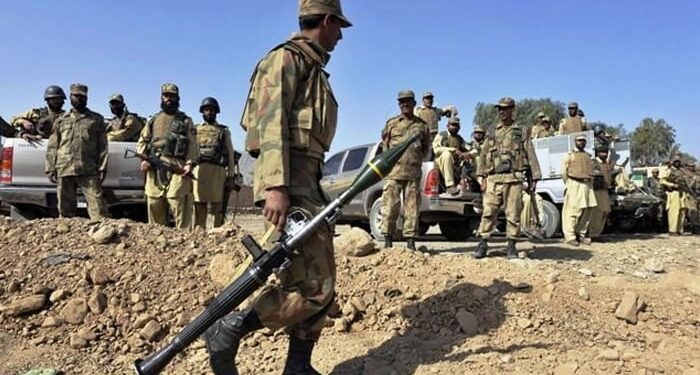
Security forces said they recovered a large quantity of weapons from the militants killed Tuesday, including M4 rifles, submachine guns, rocket launchers and mobile phones. Officials said the operation, which involves both air and ground strikes, would continue “until the last terrorist is eliminated.”
Operation launched after deadly police post attack
The operation is being carried out jointly by the Pakistan Army, the paramilitary Frontier Corps, and Balochistan police, using both ground assaults and airstrikes. State television footage broadcast in recent days has shown army helicopter gunships sweeping over the mountainous terrain that covers much of the province, engaging militant positions.
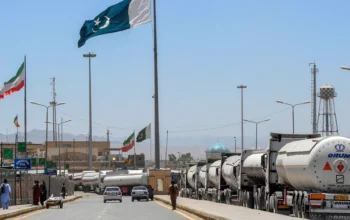
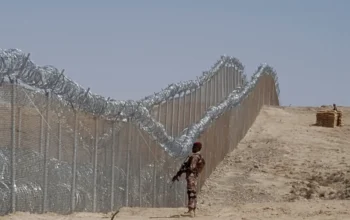
Balochistan, Pakistan’s largest province by land area but its least populated, sits along the country’s borders with Afghanistan and Iran. It has endured a separatist insurgency for two decades, driven chiefly by the banned Baloch Liberation Army, which seeks independence for the ethnic Baloch population and has increasingly targeted security forces and infrastructure tied to Chinese investment in the region. In recent years, the Pakistani Taliban — formally the Tehrik-e-Taliban Pakistan, and known within Pakistan by the government’s preferred term, Fitna al-Khawarij — has also stepped up attacks in the province, complicating what was already one of the most volatile corners of South Asia.
The current offensive traces back to July 5, when militants stormed a police post in the Mangi Dam area near Ziarat, in what officials have called one of the deadliest single attacks on Pakistani security forces in recent years. Twenty-seven police officers were killed. Pakistan’s top military spokesman, Lt. Gen. Ahmed Sharif Chaudhry, said in a briefing days later that the toll from that attack and the operations that followed had climbed to at least 42 dead altogether — four civilians, 27 police officers, and 11 additional security personnel — a reflection of how quickly the violence metastasized across the province in the days after the initial assault.
Interior Minister Mohsin Naqvi, in a statement posted to his ministry’s account on the social media platform X, praised the army and Balochistan’s Frontier Corps and police for the killing of the latest five militants, calling the operation evidence of what he described as the forces’ professionalism and readiness. He said the campaign would press on “until the elimination of Fitna al-Hindustan terrorists” — a term Pakistani officials use for Baloch separatist fighters, whom the government accuses of receiving backing from India. New Delhi has repeatedly denied any role in the insurgency.
“Those responsible for shedding the blood of innocent people in Balochistan deserve no leniency,” Naqvi said. He added that the broader campaign, which he said had by his count killed 114 fighters, “reflects the high level of preparedness, professionalism, and operational readiness of Pakistan’s security forces,” and said the country stood behind its military and police as the operation continues.
UN report cites rising violence, cross-border ties
Violence has escalated sharply in Balochistan and in Khyber Pakhtunkhwa province since the Taliban returned to power in neighboring Afghanistan in 2021, and Pakistani forces have stepped up operations in both regions.
A United Nations Security Council report released in February documented a series of attacks by the Baloch Liberation Army, a separatist group banned in Pakistan, against security forces and infrastructure tied to the China-Pakistan Economic Corridor. The report said the BLA ambushed a military convoy on September 16, 2025, killing 32 soldiers, and that despite Pakistani counterterrorism operations, the group had remained active.
The report also cited an attack in which the BLA hijacked a train, the Jaffar Express, in Balochistan on March 11, 2025, killing 31 people, including 21 hostages — an assault the UN report described as showing “a high degree of complexity and brutality.”
According to the report, some U.N. member states said the BLA had coordinated with the Pakistani Taliban, known as the TTP, and with the Islamic State group’s regional affiliate, ISIL-K, sharing training camps and resources and coordinating attacks. Other member states, the report said, found no evidence of ties between the BLA and al-Qaida or ISIL.
A separate monitoring report by a U.N. sanctions committee, released in August 2025, said the BLA — including a unit known as the Majeed Brigade — and the TTP had engaged in “close coordination.”
The U.N. report also said militant groups operating from Afghan territory had obtained advanced weapons, including night-vision and thermal-imaging equipment, sniper systems and drones, through cross-border smuggling and black-market trade. It said much of the equipment appeared to have been supplied “in conjunction with weapons permits and travel documents” issued by Afghanistan’s Taliban-led government — an allegation the Taliban has not publicly addressed in this reporting.
Tensions with Afghanistan persist
In response to the broader rise in attacks, Pakistan has carried out cross-border strikes on militant hideouts in Afghanistan, an offensive it calls Operation Ghazab lil-Haq. Pakistani officials say the strikes have killed and wounded significant numbers of Afghan Taliban fighters, though independent casualty figures were not available.
Several rounds of talks between Islamabad and the Taliban government in Kabul have failed to produce an agreement, with Pakistani officials saying the Taliban has been unwilling to act against militant groups operating from Afghan soil.
Copyright © 2021 Independent Pakistan | All rights reserved