By Staff Reporter
ISLAMABAD: Prime Minister Shehbaz Sharif on Tuesday condemned a barrage of ballistic missiles that Yemen’s Houthi movement fired at Saudi Arabia, invoking a year-old mutual defense pact between the two countries and warning that the attack threatened to further destabilize an already volatile Middle East.
The missiles, launched on Monday night at southern Saudi Arabia, were intercepted by Saudi air defenses, according to Saudi authorities. The Houthis said the strike was retaliation for a Saudi-backed assault on an airport the group controls in Sanaa, Yemen’s capital — an exchange that shattered a truce that had held for roughly four years and kept the kingdom largely out of direct confrontation with the Iran-aligned militia.
“Pakistan strongly condemns the blatant attacks carried out against the brotherly Kingdom of Saudi Arabia last night,” Sharif said in a statement, adding that the assault “constitute[d] a violation of the sovereignty and territorial integrity of the Kingdom of Saudi Arabia” with the potential to “further undermine regional peace and stability.”
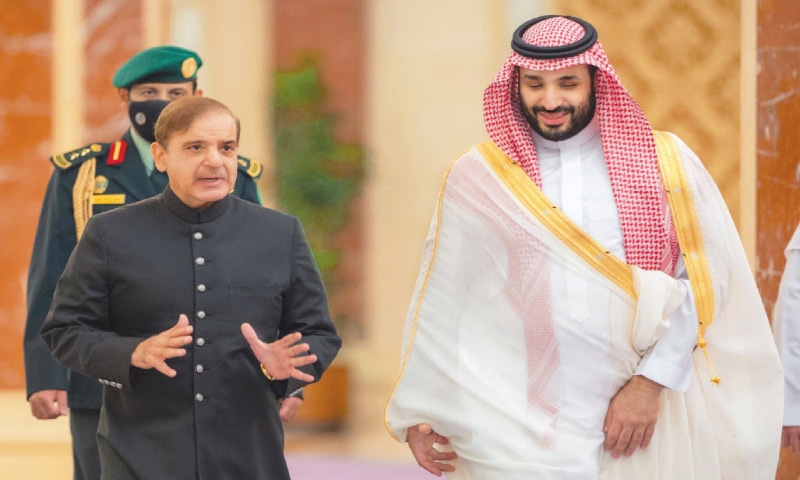
The condemnation was among the strongest Pakistan has issued over the widening conflict in Yemen, and it underscored the depth of a defense relationship that Islamabad and Riyadh formalized last September, when the two governments signed a mutual security agreement in the Saudi capital. Under its terms, an armed attack on either country is to be treated as an attack on both. Sharif said his government would “continue to support all sincere efforts aimed at promoting peace, stability, security, and mutual understanding across the region.”
The prime minister’s statement followed a similarly forceful message delivered a day earlier by Pakistan’s delegation at the United Nations, where an emergency Security Council session on Yemen was convened after Monday’s escalation. Ambassador Usman Jadoon, Pakistan’s deputy permanent representative to the UN, told the council that Islamabad stood in “full solidarity” with Saudi Arabia and reaffirmed the kingdom’s right to security, sovereignty and territorial integrity.
Jadoon also addressed the toll the war has taken on Yemen itself, saying years of fighting had left the population enduring “displacement, economic hardship, food insecurity and the collapse of essential services,” and he called for a Yemeni-led political settlement, brokered by the UN, as the only durable path to peace. He cited a prisoner exchange completed in May, in which the Yemeni government and the Houthis traded more than 1,600 detainees, as evidence that negotiation could still yield results even amid active hostilities.
The ambassador further condemned what he described as the Houthis’ arbitrary detention of United Nations staff, humanitarian workers and diplomats, along with the seizure of UN facilities, and demanded their immediate release.
Monday’s confrontation marked the most serious flare-up between the Yemeni government and the Houthis in years. It began when Yemeni government forces struck the international airport in Sanaa, which has been under Houthi control since the militia seized the capital in 2014. Yemeni officials said the strike was intended to stop an Iranian aircraft from landing after they failed to persuade a Houthi delegation — in Tehran for the funeral of Iran’s assassinated supreme leader, Ayatollah Ali Khamenei — to instead fly home aboard Yemen’s national flag carrier. Hours later, Saudi Arabia reported the missile launches toward its southern border.
The Houthis have accused Saudi Arabia of engineering the airport strike, and they say the missile attack was a direct response. The exchange has raised fears in the region that the fragile calm brokered by the UN in 2022, after years of a Saudi-led military campaign against the Houthis, could unravel entirely.
Pakistan has positioned itself as an advocate for de-escalation throughout the conflict, which began after the 2014 Houthi takeover of Sanaa prompted a Saudi-led coalition to intervene militarily the following year on behalf of Yemen’s internationally recognized government. Islamabad’s relationship with Riyadh, meanwhile, has long been one of the more consequential alliances in its foreign policy, built on decades of defense and security cooperation that both governments have described as central to their regional diplomacy.
“We call on the parties concerned to resolve differences through dialogue, diplomacy and a steadfast commitment to de-escalation,” Jadoon told the Security Council, a message Sharif’s office echoed a day later as it moved to align Islamabad firmly behind Riyadh.
Copyright © 2021 Independent Pakistan | All rights reserved