By Staff Reporter
RAWALAKOT: A paramilitary Rangers was shot and killed early on Tuesday and a second was wounded in a burst of gunfire that police blame on armed supporters of a banned protest movement — the latest and, by several accounts, far from the only fatality in a night of clashes that has left the territory bracing for its most contentious election in years.
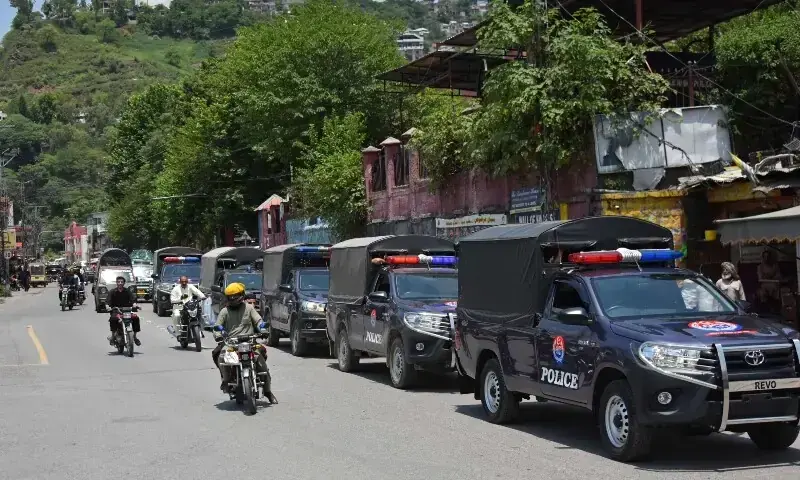
The shooting took place before dawn near the Matial Maira bus terminal, a spot that has become a flashpoint in weeks of unrest led by the Jammu Kashmir Joint Awami Action Committee, a coalition that the regional government outlawed last month under anti-terrorism statutes. Police said gunmen tied to the group opened fire indiscriminately in a residential area, then turned their weapons on officers and Rangers who arrived to restore order, also deploying explosives during the exchange.
Local residents and organizers offered a starkly different account of the night, describing a broader and bloodier confrontation across the Poonch Division that they say left as many as six people dead — including, they allege, protesters and bystanders — with the Ranger’s death occurring alongside, not apart from, a security operation against a sit-in that has drawn thousands to the streets.
Radio Pakistan, the state broadcaster, reported only that one Rangers personnel embraced martyrdom after being struck by direct fire. Those statements did not address the additional deaths reported by residents, and the protest committee had not issued a public response to the police allegations as of Tuesday afternoon.
The discrepancy is emblematic of a monthlong information war that has accompanied the unrest, waged amid intermittent internet restrictions that have made independent verification difficult. What is not in dispute is the toll the crisis has already taken: Rights advocates and local reporting put the number of people killed since protests intensified in early June at well over a dozen, with government tallies and outside accounts diverging on the precise figure, and thousands of security personnel deployed across a territory of steep, forested valleys where the state’s authority has rarely been so openly tested.
A movement transformed
The Joint Awami Action Committee did not begin as a separatist or overtly political organization. It grew out of local frustration over electricity bills, wheat subsidies and what residents describe as years of unmet government promises — grievances that, in past cycles of protest, the group’s leaders successfully negotiated into concessions from Islamabad.
This year’s campaign has taken a different, more combustible turn. Since a regional Supreme Court ruling upheld the constitutionality of 12 legislative seats reserved for refugees who fled to Pakistan from Indian-occupied Kashmir after the 1947 partition, the committee has made abolishing those seats its central demand, arguing they let Pakistan-based political parties tilt the formation of governments in territory that is nominally self-governing. The government banned the group weeks later, accusing it of violence that its leaders deny, and the crackdown that followed — mass arrests, a communications blackout, and what families in at least one Rawalakot neighborhood describe as searches that turned into looting — has hardened positions on both sides rather than settled them.
The government, for its part, has cast the confrontation in far starker terms. Unnamed officials cited in statements distributed to reporters described Tuesday’s violence as proof the group is “systematically challenging the writ of the state,” and called the use of automatic weapons and improvised explosives evidence of a coordinated campaign rather than a spontaneous clash — language that all but previewed an intensified security response even as it was being issued.
Pressure ahead of the vote
The stakes are compounded by timing. Azad Kashmir’s Election Commission has scheduled legislative elections for July 27, and the government has insisted repeatedly that the vote will go forward despite the unrest. The protest committee has warned just as insistently that it intends to keep pressing its campaign — including, its leaders have said, a long march toward the regional capital of Muzaffarabad — unless the government meets its demands beforehand, a collision course that Tuesday’s violence did nothing to soften.
The political fallout has already reached well beyond Rawalakot. On Monday, the territory’s Education Department suspended 20 current and former employees in the Rawalakot and Sudhnoti districts, accusing them of joining the protest sit-ins — 15 teachers, three support staff, a laboratory assistant and a clerk, according to officials, who said an inquiry officer has been assigned to investigate. The suspensions followed a broader review by authorities in the Rawalakot Division, who compiled a list of roughly 100 government employees, active and retired, suspected of participating in or supporting the demonstrations and forwarded it for possible disciplinary action.
What comes next
Security forces began clearing barricades and other obstacles placed by members of the banned activist group at major entry and exit points on Tuesday, hours after a confrontation in Rawalakot left one paramilitary officer dead and another wounded.
Home Secretary Chaudhry Guftar Hussain said at a press conference that the clearance operation would continue until every route is fully open. He stressed that the government would not tolerate threats or attempts to paralyze the territory.
“The state is committed to protecting human lives and property against all threats and to ensuring the continuation of economic, educational and business activities, and restoring normalcy across the region,” Hussain said. “The state will not accept any threat or blackmail, and all blackmailers will be treated with an iron hand.”
Hussain described an incident earlier Tuesday in Rawalakot in which members of the banned Jammu and Kashmir Awami Action Committee opened fire was an effort to provoke crowds and create fear. When police moved in to stop the shooting, the group responded with automatic weapons and explosives. Law enforcement agencies then launched an operation, with Rangers arriving to assist. The attackers used modern weaponry and improvised explosives, killing one officer on duty and wounding another.
Hussain said the operation was required because the group possessed modern weapons. He noted that the banned group’s leader, Khwaja Mehran, had issued a fresh 48-hour deadline to shut all entry points into the territory. The home secretary said the vast majority of people had already distanced themselves from the committee and that it lacked the strength to close the routes or bring the territory to a standstill. He accused the group of trying to shift blame onto the government through threats and propaganda.
The disruptions caused by the group have already cost the Azad Jammu and Kashmir government billions in lost revenue from tourism, business and transport, Hussain said. “Their issue is not human rights; they are enemies of the state’s peace, development and economy.”
Authorities announced that the banking system had been restored following timely government intervention.
The territory’s education secretary said the banned group had tried to draw women, children and students into the protests, effectively using them as human shields. The government has sent letters to schools and colleges directing administrators to keep students out of any violent demonstrations. All higher educational institutions, including medical colleges, reopened across Azad Jammu and Kashmir on Tuesday.
“People don’t want unrest; they want peace, stability and progress,” Hussain said.
Copyright © 2021 Independent Pakistan | All rights reserved