By Staff Reporter
KARACHI: The man accused of orchestrating a deadly assault on a paramilitary Rangers facility in Karachi last month was arrested in the days after the attack, senior police officials said on Tuesday, laying out what they described as a plot conceived, financed and directed from across the border in Afghanistan.
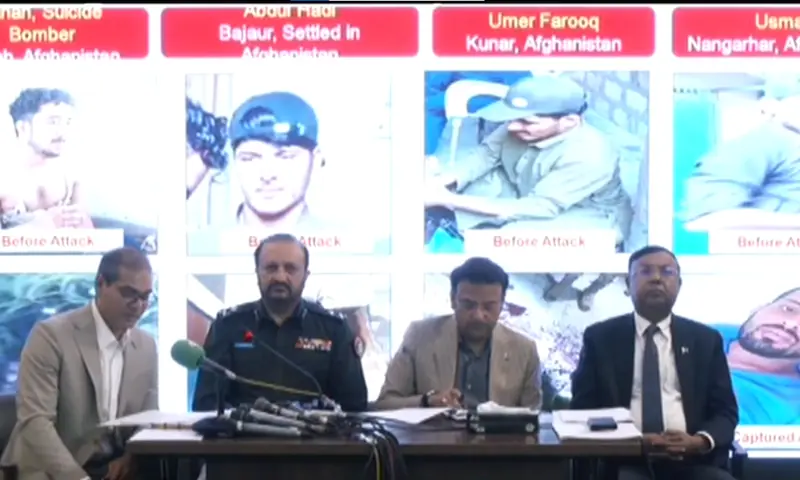
At a news conference at the Central Police Office, City Senior Superintendent of Police Irfan Bahadur named the man as Qari Basheer, who also goes by Qari Habib, and said he had been taken into custody by Pakistan Rangers personnel during the investigation that followed the June 27 attack. Bahadur, appearing alongside Sindh Home Minister Ziaul Hassan Lanjar, said Basheer had confessed to his role and told investigators that leaders of a banned militant network based in Afghanistan had given him direct instructions on how to carry out the assault.
The attack unfolded on the night of June 27, when terrorists struck the local camp of the Pakistan Rangers (Sindh) in Karachi’s Gulistan-e-Jauhar neighborhood. Three security personnel were killed and four were wounded, according to the Inter-Services Public Relations wing of the Pakistani military, before Rangers personnel killed three of the four attackers and captured the fourth alive, though injured.
The military’s media wing had said in the immediate aftermath that the assault was the work of terrorists “belonging to Indian proxy Jamaatul Ahrar,” a faction that has splintered off from the outlawed Tehreek-e-Taliban Pakistan, or TTP. Bahadur’s account Tuesday went further, tracing what he described as a chain of command running from senior TTP figures in Afghanistan down through a Karachi-based support network that sheltered, transported and armed the attackers in the days before they struck.
“The entire planning of this terrorist attack was carried out on the territory of Afghanistan,” Bahadur told reporters.
A plot in four phases
Bahadur walked through what he called the four phases of the operation. The first, he said, was the recruitment and training of the attackers inside Afghanistan. The second was moving four Afghan militants from Afghanistan into Karachi. The third involved what he described as continued direction from Afghan soil of a facilitator network already operating inside the city, with instructions relayed to the attackers “till the last stage.” The fourth and final phase, he said, was the delivery of weapons, ammunition and a suicide vest to the men once they were in position.
“And lastly, the provision of weapons, ammunition and suicide jackets to terrorists,” Bahadur said.
The officer identified the four attackers individually. The suicide bomber, he said, was a man named Janaan, from Afghanistan’s Farah province. A second attacker, identified as Bilal, also known as Hadi, was born in Bajaur, in Pakistan’s tribal belt, but had since relocated across the border to Kandahar. A third, killed in the exchange of fire, was named as Umer Farooq, of Afghanistan’s Kunar province. The fourth, captured alive and wounded, was identified as Usman Sher Mohammad, from Afghanistan’s Nangarhar province and now receiving medical treatment.
Bahadur said the plot’s origins traced back to Noor Wali, described by the government as head of what it terms “Fitna al-Khawarij” — the official designation now used by Pakistani authorities for the TTP — along with a figure identified as Sher Wali, alias Mukhlisyar, and a TTP Shura council member named Saeed Shah. According to Bahadur, the three men summoned Basheer, described as a leader within Jamaatul Ahrar, from Pakistan into Afghanistan and assigned him responsibility for the Karachi attack.
“During his interrogation, he detailed how the leadership of Fitna al-Khawarij from Afghanistan gave him instructions for the attack,” Bahadur said.
Investigators played a recorded statement from Basheer during the news conference, in which he described traveling to Afghanistan and meeting Saeed Shah, who he said arranged a meeting with Noor Wali and Sher Wali. “They gave me a task for action against the police, army and Rangers in Karachi,” Basheer said in the recording.
A separate recorded statement from Usman, the surviving attacker, was also played. According to Bahadur’s account of that interrogation, Usman said the four men had trained together at militant camps inside Afghanistan before being dispatched into Pakistan specifically to strike the Rangers facility. Bahadur said a TTP figure identified as Moulvi Tahir, described as an important member of the organization, had selected Usman from a religious seminary — Jamia Siddiqia, in Afghanistan’s Kunar province — and handed him off to a Jamaatul Ahrar commander identified as Qari Abdul Manaan. The four attackers, Bahadur said, were ultimately trained at two camps in Nangarhar province.
Facilitators and a route through Balochistan
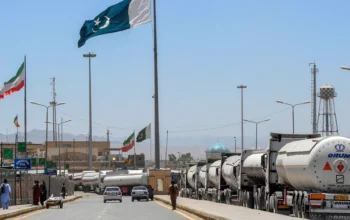
Bahadur said the four men entered Pakistan by moving through several areas of Afghanistan before crossing the border, then traveled through Balochistan province before reaching the town of Hub, on Karachi’s outskirts, where they were dropped at a location known as Chamra Chowrangi.
From there, Bahadur said, the group was sheltered in a rented room in Hub arranged by Basheer himself.
“Qari Basheer and his 13 other facilitators provided full facilitation to these four terrorists in taking them there, accommodation and providing transport to carry out a terrorist attack on the KTC Rangers camp,” Bahadur said, referring to the facility by an abbreviation used by police. He said Basheer and his principal collaborators — all relatives of his, according to police — had already been arrested. Additional recorded statements, including a brief clip of Basheer and what officials said was a final recorded statement from Janaan, the suicide bomber, were shown to reporters.
Turning to the question of how the attackers obtained their weapons, Bahadur said Basheer described in his own recorded statement how Saeed Shah had notified him that a suicide vest had arrived in Karachi, which Basheer said he then retrieved from an unidentified person. Basheer also said he received eight hand grenades through a separate, unidentified contact.
Police said the broader weapons-supply operation was run by a man identified as Rahim Afridi along with six associates, several of whom, Bahadur said, have since been arrested. Among them was a man identified as Ehsanullah, accused of personally delivering weapons to Basheer at a location in Karachi’s Korangi neighborhood.
Bahadur said that when Rangers personnel moved against the four attackers, they recovered three Kalashnikov assault rifles, along with ammunition, magazines and hand grenades, from the scene.
A pattern officials say continues
Bahadur used the news conference to renew a broader accusation Pakistani officials have leveled repeatedly at the Taliban government in Kabul: that Afghan territory continues to serve as a staging ground for attacks inside Pakistan, and that the Taliban administration has done little to close down the networks operating there.
“The most alarming fact is that Afghan residents are being used to carry out these terrorist attacks,” he said.
Islamabad has for months pressed the Taliban administration to dismantle what it describes as terrorist sanctuaries on Afghan soil, warnings that Pakistani officials say have gone largely unanswered. The Afghan Taliban has denied harboring militants and has instead accused Pakistan of failing to address security problems of its own making.
The Gulistan-e-Jauhar attack is the latest flashpoint in a relationship between the two governments that has deteriorated sharply over the past year. On the night of Feb. 26, following an unprovoked cross-border firing by Afghan Taliban forces, Pakistan’s military launched Operation Ghazab-e-Haq, a campaign targeting militant hideouts it says are operating from Afghan territory. Last week, the Pakistani army’s senior leadership said the operation would continue, describing it as a response to “terrorism emanating from Afghan Taliban-controlled territory,” and voiced what it called serious concern over the continued presence of Indian-sponsored militant groups operating from areas under Taliban control.
Bahadur, at Tuesday’s news conference, said India was providing backing to the militant groups responsible for the Karachi attack.
Asked about the broader security picture in Sindh province, Inspector General of Police Javed Alam Odho told reporters that militant violence had fallen off substantially over the past year despite continued threats from across the border.
“There were a total of seven terror incidents in Sindh this year, compared with 37 during the same period last year,” Odho said. “So there has been a marked decline of 78 percent from the previous year.”
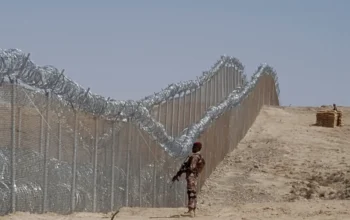
Odho attributed much of that decline to intelligence-driven operations carried out by police and other security agencies, along with the continued construction of a border fence along Pakistan’s frontier with Afghanistan. But he cautioned that the networks responsible for planning attacks like the one in Gulistan-e-Jauhar remain active and occasionally succeed despite those defenses.
“Sometimes they get lucky,” Odho said, “but we make sure that these incidents never happen again.”
Lanjar, the home minister, said authorities intend to continue deporting Afghan nationals found to be living in Pakistan illegally and warned that anyone found to be assisting militant networks would face prosecution.
“We will not allow anyone to use our soil to sabotage our country,” Lanjar said.
Copyright © 2021 Independent Pakistan | All rights reserved