By Staff Reporter
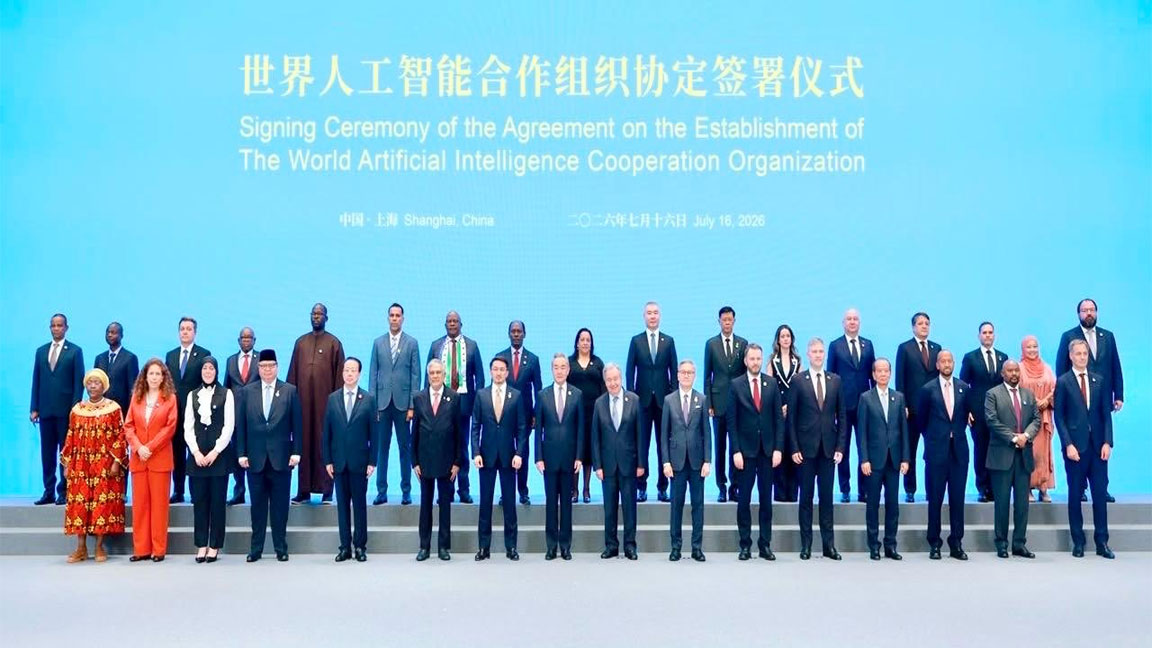
ISLAMABAD: Pakistan formally joined a new China-backed international body aimed at shaping global cooperation on artificial intelligence on Thursday, one of 29 founding member nations to sign on as Beijing moved to position itself at the centre of AI governance worldwide.
Deputy Prime Minister and Foreign Minister Ishaq Dar signed the agreement establishing the World Artificial Intelligence Cooperation Organisation, or WAICO, during a ceremony in Shanghai, according to Pakistan’s Foreign Office. The signing came on the eve of the World Artificial Intelligence Conference, the annual gathering where Chinese President Xi Jinping was expected to lay out his government’s vision for the country’s expanding role in setting the rules for AI development globally.
In a statement posted to social media, the Foreign Office said Dar signed “on behalf of Pakistan at the signing ceremony held today in Shanghai, China.” The ministry framed Pakistan’s participation as part of a broader push to advance the interests of developing nations in AI policy, saying the country “reaffirmed its commitment to advancing international cooperation in the area of artificial intelligence, especially from the perspective of the Global South.”
“Pakistan looks forward to working closely with fellow WAICO member states in efforts to help bridge the global AI divide and to promote equitable access to AI to advance development for all,” the Foreign Office said.
Pakistan was joined by a diverse roster of founding members, including Russia, Belarus, Serbia, Cuba, Brazil and Venezuela, along with 10 African nations and 12 other Asian countries, according to the Chinese state news agency Xinhua. The organization’s headquarters will be based in Shanghai.
China first floated the idea for the organization at last year’s AI conference, but Thursday marked the first time countries formally committed to membership. The proposal has been a centerpiece of Beijing’s effort to position itself as a counterweight to the United States in global technology governance, offering what Chinese officials describe as a more open and equitable framework than the one championed by Washington.
Bilateral meeting with Wang Yi
Dar’s visit extended beyond the WAICO signing. He held a bilateral meeting with Chinese Foreign Minister Wang Yi on the sidelines of the AI conference, according to the Foreign Office, during which the two discussed the broader relationship between Islamabad and Beijing.
“The two leaders reviewed the broad canvas of Pakistan-China bilateral relations and reaffirmed their shared commitment to further deepening the All-Weather Strategic Cooperative Partnership,” the Foreign Office said.
The two ministers also discussed progress on the second phase of the China-Pakistan Economic Corridor, a sprawling infrastructure initiative that has anchored the countries’ economic ties for more than a decade, and pledged deeper collaboration in trade, investment, science and technology, the digital economy and artificial intelligence. The Foreign Office described the meeting as reinforcing what it called the two nations’ “shared commitment to innovation-driven development and emerging technologies,” and said the ministers exchanged views on regional and global developments while agreeing to maintain close coordination going forward.
Dar arrived in Shanghai earlier Thursday for the two-day visit, where he was received by Shanghai Vice Mayor Wu Wei, Pakistan’s Charge d’Affaires to China Aizaz Khan, and Shanghai Consul General Shahzad Ahmad Khan, the Foreign Office said. Beyond the WAICO ceremony, Dar was also scheduled to take part in the wider AI conference and hold additional meetings with Chinese officials during the trip.
Pakistan’s involvement builds on groundwork laid earlier this year. During a four-day visit to China by Prime Minister Shehbaz Sharif in May, Islamabad voiced support for the World AI Cooperation Organisation concept, calling it “a concrete step toward promoting the development of artificial intelligence for good and for all” and committing to work with Beijing to advance international cooperation on AI governance.
A geopolitical showcase
The signing ceremony set the stage for what was expected to be a consequential edition of the World Artificial Intelligence Conference, with Xi Jinping scheduled to address the gathering in person for the first time — a move widely read as underscoring how seriously Beijing regards artificial intelligence, both as an engine of economic growth and as a lever of geopolitical influence.
The conference was also expected to double as a display of China’s technological ambitions. Huawei planned to unveil its Atlas 950 SuperPoD, a large-scale AI computing system that links thousands of the company’s Ascend processors into a single cluster for AI training and inference — one of the most visible signs yet of Beijing’s push to build advanced computing infrastructure without relying on top-tier chips from the American firm Nvidia. Chinese firm DeepSeek has reportedly adapted its newest V4 model to run entirely on Huawei’s Ascend-based systems, and domestic media reported that other Chinese chipmakers, including Biren and MetaX, were expected to unveil competing computing clusters of their own at the conference.
The timing carries broader diplomatic weight. The gathering comes as Washington and Beijing prepare for their first government-level talks on artificial intelligence under the Trump administration, transforming what has traditionally been a technology showcase into an early proving ground for how China intends to compete for influence over global AI rules. The two governments outlined competing visions for AI oversight at a United Nations dialogue last week, with American officials warning that heavy-handed regulation risks stifling innovation, while Chinese officials cast their nation’s low-cost, open-source AI models as a public good capable of narrowing the technology gap between wealthy and developing nations.
George Chen, who chairs the digital practice at the Asia Group, described the stakes in stark terms, writing that the conference “has become more than a technology showcase; it is now a geopolitical stage where Beijing seeks to articulate its vision of AI as both a national priority and a diplomatic instrument.”
The AI conference is running alongside a separate high-level meeting on global AI governance in Shanghai, where officials are expected to detail further progress on WAICO and on implementing what China calls its Global AI Governance Initiative. A commentary published this week in the Communist Party-run People’s Daily argued that “the development of AI must never move toward a technological monopoly that walls itself in, but should always be anchored to the fundamental goal of serving humanity” — language that echoes Beijing’s broader argument that its approach to AI offers a more inclusive alternative to Western models.
The conference was expected to draw a notable roster of international figures, including United Nations Secretary-General António Guterres, Kazakh President Kassym-Jomart Tokayev and Thai Prime Minister Anutin Charnvirakul, along with nine Turing Award and Nobel laureates, among them deep-learning pioneers Yoshua Bengio and Richard Sutton. Representation from major American technology companies, however, remained notably thin. Additional product unveilings expected at the conference include AI-powered smartphones from ZTE’s Nubia brand and the Chinese AI startup StepFun, according to domestic media reports.
Copyright © 2021 Independent Pakistan | All rights reserved