By Staff Reporter
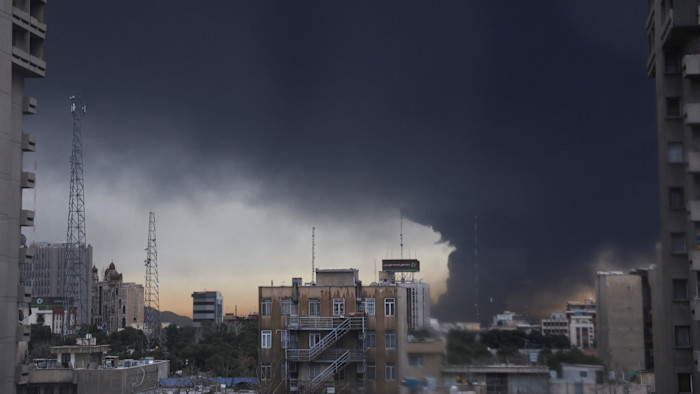
ISLAMABAD: The United States and Iran traded fire for a sixth consecutive night on Thursday, as American warplanes, drones, and warships struck deeper into Iranian territory and Tehran answered with missile and drone attacks on US military installations across the Persian Gulf, pushing a month-old ceasefire toward collapse and reviving fears of a wider Middle East war.
US Central Command said its forces had completed a new round of strikes ordered by President Donald Trump, hitting what it described as dozens of Iranian military targets, including coastal surveillance posts, air defence batteries, logistics hubs, and maritime facilities tied to Iran’s efforts to control the Strait of Hormuz, the narrow waterway through which roughly a fifth of the world’s oil supply normally passes. In a statement, the command said the operation was intended to “further degrade Iranian military capabilities” and to protect commercial shipping in the strait.
The renewed barrage — the sixth straight night of American strikes — came a month after Washington and Tehran signed a preliminary agreement meant to wind down a war that erupted in late February, when the United States and Israel launched a wave of strikes on Iranian territory. Israel has largely stayed out of the current round of fighting, and Iran has not struck Israeli territory directly, but the exchange between American and Iranian forces has escalated night after night, unravelling the truce that had briefly reopened the strait to shipping.
For the first time in this latest phase of the conflict, American strikes reached into territory closer to Tehran, Iranian state media reported, along with the northern province of Semnan, home to Iran’s ballistic missile program and space industry. Other strikes were reported in Hamedan, Hormozgan, Khuzestan, Lorestan, Markazi, and Sistan and Baluchistan provinces — a spread that officials and analysts said signalled a widening American target list.
US Central Command said its forces struck Iranian command centers, air defense sites, and missile and drone facilities, along with targets in and around Bandar Abbas, the city that is home to Iran’s largest port as well as significant naval and Islamic Revolutionary Guard Corps installations along the strait. Iranian state television and the semiofficial Mehr and IRNA news agencies reported explosions in Bandar Abbas, on the Gulf island of Qeshm, and in Bushehr, the coastal city that hosts Iran’s only civilian nuclear power plant. State television described the two explosions heard in Bushehr as a “continuation of the American enemy aggression.”
Overnight strikes also hit an airport, a railway station, and two bridges, killing at least three people and wounding others, according to Iranian state media cited by Agence France-Presse. State television said a strike on two bridges in Hormozgan province killed three people and wounded nine. Iranian broadcasters reported that at least one American munition struck Iranshahr airport in the country’s southeast, and that the railway junction in Bandar Abbas was hit as well, wounding two people, according to Mehr. Another strike wounded one person in the port city of Bushehr, according to state media.
The bridge strikes appeared to make good on a warning President Trump issued earlier in the week, when he told Fox News’ Bret Baier that the American bombing campaign would soon expand beyond military targets. “We’re going to hit them very hard tonight. We’re going to hit them very hard tomorrow night. We’re going to hit them very hard the night after, and then next week it gets really bad for them because next week comes the power plants. Next week comes the bridges,” Trump said in the interview, which aired Tuesday night. “We’re going to knock out all their power plants. We’re going to knock out all their bridges unless they get to the table and negotiate.” He added that he intended to “save the energy targets for last.”
That threat drew a sharp response from Tehran. Brigadier General Mohammad Akraminia, a spokesman for Iran’s Khatam al-Anbiya Central Headquarters, said that if the United States followed through, “all the infrastructure in the region will be crushed under the steel blows of the powerful armed forces of the Islamic Republic of Iran.” Akraminia also rejected any suggestion that American strikes near Iran’s southern coast could give Washington control over the strait. “The Islamic Republic of Iran has the ability to exert control over the Strait of Hormuz from every single point of its territory, and this matter is never dependent on coasts and islands,” he said, calling the waterway Iran’s “invincible red line.”
Hospital area near Ahvaz among targets struck
Some of the night’s most disputed strikes came in and around Ahvaz, in southwestern Iran, where the state-run IRIB news agency reported that a children’s cancer hospital had been evacuated after American airstrikes hit the surrounding area. Foreign ministry spokesman Esmaeil Baqaei called the strikes “barbaric.” Iran’s Revolutionary Guards said the attack near the hospital was what prompted their forces to fire ballistic missiles at a US airbase in Jordan.
Hani, a 34-year-old teacher in Ahvaz, described the bombardment as “very intense.” “My hands are shaking. There were at least 11 or 12 explosions. My ears are exploding,” he said. Residents in Ahvaz told Agence France-Presse they had endured a second consecutive night of heavy strikes in the area.
Iran’s government said the American campaign has taken a mounting toll on civilians and combatants alike. Government spokesperson Fatemeh Mohajerani said on Thursday that renewed US attacks had killed at least 30 people in Iran since last week; Iranian officials elsewhere put the death toll at more than 35, with over 300 people wounded, since the current round of strikes resumed. A separate American strike on Wednesday hit a barracks belonging to Iran’s 388th Mechanized Infantry Brigade in Sistan and Baluchestan province, according to Iranian state television, which reported that at least 13 missiles were fired in the attack and that seven soldiers, including conscripts, were killed, with a number of others wounded.
Iran strikes American bases in three Gulf countries
Iran’s retaliation on Thursday reached American and allied installations in three countries. Iran’s army said it targeted the Al Azraq Air Base in Jordan with ballistic missiles, while the Revolutionary Guards said separately that their forces had destroyed a satellite communications centre and an early warning radar system at the Ali Al Salem Air Base in Kuwait, as well as a US military pier in Kuwait’s Al Shuaiba area. Kuwaiti authorities said they intercepted Iranian drones over their territory, and sirens sounded across Bahrain as the kingdom’s air defence systems intercepted what its Defence Ministry described as a number of Iranian aerial attacks. There was no immediate confirmation of casualties or damage from any of the three countries.
Iran also warned its Gulf neighbours that hosting American forces would continue to carry consequences. “Our neighbours should know that providing a base to the Americans and allowing them to fire on Iranian soil is unacceptable and will not go unanswered,” the Iranian army said in a statement announcing the latest round of attacks on Gulf states.
In northern Iraq, Kurdish forces said the US-led coalition shot down eight explosive-laden drones over Erbil, the capital of Iraq’s semiautonomous Kurdish region; Agence France-Presse journalists there reported hearing explosions and seeing smoke near the US consulate. Iraqi Prime Minister Ali al-Zaidi condemned the drone attack, which came as he was in Washington on a visit during which he pledged that Iraq would work to disarm non-state armed groups, including those with ties to Iran.
Naval blockade tightens around Iran’s ports
The fighting over the Strait of Hormuz has also played out at sea, where the United States has reimposed a naval blockade of Iranian ports that Central Command said began Tuesday night. The command said Marines had boarded an oil tanker in the Gulf of Oman as part of that operation and that it had redirected three commercial vessels attempting to breach the blockade. Central Command noted that during an earlier phase of the blockade, between April 13 and June 18, American forces had disabled nine ships and redirected more than 140 others.
Separately, the US military said one of its aircraft fired on and disabled an empty oil tanker — identified in some reports as the Curacao-flagged vessel Belma — that was attempting to reach Kharg Island, Iran’s principal oil export terminal, after the ship ignored repeated warnings. A missile fired into the vessel’s smokestack disabled it without sinking it, according to the military’s account.
The strait, through which a large share of the world’s oil and natural gas normally moves, had reopened briefly after the U.S.-Iran agreement was signed in June, but Tehran announced last week that it would close the passage again “until the U.S. ends its aggression.”
Diplomacy strained but not abandoned, White House says
Even as the military exchanges intensified, officials on both sides suggested that the door to negotiations had not fully closed. White House press secretary Karoline Leavitt told reporters on Thursday that President Trump intended to hold Iran “accountable” for what she described as reneging on its commitments, but stressed that the president remained willing to talk. “They have expressed that they still want to make a deal to the president. We’re talking to them, but again, the president is not going to allow them to fire on ships in the strait without paying a consequence for that,” Leavitt said.
Iran’s chief negotiator, Mohammad Bagher Ghalibaf, offered a more sceptical assessment of the preliminary accord, saying it “only has meaning when its clauses are valid and being implemented” and that Tehran had “no reason” to abide by any agreement that did not serve Iran’s interests. He said Iran’s national security depended on preserving what he called “Iranian arrangements” governing the strait.
Pakistan, which helped broker last month’s memorandum of understanding between Washington and Tehran, urged both sides to step back. Foreign office spokesman Tahir Andrabi said Islamabad would “continue to encourage all sides to end violence and resume technical-level talks” under that agreement.
There were also signs of renewed outside mediation. Citing two Arab diplomats, Israel’s Channel 12 reported that Qatar had submitted a new proposal to Washington and Tehran aimed at restarting negotiations and easing tensions, and that Iranian officials viewed the offer as relatively favorable to their position. Attacks on Qatar have reportedly stopped since the proposal was put forward, according to the same report. Separately, Channel 12 reported that Israel was bracing for the possibility that the US campaign could expand further next week, with Israeli officials believing Washington may begin striking more of Iran’s civilian infrastructure in line with Trump’s public threats. Until now, the network reported, American strikes have been concentrated primarily on Iran’s military infrastructure.
Trump’s stated intention to strike Iranian bridges and power plants has drawn scrutiny beyond the region. After the president said in April that the United States would bomb Iranian civilian infrastructure, including bridges and power stations, the United Nations’ human rights chief, Volker Türk, said at the time that “deliberately attacking civilians and civilian infrastructure is a war crime.” The 1949 Geneva Conventions, which set out rules for the conduct of war, prohibit attacks on sites considered essential to civilian populations.
Copyright © 2021 Independent Pakistan | All rights reserved