By Staff Reporter
ISLAMABAD: The United States and Iran dramatically widened the scope of their conflict on Friday, striking bridges, a port facility, and energy infrastructure in a sixth consecutive night of American attacks, while Tehran answered with a barrage of missiles and drones that reached as far as Qatar, Kuwait, Bahrain, Jordan, and, for the first time, Syria.
The exchange marked a stark escalation in a war that reignited last week after a monthlong ceasefire collapsed, and it raised fears among diplomats and energy analysts that a conflict once centered on military and nuclear-linked sites was edging toward the kind of infrastructure war that could inflict mass civilian suffering across the region.
By Friday, Iranian health officials said American strikes had killed at least 38 people and wounded more than 400 since the fighting resumed. Separately, provincial authorities in Iran’s Hormozgan province reported seven deaths in a single overnight strike on bridges near the port city of Bandar Khamir. The casualty figures could not be independently verified.
The renewed fighting has begun to bleed well beyond the two principal combatants. Iranian missiles set off air-raid warnings in Doha, wounded a child with shrapnel in Qatar, and were intercepted over Jordan and Iraq’s Kurdish north. In Kuwait, an Iranian strike heavily damaged a power and desalination plant that supplies roughly 90 percent of the country’s drinking water, reviving memories of a nearly identical attack in March that helped push Washington to negotiate the war’s first ceasefire.
“We should be worried, and I am worried, if the situation does not improve in the next few weeks,” said Fatih Birol, head of the International Energy Agency, addressing the toll the fighting is taking on global energy supplies.
A shift toward infrastructure
US President Donald Trump has for weeks threatened to strike Iranian bridges and power plants as leverage to force Tehran back to the negotiating table over its blockade of the Strait of Hormuz, the narrow waterway through which a fifth of the world’s oil and natural gas once flowed. Friday’s strikes suggested the administration was following through.
US Central Command said its aircraft, drones, and warships hit “dozens of Iranian military targets,” including coastal surveillance and air-defence sites, logistics infrastructure, and maritime capabilities. It was the first time in more than a week that Centcom had explicitly listed infrastructure among its targets.
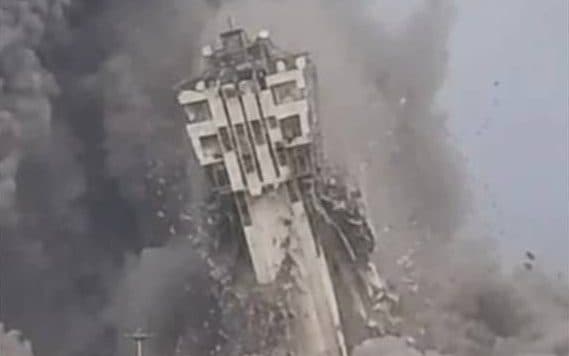
The clearest illustration of the shift came at Chabahar, a strategic Iranian port on the Gulf of Oman that serves as a trade lifeline for landlocked Afghanistan and has been developed in part with Indian investment. American strikes collapsed a tower there that Iran said oversaw commercial shipping traffic. Centcom offered a different account, describing the tower as part of a surveillance network used by Iran’s Revolutionary Guard to “track and target” commercial vessels moving through the strait.
“The destruction of the tower directly degrades [the paramilitary’s] ability to coordinate attacks on innocent civilian crew members,” Centcom said in a social media post.
Overnight strikes also hit highway and rail bridges in Hormozgan province, on Iran’s southern coast, in what analysts said appeared to be a deliberate effort to sever Bandar Abbas — Iran’s principal port — from road and rail links running north toward Tehran. Independent journalists working with the BBC verified footage showing a fireball engulfing the Gariveh Bridge overnight, followed by daylight images of a collapsed roadway and scattered rubble.
Iran’s Energy Ministry, meanwhile, issued its first acknowledgment of “attacks on power infrastructure” since the fighting resumed, calling on residents of the country’s sweltering southern provinces to conserve electricity. The ministry did not specify whether power plants or transmission lines had been struck.
The prospect of strikes on civilian infrastructure has drawn warnings from human rights officials. After Trump first raised the possibility of bombing bridges and power plants in April, the United Nations’ human rights chief, Volker Türk, said at the time that “deliberately attacking civilians and civilian infrastructure is a war crime.”
Iran retaliates across the Gulf
Iran’s response on Friday was immediate and geographically sprawling. The Islamic Revolutionary Guard Corps said it had struck American targets in Qatar, Kuwait, Bahrain, and Oman, and — for the first time in the current round of fighting — inside Syria, where it claimed to have hit a former US special operations base at al-Tanf.
The Guard described its Qatar strike, on the sprawling Al Udeid Air Base, as retaliation “to punish the aggressor and the child-killing US military.” It said separate strikes had destroyed American refueling aircraft and fighter jets in Jordan, though Jordan’s military said only that it had intercepted three incoming Iranian missiles on Friday morning and reported no casualties or damage. The Guard also claimed to have destroyed radar installations in Oman.
None of Iran’s claims of destroyed American aircraft could be independently verified, and US officials did not immediately confirm the extent of damage from any of the strikes.
In Doha, residents heard explosions overhead as air-defence batteries fired to intercept incoming Iranian fire; Qatar’s Interior Ministry said falling shrapnel wounded a child. Qatar, along with Pakistan, has served as one of the principal mediators trying to broker an end to the fighting.
In Kuwait, the state’s Ministry of Electricity, Water and Renewable Energy said the strike on its desalination and power complex sparked a fire, damaged multiple electricity-generating units, and forced firefighters to battle the blaze before technical crews could begin assessing damage and working to restore output. Kuwait’s army separately said several of its personnel were wounded by Iranian drones targeting military facilities and camps Friday morning.
At al-Tanf, in Syria, the Revolutionary Guard’s claim of a strike could not be corroborated by either Syrian or American officials, both of which declined to comment. The Pentagon said in February that it had completed a full withdrawal from the base, which sits at the remote junction of the Syrian, Jordanian, and Iraqi borders. A Syrian military source, speaking generally about the strike, said it landed near — but did not hit — the former base, causing no damage or casualties.
Syria’s president, Ahmed al-Sharaa, has worked to keep his country, still emerging from years of civil war, out of the broader regional conflict that has drawn in Hezbollah in Lebanon and Iran-aligned militias in Iraq. “Unless Syria is targeted by any party, Syria will remain outside any conflict,” Sharaa said in March, speaking at a Chatham House forum in London.
Elsewhere, explosions were reported over Erbil and Sulaymaniyah, in Iraq’s semiautonomous Kurdish region, where coalition air defences said they downed eight explosive-laden drones. A separate strike in the area appeared to target Komala, an Iranian Kurdish dissident group, killing at least nine people, according to an official who spoke on condition of anonymity. Iran has targeted Komala in past operations but had not claimed Friday’s attack as of Friday evening.
A chokehold on global oil
At the center of the conflict remains the Strait of Hormuz, the narrow passage between Iran and Oman through which roughly a fifth of the world’s traded oil and liquefied natural gas has historically moved. Iran effectively shut the strait to shipping when the war first began in late February, a move that sent oil prices soaring and handed Tehran significant leverage in ceasefire talks.
That leverage is again in play. Shipping through the strait fell to a three-week low of just eight vessels on Thursday, according to the tracking service MarineTraffic.com, with seven of those ships using a route controlled by Iran and none traveling the alternative corridor closer to the Omani coast that Washington has encouraged tankers to use. The price of Brent crude climbed roughly 2 percent Friday to above $86 a barrel, near its highest level since last month’s short-lived truce.
A British-flagged tanker sustained minor damage on Thursday when it was struck by an unidentified projectile while sailing the Oman-side route near Khasab, according to the United Kingdom Maritime Trade Operations center, which reported no injuries among the crew. Iran did not immediately acknowledge the strike, though it has openly targeted vessels using that corridor in recent days, saying the strait should fall under its sole control and that ships ought to pay Tehran passage fees — a claim at odds with decades of treatment of Hormuz as international waters.
The US military has pushed back against the blockade with its own show of force, boarding a tanker this week and releasing images of Marines rappelling from a helicopter onto its deck. Washington has also reimposed a naval blockade of Iranian ports aimed at halting Tehran’s crude exports. Iranian officials have said the tactic will not work.
“Iran could strike the strait from anywhere on its territory,” Brigadier General Mohammad Akraminia, a spokesman for Iran’s army, said on Thursday, dismissing the effectiveness of US strikes aimed at the country’s coastline.
Separately, armed men boarded a small chemical tanker in the Gulf of Aden, off Yemen, though one maritime security source said the seizure appeared to be an act of Somali piracy unrelated to the broader conflict. Iran has signaled that it could press its Houthi allies in Yemen to close the Bab al-Mandeb strait at the southern mouth of the Red Sea — the primary alternative route for Middle East oil that bypasses the Gulf entirely — if the United States follows through on threats to strike Iranian infrastructure. Officials briefed on the matter have said Tehran has already instructed the Houthis to be prepared to act.
Political pressure builds
For Trump, the surge in global energy prices and the specter of a widening war have created mounting political pressure to bring the conflict to a close — a war he inherited weeks into his term and one that runs counter to his campaign pledge to avoid prolonged entanglements in the Middle East.
In a Thursday night address to the nation focused primarily on election security, Trump insisted the war effort was succeeding. “We are likewise winning big in Iran, and you will see the fruits of that labor very, very shortly,” he said.
White House press secretary Karoline Leavitt told reporters on Thursday that the president would not “sit by and allow these active acts of terrorism to take place in the strait without ensuring Iran pays consequences for that,” while stressing that Trump remained “always open to diplomacy at the very same time.”
Trump has not ruled out deploying American ground forces, including a potential operation to seize Kharg Island, site of Iran’s main oil export terminal, and has renewed threats to strike Iranian bridges and power stations again next week unless Tehran returns to the table.
The war began Feb. 28, when the United States and Israel launched strikes on Iran, prompting Tehran to retaliate against Israeli targets and American interests and allies across the Gulf. A ceasefire negotiated roughly a month ago held for several weeks, punctuated by scattered Iranian attacks on tankers seeking to force compliance with Tehran’s demands that vessels seek authorization before crossing Hormuz. That fragile calm broke down entirely on July 7, when Iran struck ships transiting the strait and the United States answered with air strikes, plunging the region back into open conflict.
Before the war reignited, Washington and Tehran had been engaged in on-again, off-again talks over Iran’s nuclear program — talks that now appear indefinitely suspended as both sides calculate their next moves in a conflict that shows little sign of abating.
Copyright © 2021 Independent Pakistan | All rights reserved