By Staff Reporter
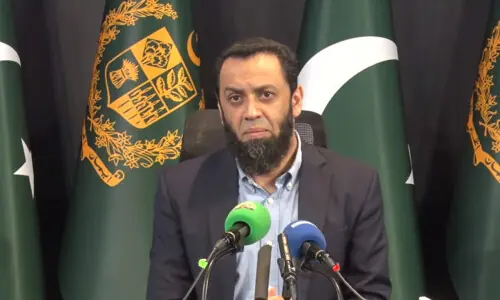
ISLAAMABAD: Pakistan’s information minister has accused a protest movement in Azad Kashmir of receiving funding and direction from India, unveiling what he described as “irrefutable evidence” linking the banned group to a cross-border disinformation network days before elections are due to be held in the territory.
Attaullah Tarar told a press conference in Islamabad on Sunday that security agencies had arrested a man some time ago who was working in digital marketing and whose business dealings were found to have links to India. The minister said the suspect had been receiving payments from across the border in exchange for running what he called a “network of misinformation” against Pakistan.
According to Tarar, the man worked alongside bot farms to spread and amplify content attacking Pakistan’s security, government, army, army chief and state institutions, some of which he said promoted sectarian violence and stoked recent unrest in Azad Jammu and Kashmir (AJK).
The minister displayed what he said were screenshots of financial transactions and social media posts allegedly tied to the campaign. He said the suspect had exchanged WhatsApp messages with an “Indian operator” in which the two discussed post engagement figures and swapped bank account details, with small sums transferred deliberately to avoid detection by financial monitoring units. Tarar said the government was now investigating the digital payment gateways used.
He went further, claiming the suspect had confessed under investigation that most of the material he received related to the Joint Awami Action Committee (JAAC), the civil rights movement that Islamabad proscribed last month under anti-terrorism legislation, citing threats to public order.
‘Conspiracy’ claim
Tarar used the arrest to renew government allegations against JAAC, telling reporters the group “wants to harm the Kashmir cause” and is working to “weaken Pakistan’s relationship with Kashmir”. He said the investigation had exposed what he called the group’s “nexus” with India, adding: “Today, no Pakistani should have any doubt that their links trace back to India, and we now have irrefutable evidence of this.”
The minister argued that if JAAC’s leadership genuinely cared about the Kashmir cause, they would contest elections rather than boycott them. “This digital marketing campaign — what interest does India have in Kashmir?” he said. “It has been proven through data that all the payments made for the social media material were from India.”
He also linked recent violence in the region to the group, saying protests had led to the deaths of Kashmiri police officers and created a law-and-order crisis in AJK, and said the group was “answerable to the entire nation” for allegedly taking funding from what he called “the enemy”.
Tarar pointed to large turnouts at political rallies held by mainstream parties ahead of the vote as proof that Kashmiris had “rejected JAAC’s conspiratorial politics”, saying it demonstrated that the bond between Pakistan and Kashmir “can neither be weakened nor broken”. He added that Pakistan’s recent diplomatic successes and what he described as its victory over India in last year’s four-day conflict were “hard to digest” for the country’s enemies, which he said was why groups such as JAAC had emerged.
The minister said investigations into the arrested suspect were ongoing and that countering disinformation remained a government responsibility. He also credited Prime Minister Shehbaz Sharif and army chief Field Marshal Asim Munir with enhancing Pakistan’s “dignity” and international standing.
Background to the dispute
Kashmir, divided between India and Pakistan since partition in 1947 and claimed in full by both, remains one of the world’s most militarised and sensitive borders, with the two nuclear-armed neighbours having fought multiple wars over the territory.
JAAC, which had previously campaigned on economic and governance grievances in AJK, shifted its focus in recent months to demanding the abolition of the territory’s 12 reserved refugee assembly seats, arguing they allow Pakistan’s mainstream political parties to shape government formation in the region. The group’s call for mass protests on 9 June was followed by its proscription.
Thousands of JAAC supporters remain camped on the outskirts of Rawalakot, roughly 100km south of the regional capital Muzaffarabad, and are reportedly planning to march on the regional headquarters on 27 July, the day general elections are scheduled to take place across parts of Azad Kashmir. The group has said it will boycott the vote.
Copyright © 2021 Independent Pakistan | All rights reserved