By Staff Reporter
MIRPUR: Voters across Azad Kashmir’s Mirpur division began casting ballots on Monday in the opening stage of a fractious three-phase election, with authorities deploying tens of thousands of security personnel and simultaneously moving to block a long march by a banned rights movement threatening to disrupt polling day.
More than 1.4 million registered voters were eligible to choose their representatives from 13 constituencies spanning the districts of Mirpur, Kotli and Bhimber, the first leg of a staggered Legislative Assembly election that will conclude in Rawalakot division next month. Voting in Muzaffarabad division and among Kashmiri refugee constituencies follows on 2 August.
The vote unfolds against a backdrop of considerable unease. The proscribed Jammu Kashmir Joint Awami Action Committee (JAAC), which has maintained a sit-in protest in Rawalakot for 47 days, announced it would march on the regional capital Muzaffarabad on Monday afternoon — the same day polling opened in Mirpur. Government officials said the march would not be permitted to proceed, with additional security forces mobilised across the territory’s routes and fresh arrests anticipated. Internet services, already patchy in the wake of earlier unrest, suffered further disruption as tensions mounted.
The confrontation has its roots in violent clashes between security forces and JAAC supporters in June, which left several people dead, including police officers, and prompted the authorities to outlaw the group. Chief among the committee’s grievances is its demand for the abolition of 12 assembly seats reserved for Kashmiri refugees who fled to Pakistan following the wars of 1947 and 1965.
Pakistan Tehreek-e-Insaf, which swept to power in the region’s 2021 election, has opted to boycott the current polls altogether, accusing the authorities of bias and lending its support to the banned committee’s position — a stance that has deepened doubts about the credibility of a process the Election Commission insists will be free, fair and transparent.
Security operation on an unprecedented scale
Officials have mounted what they describe as the largest coordinated security operation in the region’s electoral history. Roughly 18,560 police and paramilitary personnel have been deployed across Mirpur division alone under a three-tier arrangement: police forming the first line of defence, Pakistan Rangers from Punjab and Sindh together with the Federal Constabulary providing the second, and some 2,100 army troops held in reserve as the third. Quick Response Force units remain on standby throughout the division’s 2,316 polling stations, more than half of which — 1,241 — have been classified as highly sensitive.
Speaking at a joint press conference in Muzaffarabad on Sunday, AJK Chief Secretary Khushhal Khan said law and order remained the government’s foremost concern and that authorities would act without discrimination against anyone seeking to intimidate voters or disrupt proceedings. Election Commission Secretary Raja Muhammad Shakeel Khan told reporters that more than 22,000 polling staff had been trained and deployed, with material reaching every polling station ahead of schedule. Both officials dismissed circulating social media claims — including an old video calling for a boycott — as attempts to sow confusion, insisting the campaign period had passed without serious incident.
Chief Election Commissioner Justice (Retd) Ghulam Mustafa Mughal, who has personally reviewed preparations in Mirpur, used a video message on Sunday to press voters to turn out in large numbers, describing the ballot as a national and civic duty. The commission separately confirmed it had granted political parties permission to use automated robocalls for campaigning up until the mandatory 48-hour pre-polling silence takes effect.
A crowded and combative field
Some 1,265 candidates are standing across all 45 constituencies in the wider election, of whom 1,047 are contesting 33 territorial seats and 218 are vying for the 12 refugee seats. In Mirpur division itself, 288 candidates are competing for the 13 seats up for grabs on Monday, watched over by 3.8 million registered voters across the region as a whole. Twenty-two political parties are taking part, chief among them the Pakistan Peoples Party, Pakistan Muslim League-Nawaz, Istehkam-e-Pakistan Party and the Muslim Conference.
The campaign has been marked by an unusually personal exchange between the PPP’s Bilawal Bhutto-Zardari and PML-N stalwart Nawaz Sharif. Addressing a rally in Mirpur on Friday, Sharif suggested the district should not be confused with Mirpurkhas in Sindh, nor Kashmir with Kashmore — both PPP strongholds. Bhutto-Zardari responded in a video statement shared on social media, opening with the words “Mian sahib, please don’t take offence” before arguing that the places shared not just similar names but a common temperament and shared determination to defend their rights. He predicted voters would deliver the same verdict against the PML-N that they had in Sindh.
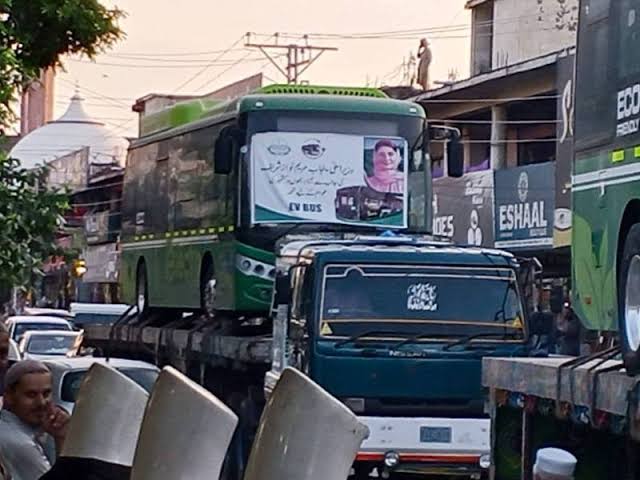
The PPP chairman also hit out at the PML-N’s decision to send electric buses to Muzaffarabad and Mirpur ahead of polling, insisting that infrastructure funded by public money was a right rather than a gift from any politician. He pointed to funding he said he had secured for Mirpur Airport and to thousands of new teaching posts included in the region’s budget as evidence of his party’s record, while renewing calls for a Truth and Reconciliation Commission to examine the unrest of recent months and deliver justice to the families of those killed, whether civilians, police or security personnel.
The PPP’s AJK president, Chaudhry Muhammad Yasin, has separately written to the chief election commissioner alleging repeated breaches of the code of conduct by PML-N ministers using official protocol and state resources during campaign events.
For its part, the PML-N has pointed to its record in government. At a rally in Rawalpindi on Sunday, Punjab senior minister Marriyum Aurangzeb said Muzaffarabad had already delivered its verdict in the party’s favour and pointed to housing, laptop distribution and scholarship schemes overseen by Punjab Chief Minister Maryam Nawaz as evidence of the party’s delivery record.
A campaign without its usual energy
Away from the rallies, there is a palpable sense among residents and observers that this election lacks the vigour of previous contests. “We have seen previous campaigns in Muzaffarabad and other parts of the region. This time the campaign lacks excitement, inclusivity and thrill,” said one Muzaffarabad resident. Political analysts have pointed to the phased schedule and heightened security measures introduced in the aftermath of June’s unrest as factors dampening turnout enthusiasm, even as officials insist maximum participation remains essential to the process’s legitimacy.
Copyright © 2021 Independent Pakistan | All rights reserved