By Staff Reporter
ISLAMABAD: The United States held off from further strikes on Iran for a second consecutive night on Sunday, as President Donald Trump weighed diplomatic and military options in a conflict now closing in on its fifth month.
The US president is said to be considering both paths as Binyamin Netanyahu prepares to arrive at the White House on Tuesday. The Israeli prime minister, a persistent critic of Washington’s diplomatic overtures to Tehran, is under mounting political pressure to demonstrate that his campaigns against Iran and Hizbullah in Lebanon have delivered results ahead of elections scheduled for October.
Tehran said on Sunday it had likewise suspended its “retaliatory” attacks on US allies across the region. “These attacks continued until two nights ago, but over the past two nights the Americans have stopped their attacks,” said army spokesman Mohammad Akraminia. “Our strategy has essentially been retaliatory. We have also halted our retaliatory operations.”
The pause follows growing reports that senior figures within the Trump administration have warned the president that dwindling stockpiles of munitions could hamper any sustained campaign against Iran. Asked on NBC’s Meet the Press whether Trump was ruling out further strikes, his ambassador to the United Nations, Mike Waltz, insisted no such decision had been made. “I wouldn’t go that far at all,” he said. “The president is keeping all options on the table.”
A conflict without an ending
The lull, which began on Friday evening, brings a temporary halt to nearly two weeks of near-nightly American strikes and follows the collapse of a ceasefire that Trump himself had brokered earlier in the conflict. Washington has blamed Tehran for a wave of attacks on US forces and regional allies, as well as for the closure of the Strait of Hormuz — a waterway through which an estimated fifth of the world’s oil and gas passes.
Senior Iranian and Omani diplomats were reported to be holding talks on Sunday aimed at reopening the strait, and an official in Tehran confirmed that counterparts had also been in contact with American negotiators in an effort to head off a return to full-scale war. Iran has demanded both payment and a degree of control over which vessels are permitted through the passage.
“Mediators are working and trying to prevent tension from escalating,” Iranian foreign ministry spokesman Esmail Baghaei told reporters on Sunday.
Not every voice in Tehran struck a conciliatory note. An army spokesman accused Washington of drifting without a coherent strategy, saying the US was “experiencing strategic decision-making fatigue.”
Warnings inside the Oval Office
The retreat from further strikes followed a tense meeting in the Oval Office on Friday, where vice-president JD Vance and General Dan Caine, chairman of the joint chiefs of staff, are reported to have raised concerns with Trump about the risks of pressing ahead with a renewed campaign. Trump subsequently ordered the military to stand down from further action — a notable reversal for a president who had, only days earlier, threatened to “knock out everything they have.”
“We’re talking to them right now,” Trump told reporters on Friday. “I think they’re getting more and more serious as the days go by. We’re locked and loaded and ready to go, but we’re talking to them.” Speaking later that evening at the White House Correspondents’ Association dinner, he said he did not believe Iran was yet ready to strike a deal, but that he remained willing to listen.
According to officials briefed on the discussion, Caine’s warning centred on depleted stockpiles of Patriot missile interceptors and offensive weaponry including Tomahawk cruise missiles. Vance, who campaigned on scepticism towards US military entanglements in the Middle East, has become an increasingly vocal opponent of continued escalation.
The New York Times reported on Saturday, citing two people briefed on the matter, that Trump had decided — for now — to step back from plans to intensify the campaign, amid concerns within his administration about a widening conflict, the depletion of defence stockpiles, the alienation of Gulf allies, and the knock-on effects for energy supplies and the wider global economy. A Pentagon source told CNN that operations were “on a hold.” Axios reported that the Pentagon had in fact presented Trump with a plan for a fourteenth consecutive night of strikes, which he declined to authorise, opting instead to give talks more room to develop.
Waltz, appearing separately on Fox News on Sunday, said the US remained “locked and loaded” for further action, with additional military assets having been moved into the region, even as Trump gave diplomacy “a little bit of room.”
Pressed on reports that the US military was rationing certain munitions amid supply concerns, Waltz rejected the suggestion outright, first noting that stockpiles had been “depleted” under the previous administration before flatly denying any current shortfall. “I want to be crystal clear,” he said. “The US military — and I’ve verified this every which way — has everything that it needs to conduct this campaign as effectively as it needs to be.” Of those responsible for the reports, he added: “The people that are leaking this nonsense deserve to be in jail.”
Netanyahu heads for Washington
Netanyahu’s office confirmed on Sunday that he would convene his security cabinet before departing for Washington on Monday. The Israeli leader played a central role in persuading Trump to launch joint strikes against Iran in February, and has consistently argued that any settlement must take a hard line on Tehran’s nuclear and ballistic missile programmes — a priority that appears to have been overtaken, at least for now, by Washington’s focus on reopening the Strait of Hormuz.
He arrives in the American capital against a backdrop of some of the worst violence recorded this year in the West Bank, where Israeli forces have launched what has been described as an “extensive” operation following the deaths of four Palestinians and two Israelis after armed settlers entered a Palestinian village on Thursday.
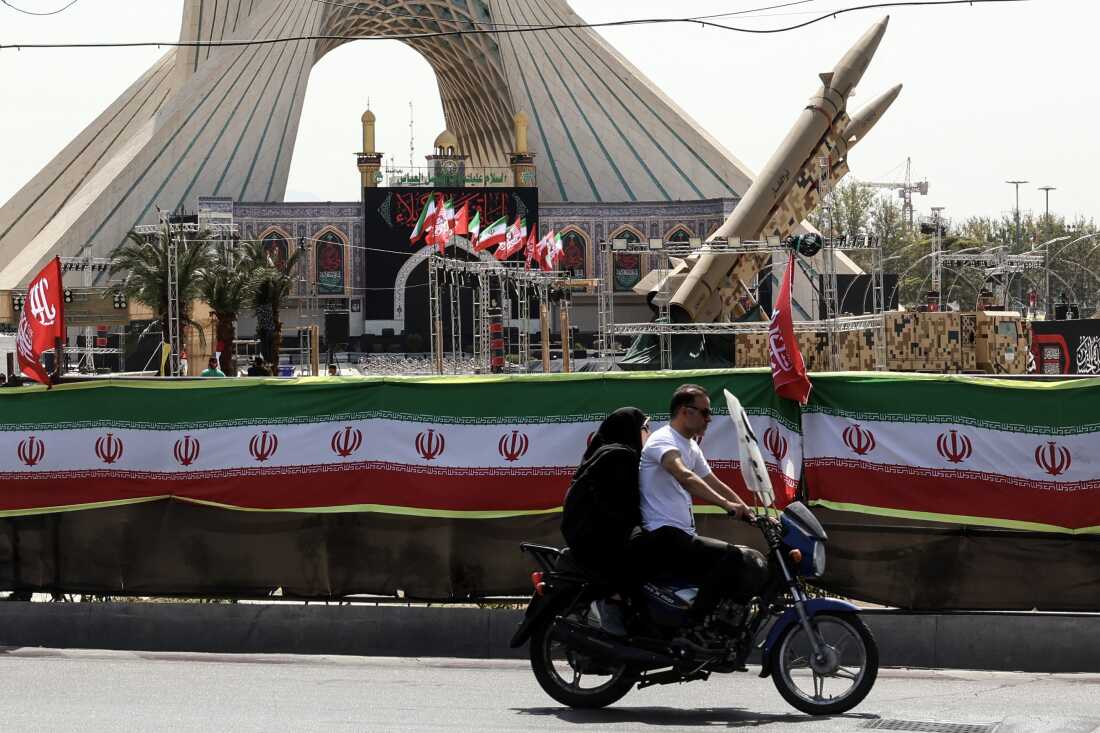
In Tehran itself, life on Sunday bore few outward signs of the wider crisis. Commuters navigated heavy morning traffic, shops and restaurants stayed open as usual, and the city endured a heatwave, according to an AFP correspondent on the ground.
A war spreading outward
Even as the pause held over the weekend, the conflict widened on two further fronts. Yemen’s Iran-aligned Houthi movement struck Saudi oil installations along the Red Sea coast, while Iran accused Ukraine of attacking one of its vessels in the Caspian Sea — an allegation that, if it escalates, threatens to draw yet another power into an already sprawling confrontation.
Houthi military spokesman Yahya Saree said fighters had struck facilities belonging to the Saudi state oil giant Aramco in the cities of Jizan and Yanbu on Saturday. Footage verified by Reuters showed a large plume of smoke rising near the Aramco refinery in Jizan, close to the Yemeni border — a facility capable of processing up to 400,000 barrels of crude oil a day. Two Asia-based trading sources said they had been told of possible damage to fuel and storage sites in the area, though Aramco did not respond to requests for comment. In Yanbu, Saudi Arabia’s principal Red Sea oil port and an increasingly important route for exports bypassing the blockaded Strait of Hormuz, two missiles aimed at oil installations were intercepted; a Greek-operated air defence battery stationed in the kingdom was reported to have downed two ballistic missiles and a drone over the port.
The Houthis said on Sunday they had also downed a Saudi drone over northwest Yemen. In Yemen itself, officials said the air force of the internationally recognised, Saudi-backed government struck Houthi positions in the Marib and al-Jawf provinces, with both sides reported to be mobilising forces along the front line.
Saudi Arabia has led an Arab coalition against the Houthis since the Iran-aligned movement seized the Yemeni capital, Sanaa, more than a decade ago. A ceasefire had held since 2022 in a civil war that killed hundreds of thousands of people through a combination of famine and fighting. That truce collapsed this month, with the Houthis effectively folding themselves into the broader war their Iranian patrons have waged since coming under US and Israeli attack five months ago. The group has declared a naval blockade of Saudi Arabia over the past week, and its leader, Abdul Malik al-Houthi, has warned that all Saudi oil facilities could now be considered targets.
Iran’s foreign minister, Abbas Araghchi, said Tehran could not be blamed for the widening confrontation and offered to mediate between the Houthis and Riyadh, insisting “there is no military solution.”
Accusations across the Caspian
Iran’s foreign ministry separately accused Ukraine of striking an Iranian commercial vessel in the Caspian Sea, killing one sailor and injuring another. State news agency IRNA reported that the ministry had summoned Ukraine’s chargé d’affaires in Tehran to lodge a protest over what it called a “hostile and criminal” act.
The accusation came as Ukrainian president Volodymyr Zelensky said Kyiv had observed Russia passing its own satellite intelligence on the Middle East to Iran, information Tehran could use to direct strikes across the region. Araghchi said the alleged attack on the Iranian vessel “cannot go unanswered,” raising the matter in calls with EU foreign policy chief Kaja Kallas and Russian foreign minister Sergei Lavrov.
The strait at the centre of it all
Iran’s armed forces said they had intercepted six vessels attempting to transit the Strait of Hormuz over the preceding 24 hours, according to state television — a reminder that Tehran’s effective blockade of the waterway remains the single largest flashpoint in its standoff with Washington.
Iran also said on Sunday that it had made progress in talks with Oman on “common principles and operational mechanisms” for shipping through the strait. The two countries had discussed introducing service fees on transiting vessels as far back as June, a proposal Washington opposes. Oman has also indicated that ships could pass through Hormuz using its own territorial waters — an arrangement that has drawn anger from Tehran, which regards it as an attempt to route around its control of the passage.
The US military said on Saturday that its naval blockade against Iran “remains in full effect,” though it offered no explanation for the sudden halt to a run of 13 consecutive nights of escalating strikes, the longest sustained American bombardment since a ceasefire in April briefly quieted the conflict.
A senior official in the Trump administration, asked about the pause, said the president “has always been clear that his preference is diplomacy, but he has shown Iran what will happen if they fail to come to the table in a serious way.”
What began as a war Trump once predicted would last four or five weeks is now edging towards its fifth month — a duration increasingly difficult to separate from the president’s own approval ratings as the country heads towards November’s midterm elections.
Copyright © 2021 Independent Pakistan | All rights reserved