By Staff Reporter
ISLAMABAD: The search for seven mountaineers missing since an avalanche tore through a summit attempt on Broad Peak has been suspended because of deteriorating weather, rescue officials in northern Pakistan said on Friday night, as fears grow for the fate of those still unaccounted for on one of the world’s most unforgiving peaks.
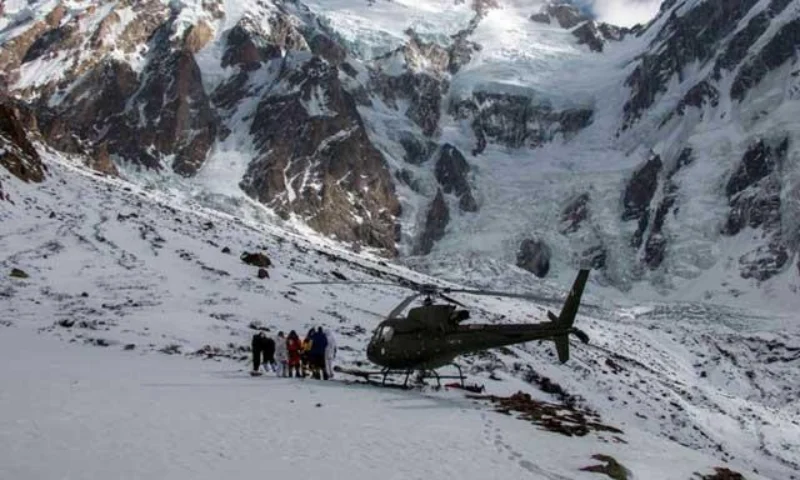
Three bodies have so far been recovered and flown by Pakistan Army helicopter from the mountain to Skardu, the gateway town for expeditions into the Karakoram range. They were identified as Nadhira Ahmed Abdullah Al Harthy, a mountaineer from Oman; Pur Bahadur Gurung, from Nepal; and the American climber Mallory Geis.
Confusion had surrounded the death toll for much of Friday, with early reports suggesting four bodies had been located before officials revised the figure down to three. Seven climbers from the original expedition team remain missing, among them the celebrated British-Nepali mountaineer Nirmal Purja, whose disappearance has drawn a formal statement of concern from the UK Embassy in Islamabad.
The disaster unfolded around midday on Thursday, when an avalanche swept across the upper reaches of Broad Peak, the world’s twelfth-highest mountain at 8,047 metres, engulfing a team of ten climbers who had launched a joint summit push shortly beforehand. According to the Alpine Club of Pakistan, GPS trackers carried by some of the climbers showed the group had been dragged roughly 1,000 metres down the mountainside, leaving them trapped beneath snow and ice in one of the range’s most punishing and remote stretches.
The expedition drew climbers from across the world: six Nepalese mountaineers, including Purja, Gurung, Kili Pemba Sherpa, Nima Sherpa, Nawang Thindu Sherpa and Gyalu Sherpa; a Pakistani climber, Sohail Sakhi; Al Harthy from Oman; Geis from the United States; and Wang Zhong from China.
A rescue operation was launched after tour operators submitted a formal request to the Commissioner of Baltistan Division, triggering an emergency response that has drawn together the Pakistan Army, government agencies and civilian mountaineering specialists. A three-member civilian rescue team, led by the mountaineer Sarbaz Khan, was flown by Pakistan Army Aviation helicopters to Broad Peak’s base camp, from where the recovery of the three bodies was carried out before conditions forced a halt to operations.
Rescuers said drone footage captured during the search had revealed signs suggesting further climbers may be nearby, offering a fragile thread of hope even as officials cautioned that the operation would not resume until Saturday, weather permitting. Sherpas already engaged in other expeditions on the mountain are expected to join the search once it restarts.
Sajid Hussain, deputy director of the tourism department in Gilgit-Baltistan, described the search as concentrated on “a remote and difficult area” of the mountain, underlining the scale of the challenge facing rescue teams operating at extreme altitude in deteriorating conditions.
Chhang Dawa Sherpa, a board director at the trekking company Seven Summit Treks, which had three sherpa guides among the missing, said the team’s last tracked position before the suspected avalanche was at 6,600 metres, adding that they had “fell down straight from there.” He said the entire group had been out of contact since the moment the avalanche struck.
The Alpine Club of Pakistan said two of its rescue helicopters, loaded with specialised equipment and personnel, had been dispatched to support the operation, with its leadership maintaining what it described as constant contact with senior government figures to keep resources moving. “Every possible effort is being made to ensure that helicopter support and all available rescue resources are mobilised at the earliest opportunity, subject to weather and operational conditions,” the club said in a statement, adding that it remained in close coordination with all relevant stakeholders and stood in solidarity with the families of those affected and the wider mountaineering community.
Ayaz Shigri, the club’s general secretary, said several expedition teams had combined forces for their summit attempt shortly before disaster struck. He said there were also concerns that local high-altitude porters supporting the climb might have been caught up in the avalanche. “We pray for the safety of all the climbers,” he said. “It is a big incident.”
The Gilgit-Baltistan government has pledged full support to the families of those who died, promising assistance both with the ongoing rescue effort and with the eventual repatriation of the bodies to their home countries. Chief Minister Amjad Hussain Advocate has ordered all relevant departments to remain on high alert and to accelerate the search in coordination with the army, instructing local administrators to draw on every available resource to protect the climbers’ safety.
Naiknam Karim, the province’s minister for tourism, sport and culture, said the government was doing everything in its power to locate the missing team members. “All relevant departments are in constant coordination and every available resource was being utilised to support the ongoing search and rescue operation,” he said, voicing hope that the climbers would yet be found alive and calling for further logistical and operational support to reach the teams working in the field.
Despite that hope, experts familiar with high-altitude rescue operations have warned that the odds of finding survivors diminish sharply with each hour that passes, given the extreme cold, thin air and hazardous terrain in which the search is being conducted.
Concern has focused heavily on Purja, 43, one of the most recognisable figures in modern mountaineering. A former member of Britain’s Brigade of Gurkhas who went on to serve with the elite Special Boat Service, Purja shot to global prominence in 2019 when he climbed all fourteen of the world’s “eight-thousanders” — peaks exceeding 8,000 metres — in just six months and six days, shattering the previous record for the feat. His journey was later chronicled in a Netflix documentary that introduced him to audiences well beyond the mountaineering world. He first summited Annapurna, the world’s tenth-highest peak, in April 2019, before completing the historic run that made his name. In 2021 he took part in the first successful winter ascent of K2, climbing alongside a team of nine fellow Nepalese mountaineers in a feat widely regarded as one of the great achievements in modern Himalayan climbing.
The UK Embassy in Islamabad confirmed it was monitoring the situation closely. “We are concerned by reports that several climbers have gone missing during a Broad Peak expedition, including a British-Nepali national,” the embassy said in a post on X, adding that it remained in contact with Pakistani authorities.
Also among those unaccounted for is Sohail Sakhi, a climber from Hunza regarded as one of Pakistan’s strongest high-altitude mountaineers. Sakhi summited Kanchenjunga, the world’s third-highest mountain, in Nepal only in May, and has previously climbed K2, Nanga Parbat, Gasherbrum I and Gasherbrum II without the use of supplemental oxygen — an achievement that places him among a small elite of climbers capable of operating at extreme altitude without artificial assistance.
Broad Peak sits in Pakistan’s Karakoram range, a corridor of some of the planet’s highest and most technically demanding mountains, and is regarded as one of the country’s most formidable challenges for expedition climbers. Of the world’s fourteen peaks above 8,000 metres, eight lie in Nepal, five in Pakistan and one in Tibet. Fewer than forty climbers are believed to have successfully summited all fourteen.
For now, attention on the mountain remains fixed on the seven still missing, with rescue teams poised to resume their search as soon as the weather allows.
Copyright © 2021 Independent Pakistan | All rights reserved