By Staff Reporter
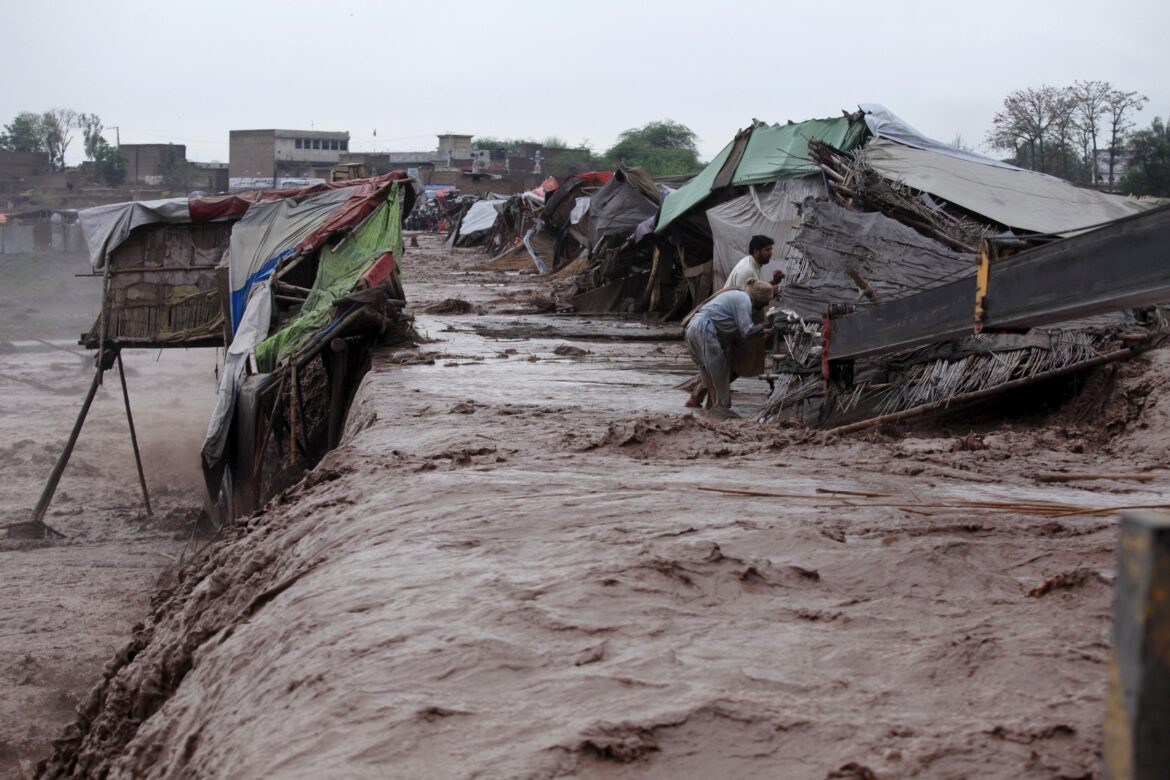
ISLAMABAD: Pakistan’s monsoon death toll has climbed to 136 after 10 more people were killed in rain-related incidents over the past 24 hours, as flash floods swept away three schoolgirls walking home from school and authorities warned of further heavy rainfall in the days ahead.
The National Disaster Management Authority (NDMA) said on Monday that the latest deaths, recorded across Sindh, Punjab and Khyber Pakhtunkhwa, were caused by drowning, house collapses and a falling boulder. A further 418 people have been injured since the monsoon season began on 26 June, the authority said in its latest situation report.
Three of the deaths occurred in Punjab, two in Khyber Pakhtunkhwa and the remaining five in the southern province of Sindh.
The NDMA cautioned that more heavy rain was likely over the next 24 to 36 hours, attributing the wet spell to a low-pressure system over west Rajasthan in India, reinforced by monsoon currents and a shallow trough of westerly wind. Isolated heavy falls are expected across Punjab, Khyber Pakhtunkhwa and the northeast of Balochistan, the authority said.
Officials have repeatedly warned that the rains, expected to continue until 6 August, could trigger flash flooding in Punjab and Khyber Pakhtunkhwa. Monday’s report said the River Chenab was expected to fluctuate between low and medium flood levels at Marala, Khanki and Qadirabad, while nullahs along the Jhelum, Chenab and Ravi were likely to see medium to high water flows.
The NDMA said flash flooding was expected in the hill torrents of Dera Ghazi Khan, in streams across Khyber Pakhtunkhwa, and along the Kabul river and its tributaries, as well as in northern Balochistan. Urban flooding was also forecast for Rawalpindi, Jhelum, Gujranwala, Sargodha, Mandi Bahauddin, Sialkot, Gujrat, Narowal and Faisalabad.
Pakistan has endured increasingly erratic weather over recent years, lurching between heatwaves, drought and flash flooding. Although the country contributes less than one per cent of global greenhouse gas emissions, it is consistently ranked among the nations most exposed to the effects of the climate crisis. Last year, monsoon rains and flooding above the seasonal average killed more than 1,000 people and inflicted extensive damage on homes, roads, farmland and infrastructure, with Punjab among the worst affected.
Schoolgirls swept away in Khyber Pakhtunkhwa
The human cost of the rains was laid bare on Monday in Khyber Pakhtunkhwa, where flash floods triggered by monsoon downpours and a cloudburst tore through Lower Chitral and Mansehra districts, destroying dozens of houses and key infrastructure and claiming three lives, including those of two schoolgirls.
In Lower Chitral, flash floods struck three villages, destroying more than 40 houses, a petrol pump and two bridges, and causing widespread damage to crops and orchards. A torrent in Zhoghor Gol washed away at least 25 houses along with standing crops and orchards, though residents reached safety in time and no deaths were reported there.
Later the same day, flash floods in Broze Gol destroyed a further 20 houses, another petrol pump and more crops, while damaging two bridges and disrupting traffic on the Chitral-Peshawar road. A separate flood in Shishi Koh caused property losses running into millions of rupees. Fatehul Mulk Nasir, a member of the provincial assembly, visited the worst-hit village of Zhoghor and pledged assistance to affected families. Floodwaters were also reported to have obstructed the Chitral river at several points.
The most harrowing incident unfolded in Mansehra, where a cloudburst sent floodwaters tearing through Buzballa Narak village in the Siran Valley, sweeping three schoolgirls into a stream that normally runs dry.
One of the girls was rescued by people nearby. The bodies of the other two were recovered downstream in the Jabori area, according to Tariq Khan, the station house officer at Shinkiari police station.
The girls, all pupils returning home to Buzballa Narak in the Chahlabah union council, were named as seven-year-old Sania Bibi, daughter of Mohammad Ashiq and a student at Zafar Public School; 12-year-old Aiman Bibi, daughter of Qari Shafiqur Rehman; and seven-year-old Faiza Bibi, daughter of Zahid Khan. Faiza Bibi was the girl rescued by locals and taken to a nearby health facility, where she was admitted for treatment.
Khan, who went to the scene with police personnel, said the stream had swollen suddenly after a cloudburst combined with monsoon rain, sweeping the girls away as they tried to cross it. The flood also inundated surrounding areas and carried boulders and rocks onto the road, disrupting traffic, he said.
He added that Rescue 1122, the emergency service, had repeatedly warned residents through loudspeaker announcements that monsoon rain could cause sudden and dangerous surges in the Siran river and local streams capable of sweeping away anything in their path.
In a separate incident in the Kholian area of Balakot, a landslide broke away from a roadside mountain and struck a car travelling towards Qalandarabad in Abbottabad. Mohammad Rameez and two women in the vehicle were critically injured. They were taken to Tehsil Headquarters Hospital in Balakot, where doctors pronounced Rameez dead. The injured women were referred to King Abdullah Teaching Hospital in Mansehra for further treatment.
District administrations across the upper reaches of the Hazara division have since directed families living along streams and riverbanks to move to safer ground for the duration of the monsoon season.
More rain forecast for Tuesday
The Pakistan Meteorological Department (PMD) has forecast rain, wind and thunderstorms across Kashmir, Gilgit-Baltistan, Khyber Pakhtunkhwa, Islamabad, and upper and central Punjab, as well as northeastern Balochistan, on Tuesday. It warned that isolated heavy to very heavy falls could trigger urban flooding, flash floods and landslides in vulnerable areas.
Hot and humid conditions are expected to persist across southern Pakistan, including most of Sindh and Balochistan, with only isolated rain, wind and thunder forecast for Zhob, Musa Khel, Barkhan, Kohlu, Dera Bugti and surrounding areas.
The department warned that heavy rain on Tuesday could inundate low-lying areas of Islamabad, Rawalpindi, Sheikhupura, Kasur, Faisalabad, Multan, Sahiwal, Okara, Bahawalnagar, Gujranwala, Gujrat, Sialkot, Lahore, the Potohar region, Peshawar and Nowshera. Landslides were considered possible in the hilly districts of upper Khyber Pakhtunkhwa, including Dir, Swat, Kohistan, Buner, Battagram, Mansehra, Shangla and Abbottabad, as well as in Murree, the Galiyat hills and Kashmir.
Flash floods were also considered likely in local streams and nullahs across Kashmir, Murree, Galiyat, northeastern Punjab, Islamabad, the Potohar region, Khyber Pakhtunkhwa and the hill torrents of Dera Ghazi Khan.
During the past 24 hours, rain accompanied by wind and thunder fell at scattered locations across Punjab, upper Khyber Pakhtunkhwa and Kashmir, with isolated rainfall also recorded in Mirpurkhas and Barkhan. Faisalabad recorded the heaviest rainfall in the country at 77mm, followed by Sialkot city with 73mm, Bahawalpur city with 64mm, Gujrat with 54mm and Mandi Bahauddin with 49mm. The country’s highest temperature on Monday was 45C, recorded in Dalbandin, followed by 44C in both Nokkundi and Sibi.
Punjab hit by fresh deaths and urban flooding
At least three people were killed and three others injured in rain-related incidents across Punjab on Monday, as torrential downpours inundated roads and low-lying neighbourhoods in several cities, disrupting traffic and restricting public movement.
The PMD’s Flood Forecasting Division had forecast heavy to very heavy rainfall across parts of Punjab, Sindh and Balochistan running until 4 August.
According to a loss and damage report from the Provincial Disaster Management Authority (PDMA), a man was killed and another injured when a house collapsed in the Uch Sharif area of Bahawalpur district, while two children drowned in Khushab. Two further people were injured in separate roof collapses in Mandi Bahauddin and Lodhran, and a house was reported damaged in Bahawalpur.
Heavy rain lashed Lahore for several hours, causing extensive waterlogging across the provincial capital. Water accumulated to depths of between one and one-and-a-half feet in Township, Kacha Jail Road, Haider Road and the Quaid-i-Azam Industrial Estate, submerging major roads and severely disrupting traffic. Long queues of vehicles formed on flooded roads as commuters struggled to reach their destinations, forcing many residents to take alternative routes.
According to Wasa Lahore’s monsoon control room, the city received an average of 24.8mm of rainfall, with the highest recorded at the Wasa head office in Gulberg (66.4mm), followed by Shadipura (58.8mm), Mughalpura (55.6mm), Mannawan (46.4mm) and Johar Town (45.6mm). Other areas, including Tajpura, Farrukhabad, Kahna, Nishtar Town and the airport area, also recorded significant rainfall. Residents have urged Wasa and the district administration to speed up drainage operations and restore normal traffic flow.
Faisalabad recorded the heaviest downpour of any city, with 103mm of rain, according to a ponding report issued by the local Wasa head office. Water accumulated to 23 inches at Chaudhry Flour Mills Chowk, 20 inches on Jaranwala Road near the Lower Canal, and 19 inches in Saad Bela, with further significant flooding at Riaz Shahid Chowk, Iqbal Stadium and several other locations. Wasa teams continued de-watering operations at dozens of inundated points across the city into the evening.
In Gujrat, rainfall reached 68.8mm, with water accumulating between two and five inches on Railway Road, Ghareeb Pura Road, Bhimber Road and Jalalpur Jattan Road; officials said clearance work was ongoing, though several roads remained partially flooded. Mandi Bahauddin recorded 56.8mm of rainfall, with water reaching up to eight inches on Jail Road. In Jhelum, by contrast, only 0.87mm of rain fell and no significant waterlogging remained by the afternoon, with all identified flooding points cleared.
Officials attributed the widespread waterlogging to the intensity of the downpours, inadequate drainage capacity in several locations, and the accumulation of runoff in low-lying urban areas. Wasa teams and district administrations continued drainage operations across the affected cities throughout the day.
Copyright © 2021 Independent Pakistan | All rights reserved